Passionate hobbyist, restoring the past, one old camera at a time. iPhone14 Max Pro - Sony A7II and about 80 others from the days of silver halide 📸 Main aim in life - Retirement
I have obtained some 1.5mm camera seal and have commenced the replacement of the old seal. First thing to do is measure the widths required for each of the 5 pieces needing replacement.
Measuring seal width Measuring seal width on doorMeasure all required seal widths
Easiest piece to seal is the larger segment at the hinge of the door. Setting this piece first allows you to get the start point’s correct for the longer more fiddly sections.
Door light seal replacement
When it comes to the longer runs there are two width measurements. For the seals on the back door they are approximately 2 mm wide and the ones on the camera itself are 1.5 mm wide. I have cut these myself and believe me they are awkward little buggers to get in place, I very much doubt you will do it first time (well done if you do) it’s taken me a number of attempts and to be honest I’m still not 100% happy with the results. The rear door is the second easiest piece to do as you can remove the film guard to give you some space to work.
Rear door with new light seal installed
The camera body is ultra awkward as the seal is so thin. I have put in two lengths and it’s stayed in place overnight but I may well redo it again at a later date. I will run a film through to see if it is sufficient as I suspect it may well be. My trouble is I’m just trying to be perfect but sometimes you just have to lower your expectations slightly. A couple of things I would recommend though:
Use an ultra sharp craft knife
Use a metal ruler
Wet the adhesive as you put it in place as it allows you some option to move it prior to sticking
Be patient, you will have to cut a number of strips
Be prepared to remove re clean and try again
Practice and don’t be downhearted if you fail
Try again
Practice makes perfect 👍
This is going to be a stock camera for me so there is no rush to move it on. Keep a camera spare for yourself to practice on as it will only improve your technique in the long run. This was my first attempt at seal replacement and I have learned a lot from this exercise. Come back to see the results of my test film on this camera.
What I noticed whilst inspecting this camera was that the light seals around the rear had decayed sufficiently to require replacement, and after approximately 50 yrs that seemed to be a reasonable assessment.
Quick video of the light seal removal
This page will cover the light seal removal, it is important that the camera is thoroughly cleaned and all debris removed as this will make mthe replacement of the new light seals so much easier and less cumbersome.
Items required:
Isopropyl or another sufficient cleaner
Cotton buds
Cocktail sticks or plastic modelling knifes
Compressed air can
Remove film plate – remember the correct orientation
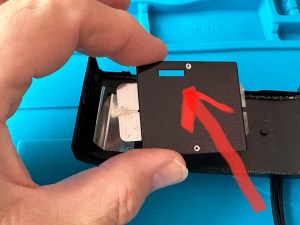
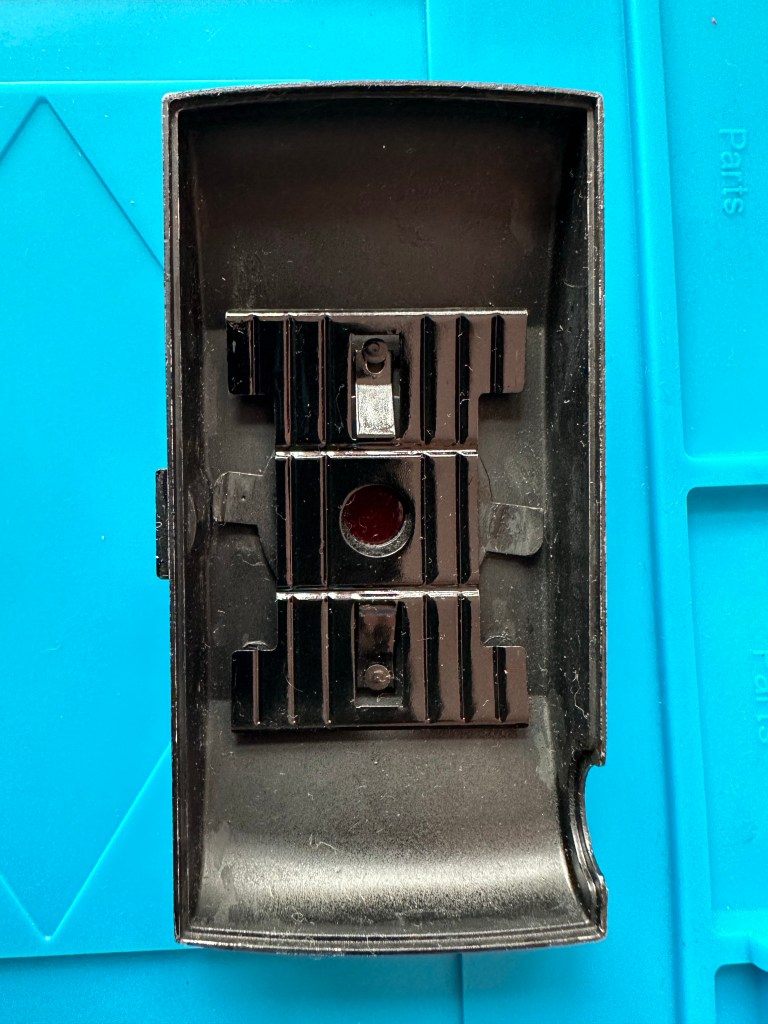
Remove the film plate on the camera door as this assists when cleaning, easy to do, just be careful when removing to ensure you don’t bend the retaining springs, and ensure it goes back in the correct orientation so that the small hole in the top corresponds with the winder sprocket on the camera body.
Scraping out the old light seal
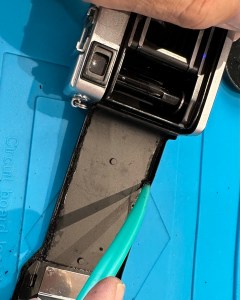
There are 5 seals on this camera. Two on the camera body one top and one bottom, the same again on the rear door and a final one where the door hinges on the camera. Lightly wet these with some isopropyl and let this seep in for a couple of minutes. Using a cocktail stick or a plastic modelling tool (not metal as you will scratch the frame) start to gently remove the old seal and remove any debris away from the camera. Take your time here as it is important to get each channel clean and debris free to ensure the refitting phase goes without issue. Now wet a cotton bud with the isopropyl and run this numerous times along each edge where you have removed the seal to ensure it is really clean.
Using a plastic tool to clear the old light seal
I would suggest you set a good hour aside to ensure you do this job correctly and completely, it really is that important to ensure you get good results.
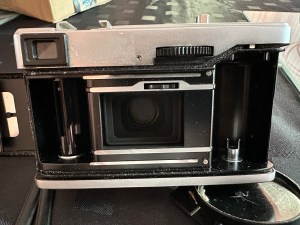
Hinge door light seal- before and after cleaning
When the removal of all seals is complete I’d recommend that you clean again, yep I know it’s boring what I am saying but the cleaning really is that important. When it’s done, get the compressed air can and give a few well aimed blasts of air into the areas you have cleaned making sure you do not direct any debris towards the shutter, please keep this area sheltered or you can create other issues.
The debris left over after a good clean
Once you are happy with the clean up, shut the camera door and leave it alone until you begin to install the new light seal on another occasion. Then we will clean the camera yet again 🤦♂️
Printed in 1957 it’s an autobiographical book based on his travels around Cyprus during the period 1953-6 that was the period of “Enosis” the union with Greece against British rule. Particularly important to me as this was the period in which my own uncle David was killed whilst in Cyprus defending against the Eoka national organisation of Cypriot fighters.
Excellent written book in my opinion, I have probably read this about 3 times now and will probably read it again soon.
So the camera I recently ordered has been delivered and the assessment of the unit has begun. The original post claimed it wasn’t winding, I wasn’t concerned about this as nine times out of ten it’s purely because the batteries are not installed.
The original batteries that came with the unit back in the day were PX640 mercury batteries x2 . These are now outlawed for sale so we have to now look at alternatives to use, this may involve using a converter to achieve the results we require. I have decided to use these converters for this camera.
converters in place and batteries installed
On first inspection I was worried as there looked like some battery acid damage to the terminal on the left (see picture) however with a wipe with some alcohol on a cotton bud it appears to be only age as it cleaned up ok. With these cameras sometimes the damage goes beyond the terminals and requires new wires soldering within the body. I dodged a bullet on this occasion.
You have a choice of batteries now, you can use two LR44 batteries or 675 air batteries. Difference here is all to do with the working battery limits of the camera. It was designed to work at 2.8v with the old Mercury batteries, the LR44s give you 3v that has been noted on some chat groups to require you to make exposure changes as it can overexpose sometimes by one stop.
The other option is to use the 675 batteries that have a lower voltage total of 2.8v however as soon as these batteries are opened they start depleting and have a shorter shelf life as such ( they are meant for hearing aids) however they are much cheaper than the LR44s . The choice is yours, I have gone with the 675s.
Batteries in place the shutter works well as does the winder and the shutter check light, excellent result as in theory the camera is working.
Camera works electrically
Cosmetically the camera needs a clean, the light seal around the film door is old and could do with replacing so I will do this in the coming weeks.
Light seal needs replacing
Overall I’m really pleased with this camera, I just now need to source some 35mm B&W film and put it to a test. I can then develop and scan this at home to see the results. But first I’m going to do the cleaning as stated earlier as well as replacing the light seals. It has also come with an Olympus pen lens cap that I may replace. I will also source a wrist strap to complete the look.
Hopefully this will be a nice little addition to my collection.
What makes me laugh? Really, I try to laugh at most of what I see and do partly because it cheers me up and partly because if I can’t see a sensible logic to something, laughing helps me get through the situation. Not perfect or suitable in many a situation and to some people I guess I might come across as quite inappropriate however it’s a coping mechanism for me. My dog Alf makes me laugh, he’s been a comfort to me throughout his short life and now as he’s starting to slow down and enter senior life he can still do it, he’s a beautiful soul.
My dog – Alfie
Humour has allowed me 32 wonderful years of marriage with my lovely wife who also has a wonderful sense of humour, it’s gotten us through some really tough times, and it works for us.
My sense of humour was inherited from my father, one of the good things he gave me. It’s kind of very low rate humour at times laughing at some quite crass things but hey, you’ve just gotta laugh. I’m laughing as I write this piece because a rude text has just popped up on my phone from a friend 🤦♂️. And that’s it I guess, you can use it as a measure to how someone is feeling, he’s told me without saying anything that he’s fine because I know his sense of humour, if he’d been more serious I’d be asking myself and him questions.
There is a time and a place I guess, but laughing makes you feel good and happy, and I believe the world needs a lot more of that.
I have been after an original Olympus trip for a while now, however the prices are so volatile for them at the moment even the non working ones demand high prices, it’s crazy just how popular they are. So, I’ve had to settle for a camera that was sold alongside the “Trip” a 35 ECR.
Olympus 35 ECR
Asking for a reasonable price, this one flashed up on my phone and I purchased it immediately, I could end up regretting it but fingers crossed 🤞 it will not be too bad. If I’d left it a few minutes longer i believe it would have been snapped up.
I believe the main fault on this unit is a winder issue that is quite well documented on these cameras, and to be honest if that is the only issue then I should be able to rectify this and add it to my collection.
A good clean and assessment of the optics is the first and foremost action to take.
Another problem that sometimes raises its head on these units is with the two little batteries that originally powered the metering, they used to be mercury based 1.35v versions (PX640 x 2) and to add further pain to the problem, they can no longer be manufactured or legally purchased. There are alternatives but they are 1.5v and have been known to cause issues with the metering resulting in film exposure/rating issues, widely documented online. The best option is to purchase a battery convertor that allows you to use a more appropriate lower power pair of hearing aid batteries (Zinc Air 1.45v – 675 battery x 2), much friendlier in the long run as well as being a much cheaper option. However i will use this option only if there is the need to do so. I have a couple on standby if required.
Im really looking forward to running a black and white film through this camera, to develop it myself and see the results.
Come back and see what is found when the camera is assessed on its arrival.
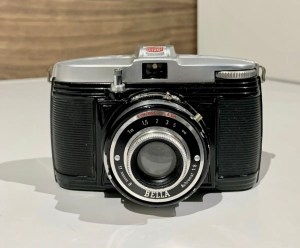
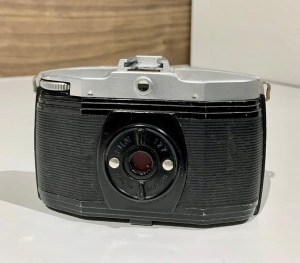
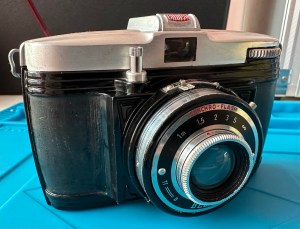
Since starting this blog this is the first camera I have actively obtained for the purpose of repair/refurbishment. I love this little camera, my thoughts are this is a Bella series 1 as later versions had the name on the body not in the hot shoe area as this one does. A low cost point and shoot of its time, I have had dealings with one in the past when I had to remove some film from one in a darkroom when the transport got stuck back in the early 1980s. Now this one is a nice tidy example of the model, and really needs little doing to it so my intention is to get it cleaned up, touch up the paintwork and maybe run a roll of film through it to check the mechanism, i may re cover the camera body, and will then put it in to storage for moving on at a later date.
These little cameras were the instamatics, or Olympus trips of their time, instead of using 35mm film (how they were designed to look) this particular model used 127 roll film that took 4×4 cm exposures, that format of film is still available today but as rare as rocking horse dung. They were made of what is called “pot metal” in theory just alloy based metal in its cheapest form.
I’ll explain what I intend to do with this camera below.
Inspection
Original condition
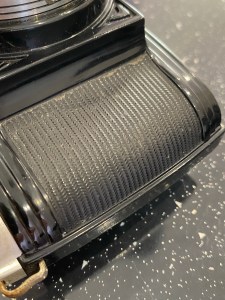
On inspection the top has some light marking and scuffing that I can attend to with some polishing and a touch of paint, the black covering I may replace and some of the black metalwork will need some retouching. The internals again are fairly good so will just be cleaned on this occasion. The mechanism works ok, I have maybe detected some dragging on it so I will inspect it closer and I will lubricate accordingly if required. I will dismantle down the whole body as much as possible and give it a thorough clean, after all I doubt it has been cleaned that much in its 50+ years of existence.
Chipped paintwork and old covering
In fact I’ve decided to go to town on this one and really mix it up. I’m going to replace the leather with a synthetic leather, cruelty free and vegan friendly. No animals suffered to make this product! and it’s bright coloured.
Here goes…
So to start I’ve pretty much dismantled the camera, the covering was a type of leather, I do know that if it was left on it would probably survive another 50 years as it was stuck to last. I had to scrape this off, sand it down and clean with a special solution to get the remaining adhesive and dirt off. I will need to produce templates to cut out the replacement covering as a result of this process.
The strip down
The plan now is to touch up, buff up, retouch the paintwork again and give a final Polish before I apply the new covering.
Undercoat with a Matt black prior to buff upFilm backing plate. Rust removed and repainted
I’ve now finished all the painting I want to do to this little camera, I have glossed buffed and painted again and the next stage is to apply some new synthetic leather when I’ve decided the one I will be using.
Awaiting the new synthetic leather body
So all I need to do now is take some templates in preparation for when the new synthetic leather arrives.
See my update when the new covering arrives.
Information regarding this camera
The Bella is a line of cheap but attractive and well-built 120, 127 roll filmand 35mm cameras made by Bilora in Germany. The Bellas went through several revisions over the life of the name. The bodies are alloy castings, with added leather-effect covering – in various colour combinations. Each is styled a little more like a 35mm camera than a roll film one. The back is removable for film loading, and most models have a large back catch. The 44 models make twelve 4x4cm images on 127 film; the 46 modelsmake 6x4cm frames on 127, and the 66 models take 6×6 photos on 120 film. The Bella 44-1 was also sold by Ansco, rebadged as the Ansco Lancer. Bilora also used the names Roxa, Bonita and Reporter for Bella variants. Manufacturer: Bilora, Germany Shutter: B, 1/50, 1/100s In production: 1953-1966
Not just teacher but probably the most influential person I have ever had the pleasure of meeting in my life was Mr.Michael Twelftree my Junior school tutor in the two years prior to moving up to secondary school.
I was at Little Reddings Junior school in Bushey Hertfordshire circa 1976/7 our class was in free fall as previous teachers had lost control of us, Mr.Twelftree stepped in for our final two years and boy was he strict. Strict but fair, he had a stack of canes in the corner that he gave you the choice of when it was your turn to receive a wack for some reason. Very rarely administered however just the thought of it made you stay in line.
He taught me and others to sail, something I still try to do to this day, we learnt so much from him, he taught the lot English, Maths, Geography, Science and all sports and made us competitors and despite his strict ethic he taught us respect and he brought out the best in everyone he taught.
We learnt all about different knots as part of our sailing training, this resulted in us having a noose hanging from the classroom ceiling as a demonstration of a knot, you wouldn’t find that in a modern day classroom.
He taught me to be a better person, shaped me up well for my future and prepared me and my fellow students well for the next move in our academic advancement.
I respected this man better than my own father, I know this sounds terrible but he shaped my life and I like to think I didn’t turn out too bad as a result. My own father unfortunately didn’t step up to his role in my life but the less said about that the better.
I would have loved to meet Mr.Twelftree again and shake his hand and say just two small words
Life’s to do list has always been quite extensive for me. Within that list was the wish to attend an opera for the first time. That wish came true at the grand old age of 57, on Friday 24th March 2023 at the Demontfort hall in Leicester.
The Ukrainian Opera and Ballet company from Kyiv were here performing Puccini’s La Boheme.
La Boheme – Puccini (Picture from brochure supplier, not my own)
I had a read up of what to expect the night prior to attending. I must say I was not at all disappointed, it was a beautiful experience, wonderful singing and you cannot beat a live orchestra. Those stringed instruments sounded heavenly and it was a few hours of entertainment that I must admit just took you away from the pressures of modern life and transported you back to a time when the world was running at a slower pace.
Did i enjoy it? You bet ya, however I’ll have to attend the next one with someone who appreciates this entertainment as the wife does not fit that category.
I feel as if a void in my life has now been filled, I have found an appreciation for this type of entertainment that I thought I did not have. My journey into the world of opera has begun.
What tattoo do you want and where would you put it?
We were in Iceland about 5 weeks ago. A fantastic holiday full of spontaneity, I just wish I could lead that life 24hrs a day. Anyway I’m drifting now, the point of this post is that spontaneous action resulted in me getting a Tattoo there and then in Reykjavik at a local tattoo studio.
Helm of Awe and Icelandic runes
It’s a Nordic protection in battle symbol called a “Helm of awe” used to strike fear into people in the early years of the islands forming, I’ve used it as a protection in life of sorts. The Icelandic runes are the letters D & E that relate to the wife and my names.
So that’s what I’ve had done, I’m now looking at having another couple done relating to my home county. I think tattoos are great and that there are some stunning ones out there if done properly.
Mind you, you don’t half see some right rotten ones. Must admit they’re not for everyone but at the end of the day what you do to your own skin is your decision and yours only.















 Foxes Den
You must be logged in to post a comment.