Learnings from testing an old camera with expired film stock
Earlier in November 2025 i repaired a Canon Eos 10 camera from the 1990s and then took it out to test it with a roll of Kodak 400 asa film. You can find the repair here: Canon EOS 10
Canon EOS 10
The caveat is that the film expired in 2005, 20 years ago. As a result I have overexposed it at 200 asa to compensate for the deterioration in sensitivity from such a long storage period. It may work, it may not, previous tests on a 200 asa film showed that a one stop over exposure was quite sufficient. Fingers crossed 🤞 on this one.
I don’t expect anything much, I expect quite a bit of grain and a definite colour hue over the entire roll. Who knows there may be nothing on it at all 🤷♂️
I’ve sent the roll off to our local photo guys in Leicester : Classic Photo Supplies and hopefully something will be on the medium res scans that i have requested. If there are pictures below, then there was some success, if not, enjoy the blackness.
Well, the scans are back and to be quite honest this one is a bit of a disaster. As stated the film is over 20 years out of date and there appears to be two problems here. Underexposure is one issue, I over exposed this by one stop but I don’t even think that is enough. If I’d overexposed at 2 stops though I might have improved the brightness, the already heavy grain would have been even more exaggerated. I think it’s fair to say this 400 asa old film stock I have is passed its time and not really fit for use.
Look at the grain at plus one stop overexposure
Hello what’s that line?
Heavy grain and a magenta cast
That shutter sync problem
Slower speed, shutter ok
So. Though the results were not good and I have now realised that this old stock film is probably best for me to use as test film only. There is heavy grain, a distinct cast over the film and a quite obvious shutter curtains sync issue. These frames above a shutter speed of 500 seem to be the issue, and that is where the shutter speed has not synced the curtain, it’s definitely running slow. The film has been beneficial in identifying an issue in this part of the camera. I will now do a CLA on this camera shutter assembly to try to remedy this issue. I wasn’t using flash here, it was a dull cold English Sunday afternoon.
This is an old camera that has been sitting idle for many years, it may sort itself out after a few more rolls of film, however I can do something about it now. And this is really a lesson to be learned for anyone buying old film cameras, they do need that little bit of tender loving care to get them back into a good working condition.
I’m pleased I’ve highlighted this issue, I will get the work done to improve the shutter sync and then run another roll of film through it.
Maybe now is the time to buy a shutter speed optical tester. That may save me a bit of expense on processing costs and will also allow me to make these checks before committing to film.
I was given a professional flashgun with a number of issues. Let’s get it fixed.
I love working with flashguns, but believe me they are highly dangerous and potentially deadly pieces of kit, once you get under the skin otherwise known as its protective casing. I inherited this one from a good friend of mine who is a professional photographer, the post regarding what he passed on to me can be found here: Cameras…i need more!
Now please do not go delving into the back of these things unless you know what you are doing. Yes they might only be powered by 6-9v of power from your batteries, however in the process of getting to the point where they unleash a lightning flash for your photographic opportunity, they have passed through a component called a capacitor, that greatly amplifies the voltage from that measly 6-9v from your batteries up to what is now between 3-400v for the flash. Yes, you read right, 400 VOLTS.
That can kill, and if it doesn’t, you have been very fortunate, but will probably bear an entry and exit burn where you made contact with that very component. You have been warned – take heed!
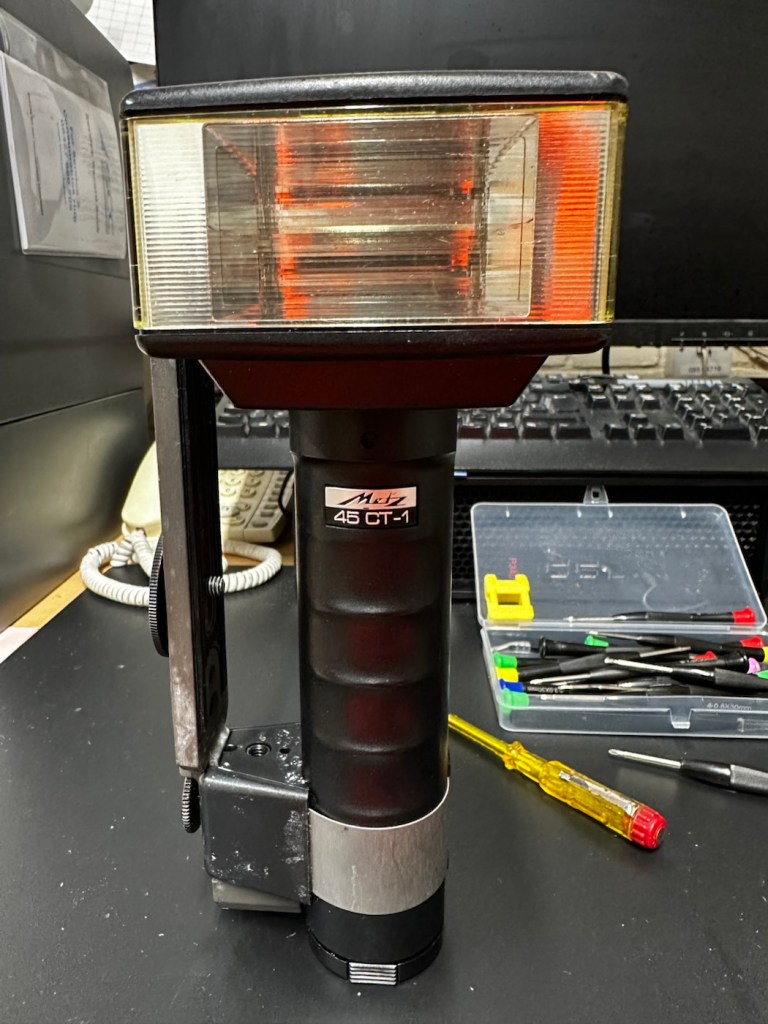
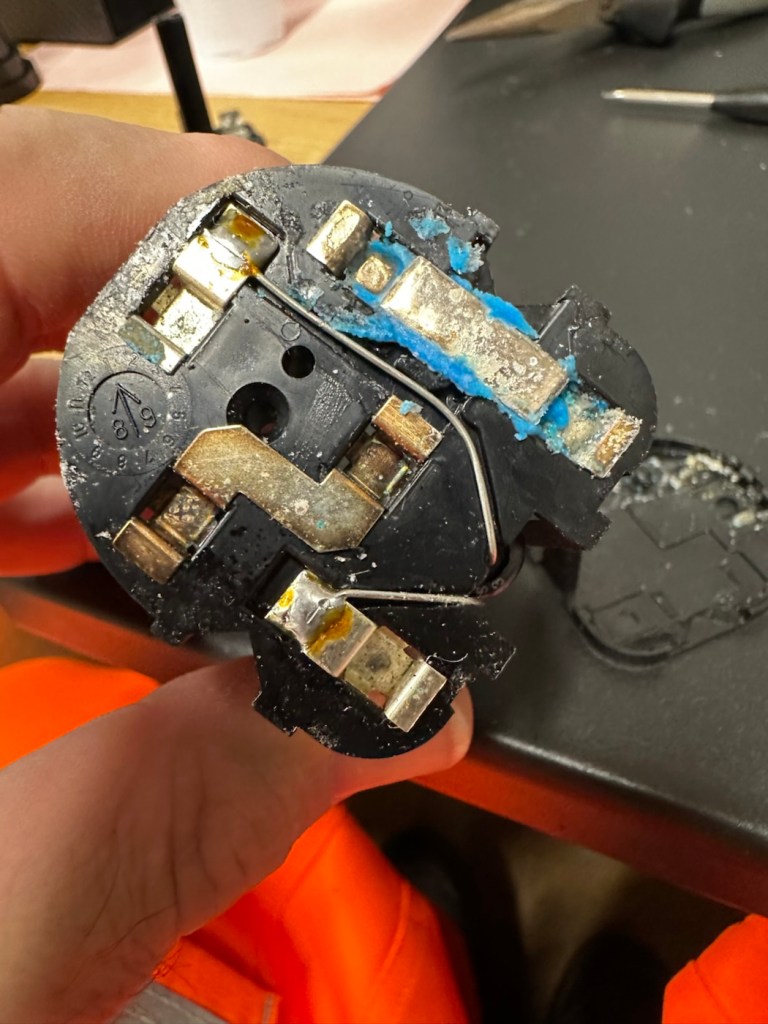
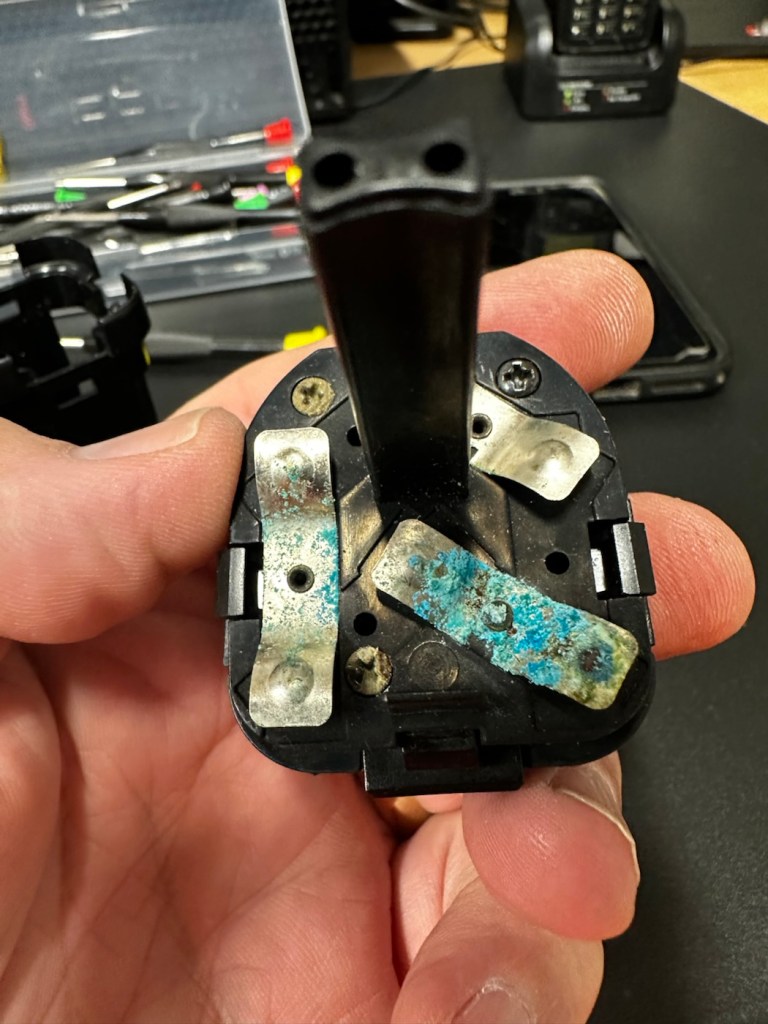
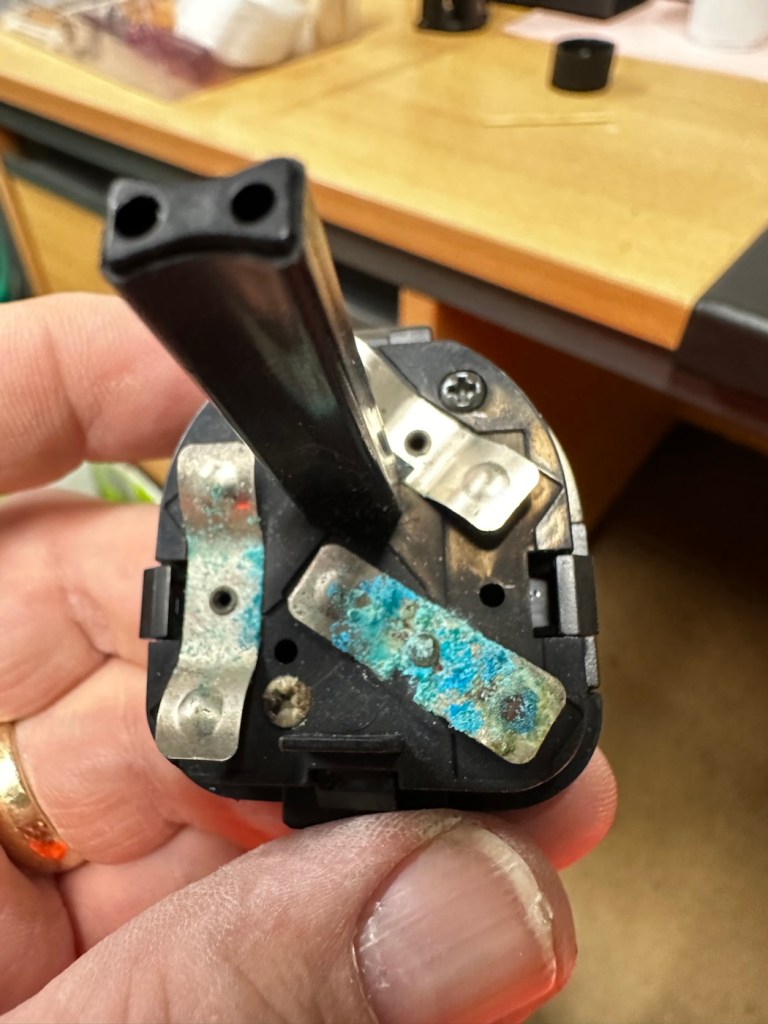
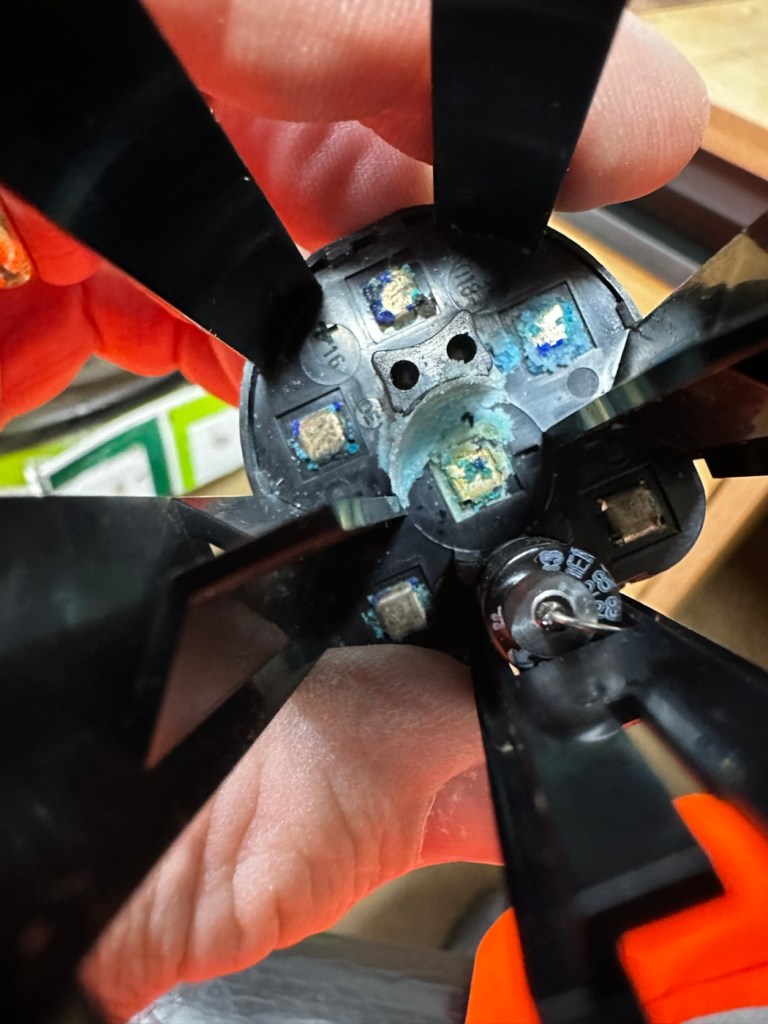
Metz 45 CT-1Floppy headYou could smell thisCorrosionLovely shade of blueCorrosion carnage
Here’s a little about this flashgun. They were manufactured circa 1979.
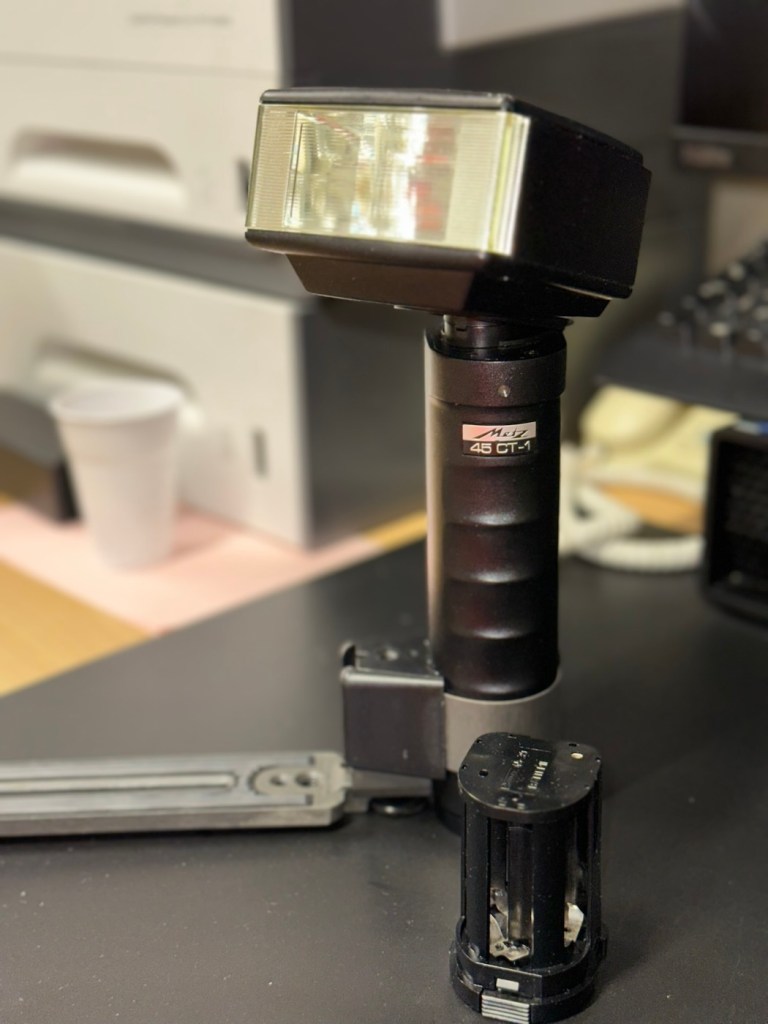
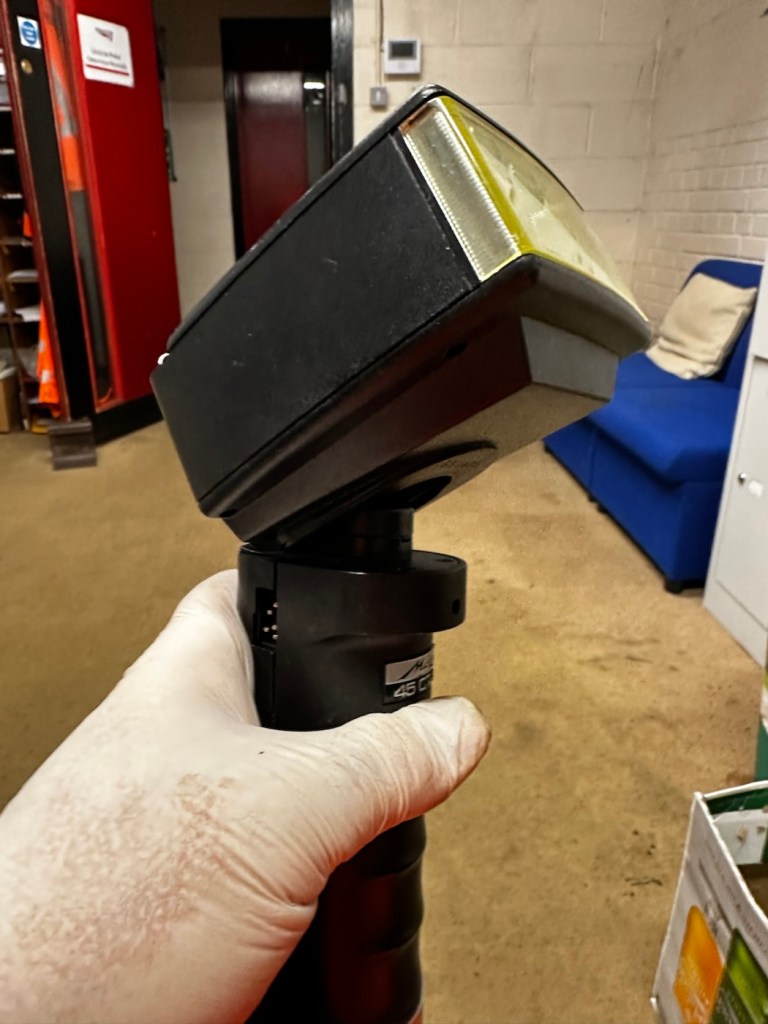
The Metz 45 CT-1 is a classic, powerful handle-mount flash gun known for its “hammerhead” design, high light output, and versatile features like a swivel and tilt head. It was a popular and durable accessory for professional photographers.
Key Features
Guide Number: The flash has a high guide number of 45 metres at ISO 100, indicating powerful light output.
Exposure Control: It features an analog control display and offers five different “tele-computer” automatic aperture settings, allowing for easy exposure control in automatic mode.
Versatility: The flash head can swivel and tilt, allowing for bounce flash techniques to achieve softer, more flattering light. It also includes a built-in wide-angle diffuser.
Compatibility: The 45 CT-1 is a non-dedicated flash with a standard sync cable connection, making it universally compatible with many cameras, both film and digital (with caveats).
Power Source: It typically uses a rechargeable NiCad battery pack or a holder for 6x AA batteries.
Durability: Known for its robust, professional construction.
Google
Assessment:
To be honest on first receiving this unit, you didn’t know what was coming, but you could certainly smell it. Within the box the smell of battery corrosion was heavy. It’s a hard smell to describe but once you have dealt with it you know what’s coming, and this smelt really heavy.
Awful corrosion
The smell was coming from two battery pods that play in to the base of the flashgun arm. Thankfully they had been kept separately, and their spread of “Corrosion” was not able to get to the main unit.
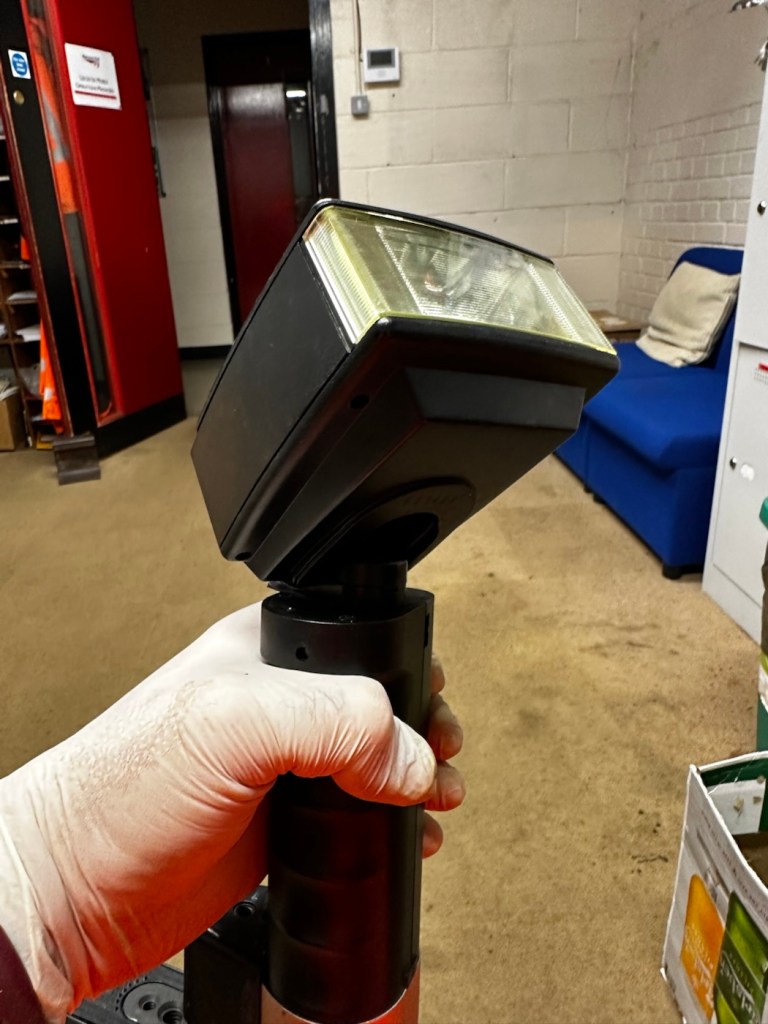
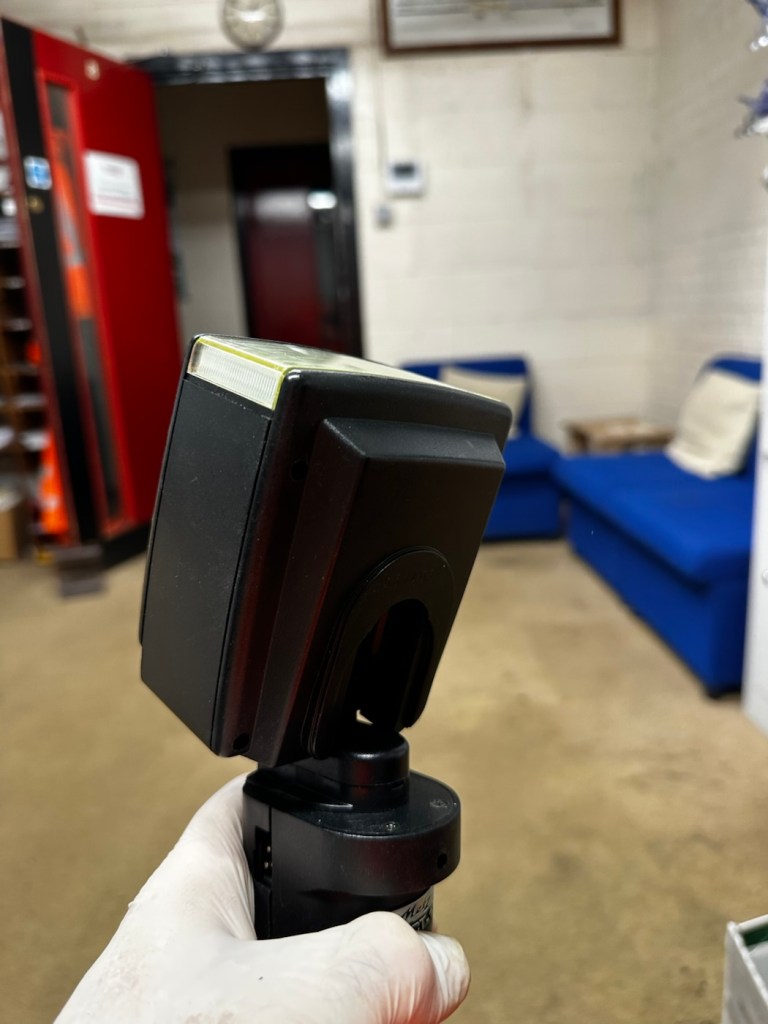
The main unit itself had a problem in that the head was floppy, unable to be at any other angle than straight up or, flat down and nothing in between, and something was rattling about inside of it.
So bearing in mind my sermon at the start of this post, I gloved up, armed myself with my capacitor discharge probe and cracked the unit open.
Repair:
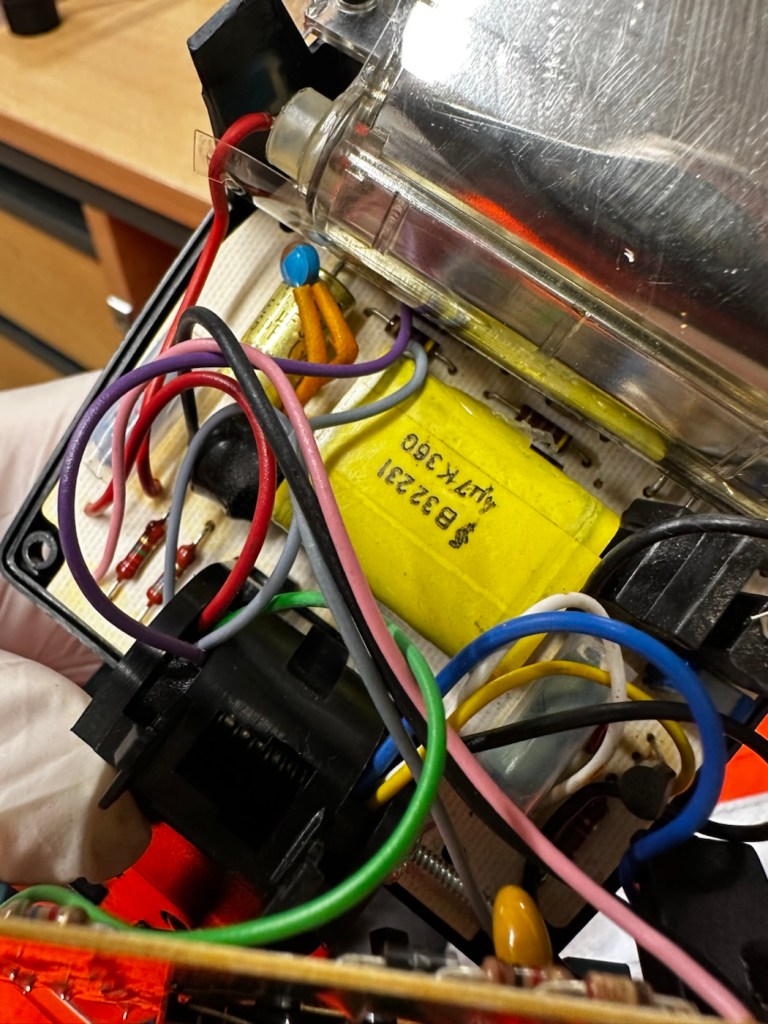
Straight in at the head of the unit and I went in search of my nemesis. The charge capacitor. And it wasn’t that hard to find. Sitting there all inoffensive and bright yellow, it was rated at 360 volts. As I had put a small load on it earlier to test its operation it was sitting there still holding a charge of 260 volts, needless to say I made sure this was discharged before I commenced any work in the area.
Now where is it?Come on don’t hideAhh there you are
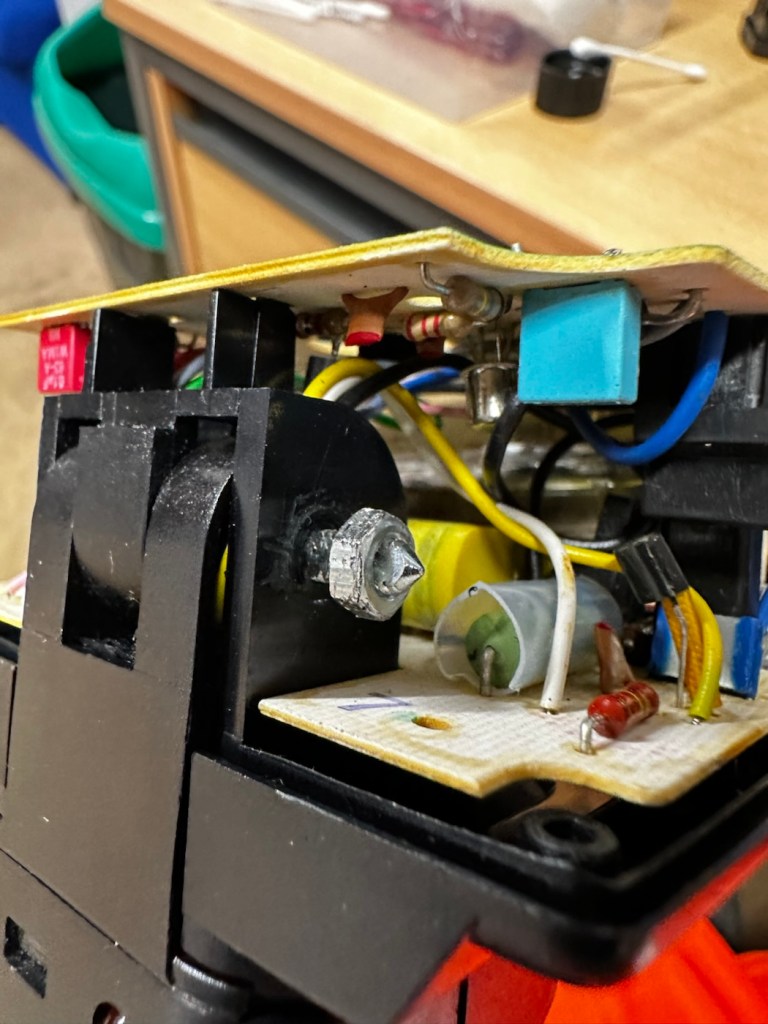
The “Knuckle” that the head pivots on is just behind the capacitor, so it made sense to discharge it.
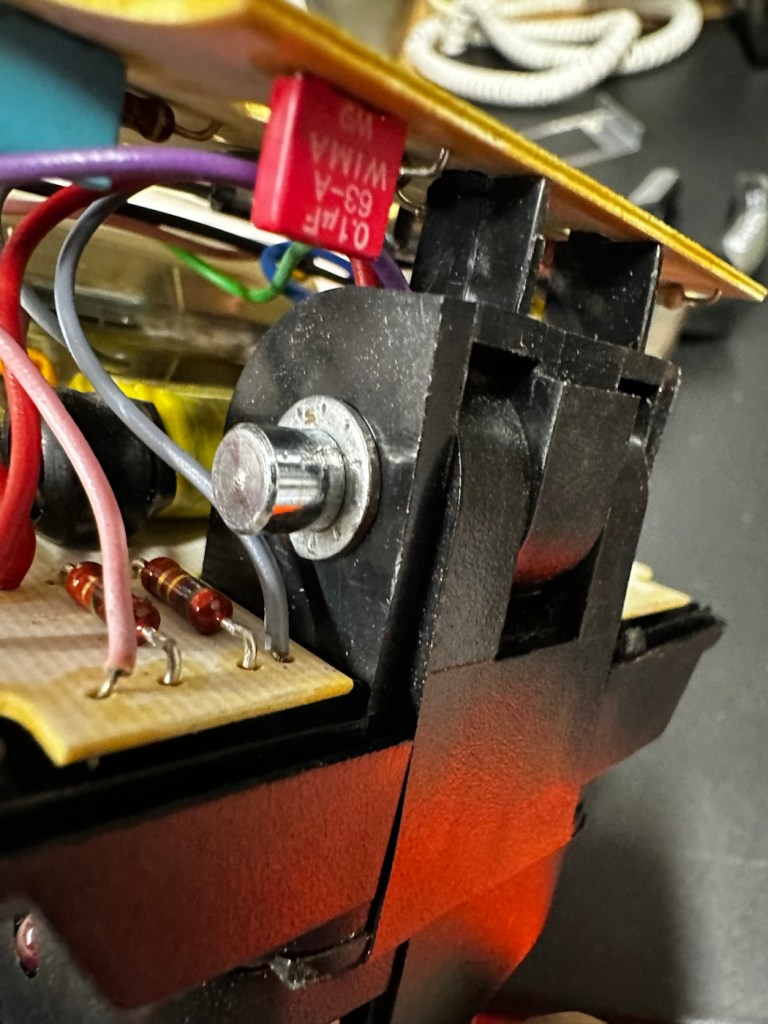
The piece that was rattling about was relevant to the reason the head wasn’t able to pivot, it was once part of a rectangular washer that had a serrated side that would mesh up against the head that was also serrated to create a clicking action to angle the head at any point between zero and ninety degrees.
The broken mesh washer
As parts for these had ceased production years back it was time to improvise.
Here is the setup as it was originally.
Original setup
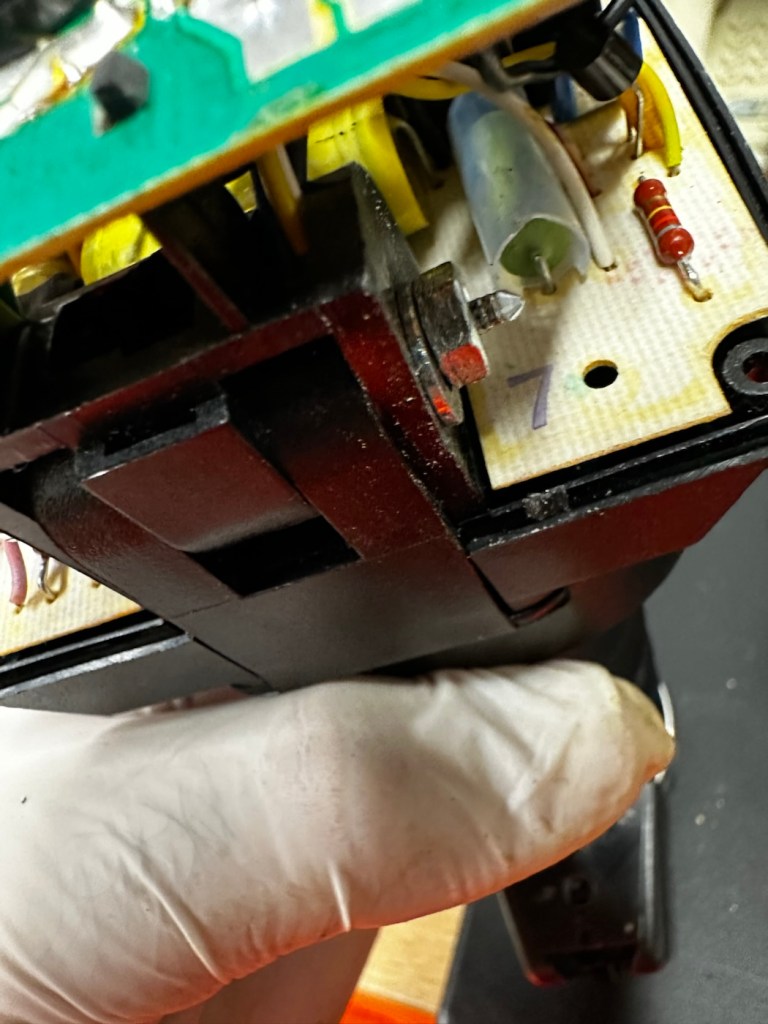
You will see a chrome bolt, that has a spring along its length that would have applied pressure on the mesh washer that is now broken, allowing the head to click into varying angles. To make up for this I have now added a washer on either end so the spring no longer gets depressed, and where the old mesh washer used to be I have now added two small “crinkle” washers that should now take over where the mesh washer was originally placed. the washer at the other end prevents too much compromise, allowing more pressure to be added at the securing end with out damage to the plastic frame.
Washers either end as well as two more internally
I’ve tried moving the head and although there isn’t the clicking now, the head does remain in position, whatever angle it is placed in. There is free movement around all axis, and the head stays where it is placed. I’m happy this has been repaired in that sense. Let’s get the casing back on.
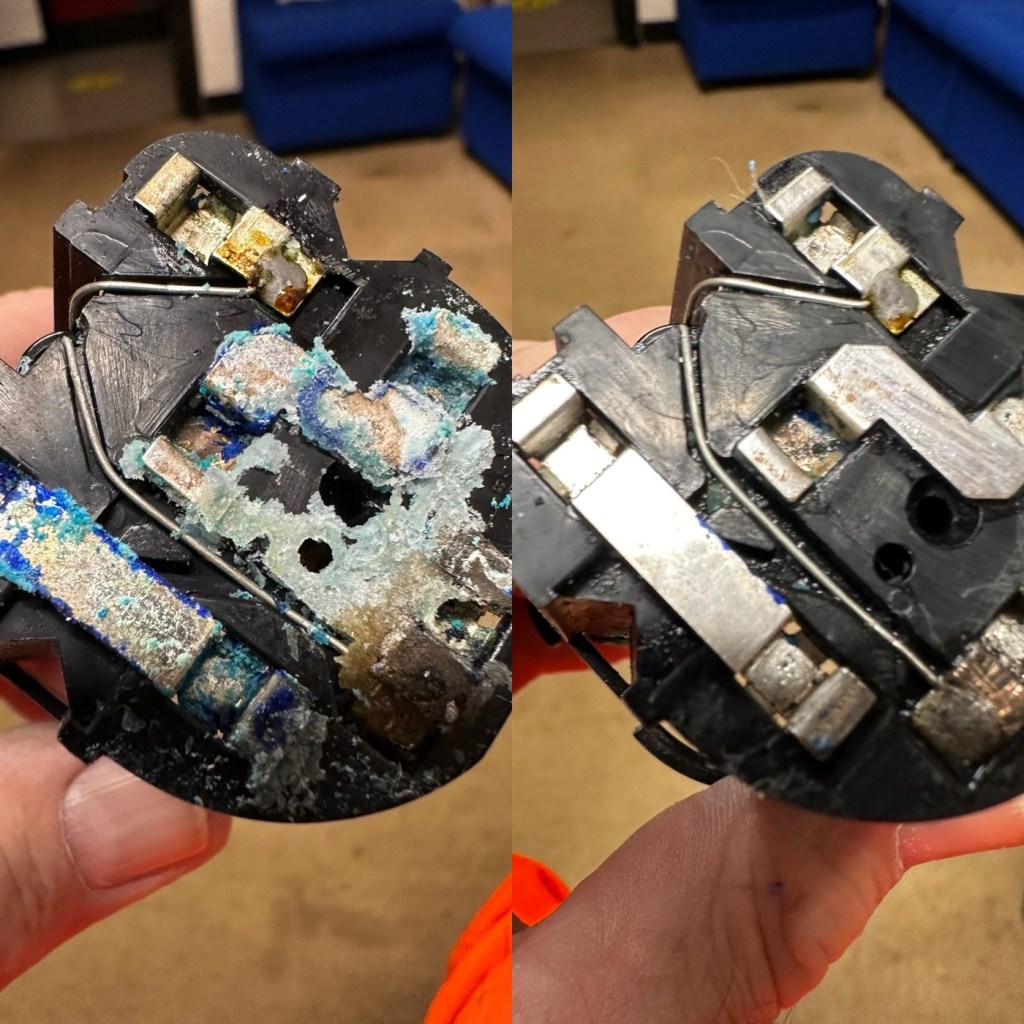
The next issue is the corrosion issue. Below you will see before and after photos, all that was used here was an old tooth brush, cotton buds, tooth picks and isopropyl alcohol. And a lot of time and patience
Battery case one, before and afterBattery case two, before and after
Once these were cleaned, I used a multimeter to check their continuity and all seemed fine. A final clean with some antibacterial cleaner has left them looking and smelling a lot sweeter than when they first arrived.
Reassembled, polished and smelling fine
A very brief video showing its operation.
One minute of unadulterated flashing
And with that, apart from a good old polish I think we are done here.
Result:
Look at me
Pivots just lovely now
And doesn’t she look gorgeous after a good Polish?
This flash was really destined for the dump, and has now been given a new lease of life. Perfectly usable, in a very good condition and a lovely piece of photographic history. I’m so pleased with how this project has gone and so proud of myself for saving yet another classic item from landfill.
Thank you so much for passing by, as always you know it is very much appreciated.















 Foxes Den
You must be logged in to post a comment.