What’s that then? I hear you ask. Well since I became a radio amateur (M0ESB) back in Feb 2003 anything regarding radio has fascinated me.
The Duga or – Russian woodpecker issue of the early 80s has always been an item of interest to me. It was allegedly constructed as a Russian over the horizon early warning system and was replaced in the late 80s when satellite systems took over the early warning mantle.
However it obtained notoriety by creating havoc on the airwaves worldwide for quite a considerable period of time.
This video by a fellow Amateur radio enthusiast M3HHY explains quite eloquently, in 11 minutes what the issue was. Some great photos of this absolutely massive antenna array can be seen in this video.
And whilst we are still here this is what Wikipedia has to say:
The duga system was extremely powerful, reaching over 10 MW, and emitted in the shortwave radiobands. It was given the nickname Russian Woodpecker by shortwave listeners for its emissions randomly appearing and sounding like sharp, repetitive tapping noises at a frequency of 10 Hz. The random frequency hops often disrupted legitimate broadcasts, amateur radio operations, oceanic, commercial, aviation communications, and utility transmissions, resulting in thousands of complaints from many countries worldwide.
Courtesy: Wikipedia
I hope you find this as fascinating and informative as I have. Radio remains to this day special to me. I’d sooner be listening to it in any form rather than watching a tv. In my eyes or should I say ears, it was the most significant invention ever made, if only Marconi knew back in the 1890s just how important this communication method would become he would have been blown away. It has helped to shape so much, our modern day world, and how we communicate with each other on a daily basis.
This years birthday, I’d hinted that I wanted to build an RC model boat from scratch, and that’s what I got. A good friend of my wife and I came up trumps and brought me this nice little wooden boat starter kit. I’m fairly experienced at building balsa gliders and planes from plans and have done quite a few. I’ve never ventured into boats though so this is a first for me. It all stems from going on holiday to Norfolk, where we normally stay in a place called Gorleston where there is a nice boating pond that two of my brother in laws sail prebuilt trawlers that they have brought, i’ve always said that I’d join them on one of our trips, jokingly saying I’d get a submarine or battleship to blow them out of the water. However i wouldn’t do that, and this is the first stage of venturing into the world of model boats. I’ve now just got to build it.
Boating pond at Gorleston
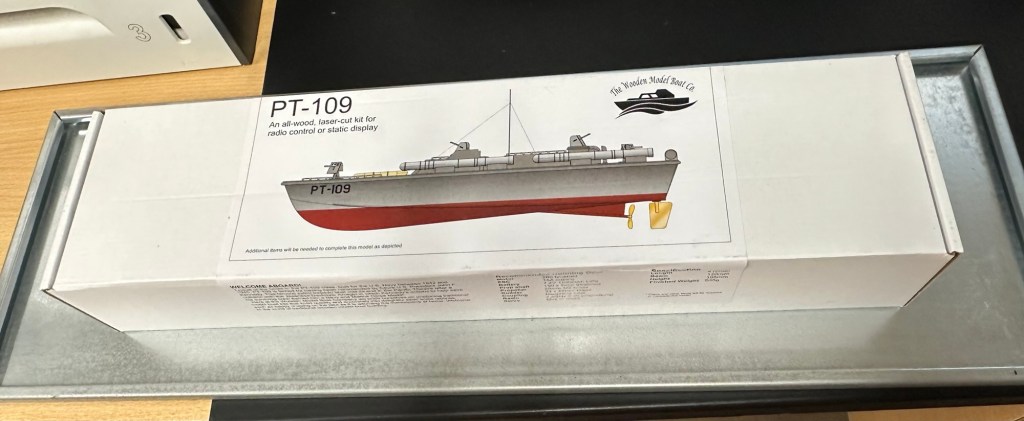
The boat that i have chosen is made by the wooden model boat company distributed in the Uk by JPerkins models. It is a PT109 torpedo boat modelled on the one that John F Kennedy sailed in, in the Pacific theatre after a collision with the Japanese Destroyer Amagiri in which Kennedy’s actions to help save his surviving crew earned him a Navy and Marine Corps Medal. I’m going to put my own touch on the paint scheme though and not go with the traditional all green or grey. I’m going to mix it up a little by highlighting and brightening up the look of the boat a bit.
The boxed kit
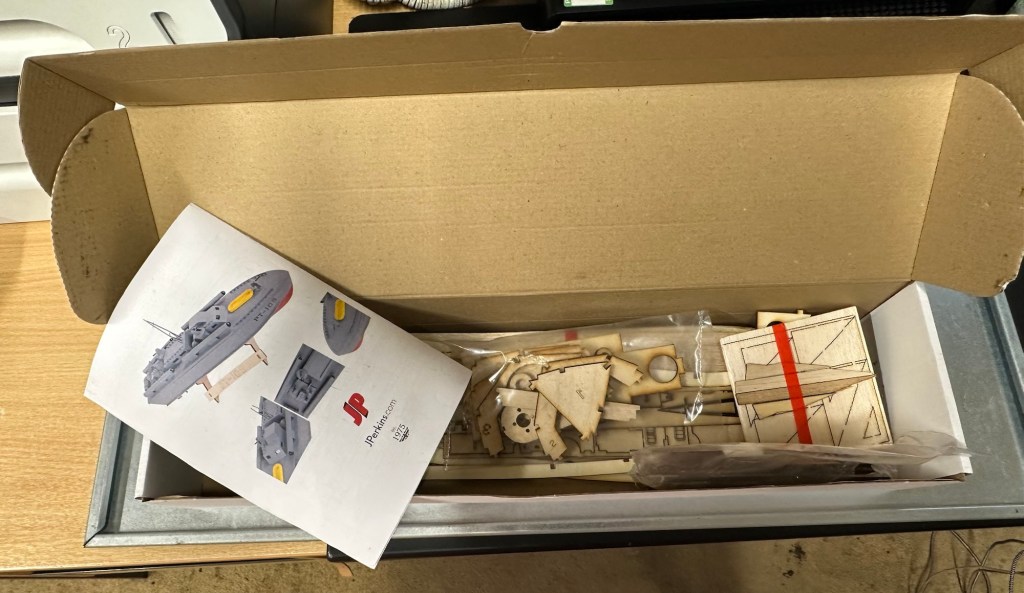
Bitsand pieces Instructions Inside the box
These kits have laser etched parts, its my first experience with them and my only gripe so far is that some of the parts are so small and delicate that this process cremates the object because of its small size. I have had to make some of my own parts for this kit as in some cases it’s just like trying to press out burnt wood from the etched parts. Not good in my honest opinion, and as this is a starter set it’s more than likely liable to put a beginner off of the hobby to be honest. Not everyone is able to easily replicate the missing/damaged parts.
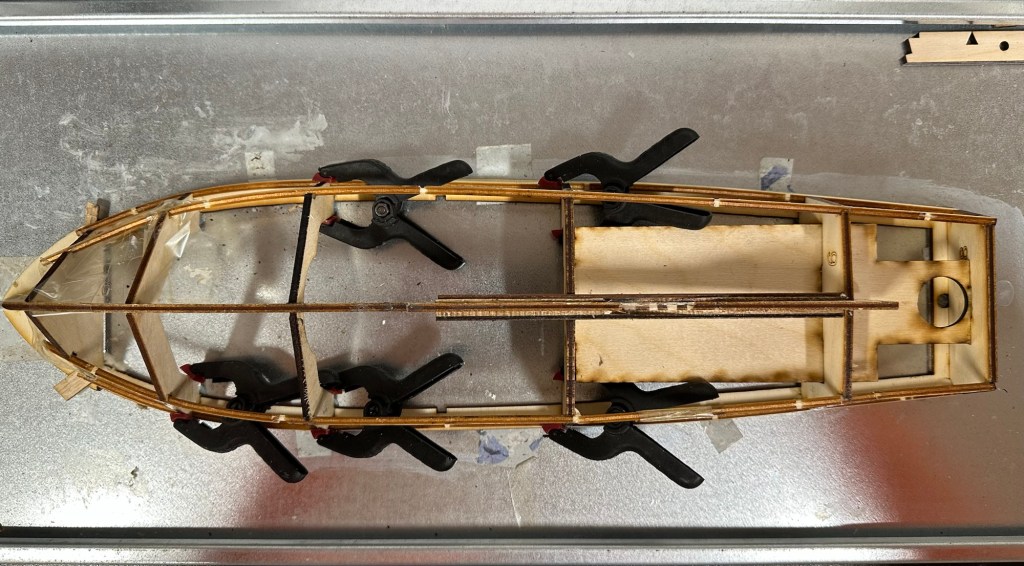
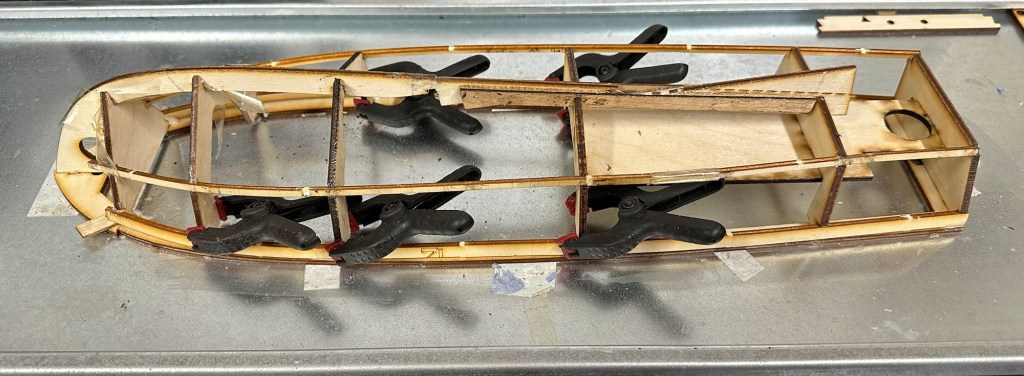
Firstly you have to secure the deck frame to a flat surface using some double sided tape. This is so you can start building the hull frame and prevent warping. I use a small steel shelf for my base that can easily be moved around and stored between sessions.
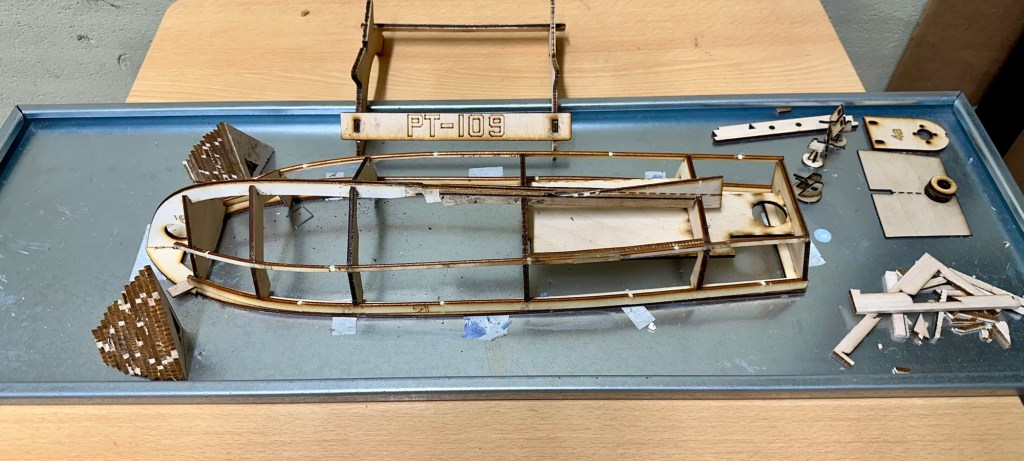
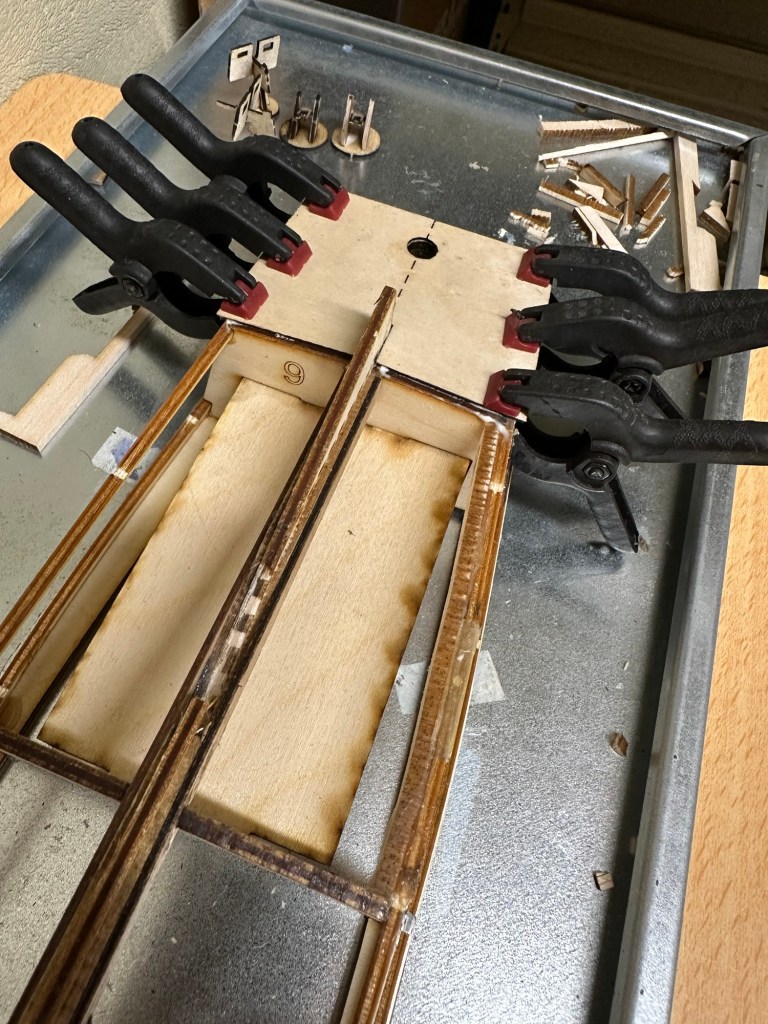
Secured to flat baseHull frameClamping strengtheners CuringMy shelf working space
There is a lot of time between sessions where you just have to leave parts to dry, you can quite easily try to do so much and potentially ruin all the good work you have done. Patience really does have to be a big part of what you do in build these models, the old adage of measure twice, cut once needs to be used so mistakes are kept to a minimum. You can make tiny adjustments when in the finishing process but for the time being you need to adhere to instructions as much as possible. Check and double check and always dry fit prior to gluing in place.
HullFormers to shape the bowRudder base in place
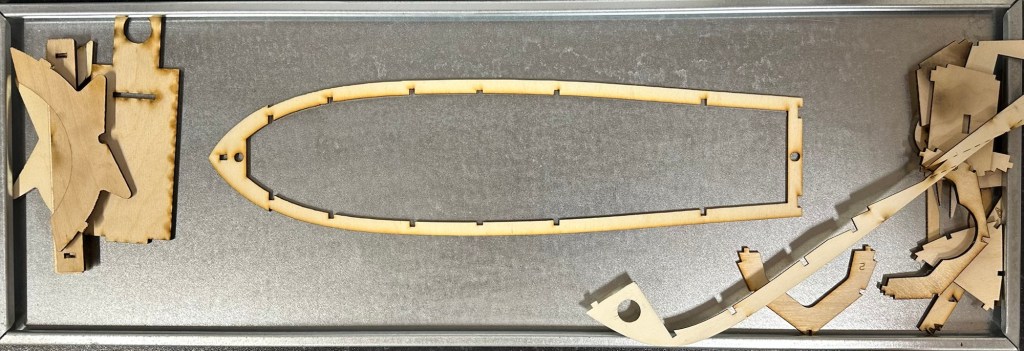
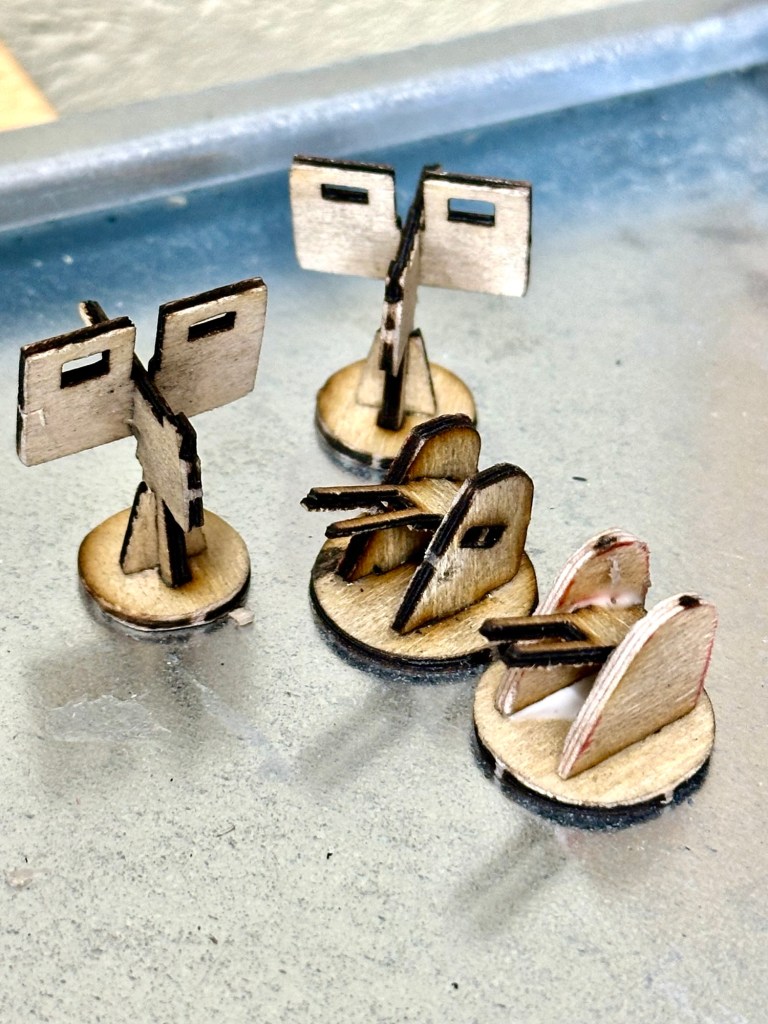
If you look at the picture below you will see how the laser etching burns really small parts. This doesn’t look good however they will look a lot better after they are sealed and painted, if I left all the parts like this the whole project would look as if it had been in a fire. I’ve had to build some of these parts from scratch as the kit itself had insufficient parts pre cut.
Burnt small parts…to be finished
The hull framework is now complete, next stage is to get the outer skins on, the bow formers in place and then hand sand, fill and sand again until the whole hull is ready to be sealed. Again there are issues here with the kit as one of the hull skins is two times thicker than it should be, hence the amount of bending required to shape the hull is not achievable. I have brought this up with the supplier and within a few days I have had a new set of replacement hull skins sent free of charge. Their customer service has been superb and it is good to see that some companies do still try their utmost to keep their customers happy. I will now progress with completing the hull.
These four boards form the outer skins. At 1.5mm they are very flexible. However you can see the second one from the left is twice as thick and not pliable enough. These were replaced by the supplier within a few days of notifying them of the issue.
Below is a small video of the completed framework. It has probably taken about 8 hours in total to get to this stage (plus many more hours to allow glues to cure)
The hull framework complete
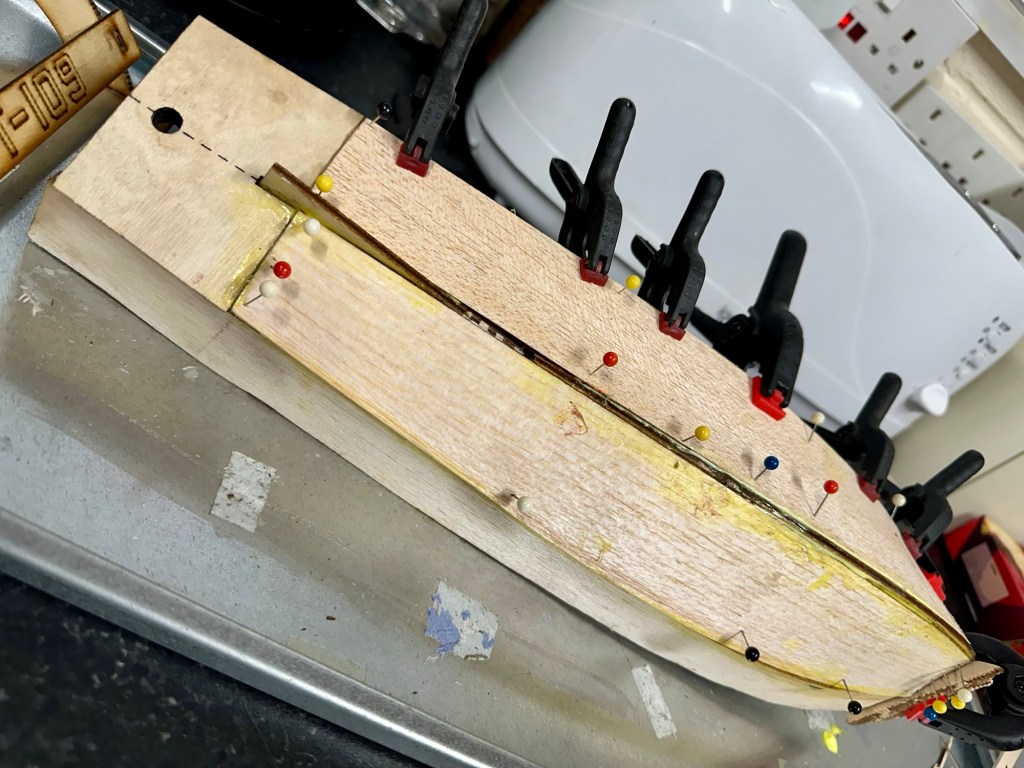
So tonight over a period of about 8 hrs I’ve managed to get the 4 balsa skins that form the hull into place. I’ve had to do a bit of re shaping and minor alterations, and the final bend of the skin would have bust it under the strain if I didn’t decide to wet it first. Wetting balsa allows the inside edge of the sheet to bend in, making these big bends in the hull shape possible. That as well as plenty of pins and clamps with epoxy resin ensures the skin stays where it is put. I left about an hour between each skin placement before moving on to the next one.
First skin Second skin Third and fourth skins in place, when dry I can commence light sanding and filling.
Here is the hull, assembled ready for sanding filling and all the other fun stuff required to make it look good and waterproof.
The hull ready for sanding, waterproofing and painting.
Tonight I have given the first heavy sanding with a course paper. This has really brought the hull up lovely. The former’s that were put in place have now been sanded to form a good bow profile. See photos below.
Before shaping After shaping
I now have to do a small bit of filling with balsa filler and then I will sand with a finer paper.
Looking more like a boat
Once the final sanding has been done I can then look at sealing the exposed wood and then begin the waterproofing and painting. The installation of the radio gear will go in place towards the end of the build. In the meantime I just have to build the superstructure on to the top deck. This will require some small bits to be painted before being put into place.
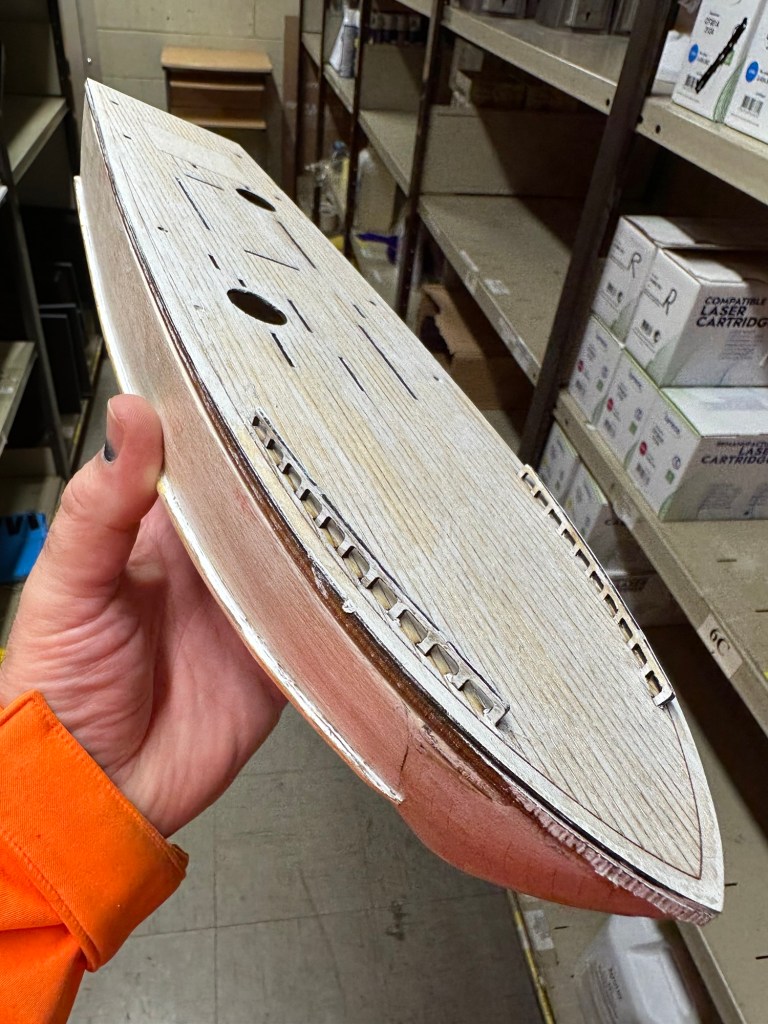
I’ve built the superstructure and that has been set aside to cure. There will be a lot of sanding and painting needed. I have attached the deck now and all those items will attach to it, and i must say it’s looking quite good.
Deck in placeHull structure now completeJust needs superstructure cabins adding once it has been sealed and painted.
I’ve now detached the deck and gone around with some balsa filler and hopefully tomorrow once it’s dry I can give it a sand with some fine paper and then I can look at putting on a coat or three of sanding sealer.
Sanding sealerTo be sandedAll superstructure sand sealed
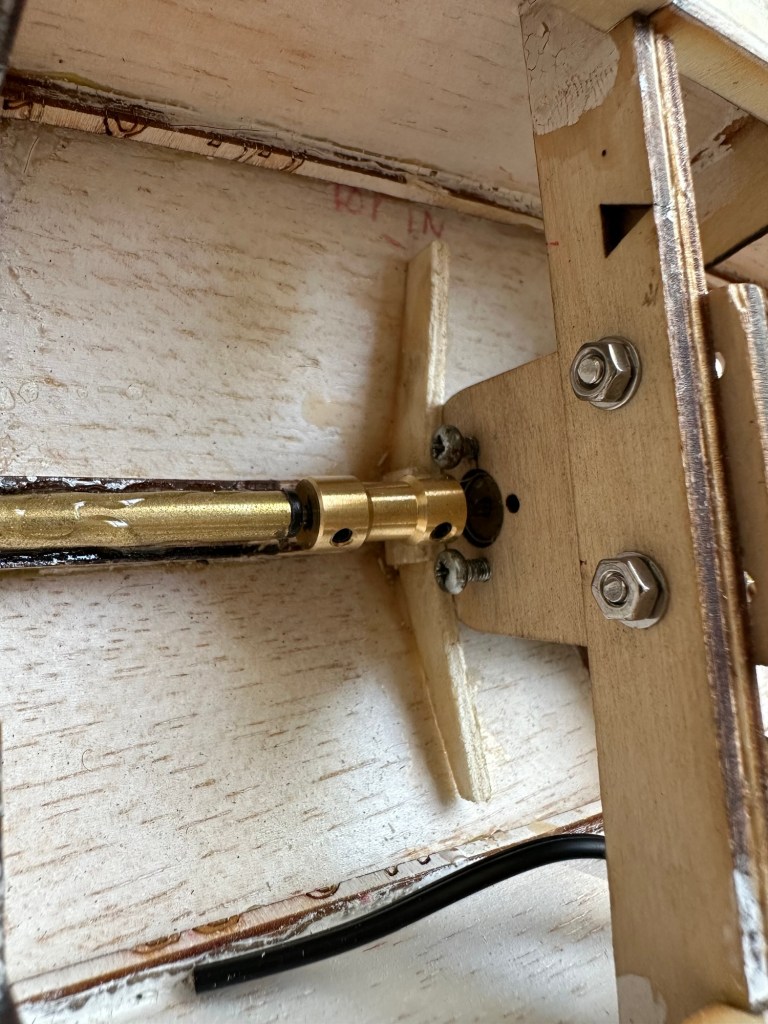
I’ve tonight managed to get coats one and two of the sanding sealer applied with sanding after each coat with a fine sandpaper. The torpedo tubes have been assembled along with other items and we are now very close to getting the painting started. However first I will give a final sand to the structure to see if it is ready for the primer. If not it will mean applying some balsa filler and applying coat 3. There really is no rush. I need to now get the prop tube in place and permanently positioned prior to any painting. I am considering a number of different paint combinations at this stage, but they are changing on a daily basis. I wonder what colours I will go with?
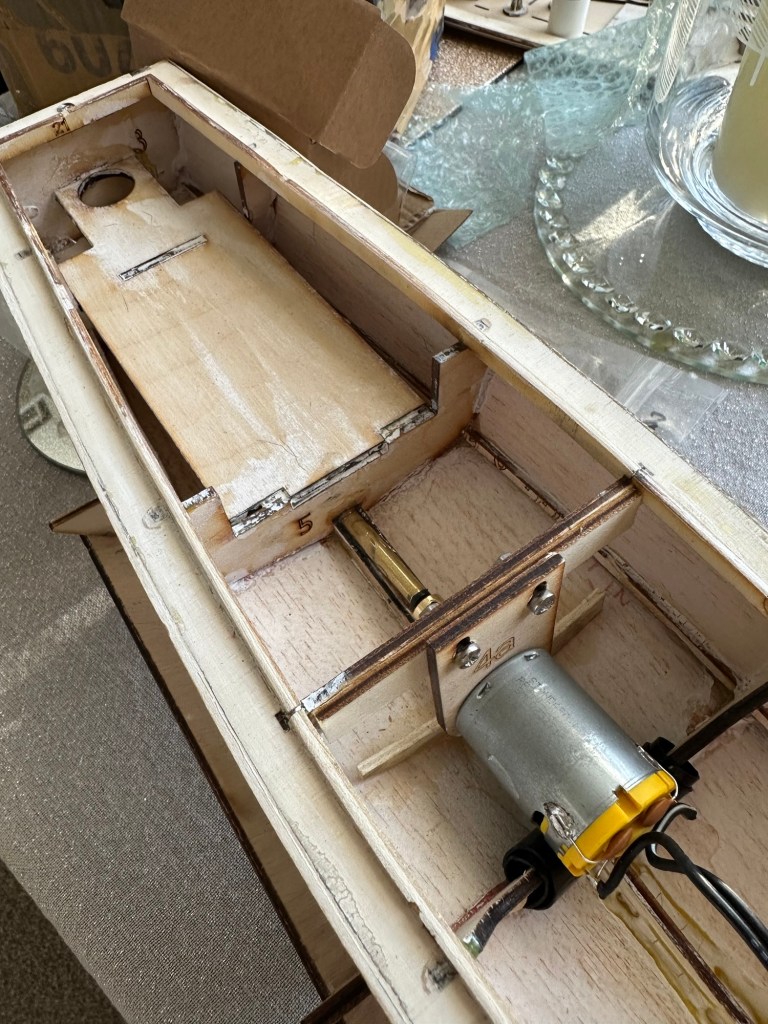
Rudder checks doneEngine in placeDrive connector in place
I’ve done the all the sanding and I’m now happy to commence the undercoat of the hull. I’ve fitted and removed the rudder and engine to test they fit ok, the boat is now bare and ready to paint. I’m going to individually paint the guns and superstructure before fixing to the deck. I might paint the deck with a dark varnish, I haven’t quite decided yet.
Part 2 of this post will cover the painting of the boat. Coming sometime in Feb 2025.
Interesting to read this. I passed my RAE exam back in December 2003. We didn’t have to master Morse code but I did take it on and even today I’m ok at deciphering it, if a tad slowly. I could transmit it at about 8 words a minute, and if I’d stuck at it I’m sure I’d have become better.
But like most things i just didn’t have the time available to further it. I do still like to put the radio on occasionally and listen to slow Morse on the amateur bands.
If you were in Tunisia in October, you might have caught some of the Morse Code championships this year. If you didn’t make it, you could catch the …
There is a form of amateur radio comms that I enjoy and that is slow scan television. Here’s a basic explanation:
A literal term for SSTV is narrowband television. Analog broadcast television requires at least 6 MHz wide channels, because it transmits 25 or 30 picture frames per second (see ITU analog broadcast standards), but SSTV usually only takes up to a maximum of 3 kHz of bandwidth. It is a much slower method of still picture transmission, usually taking from about eight seconds to a couple of minutes, depending on the mode used, to transmit one image frame.
Since SSTV systems operate on voicefrequencies, amateurs use it on shortwave (also known as HF by amateurradio operators), VHF and UHF radio.
Wikipedia
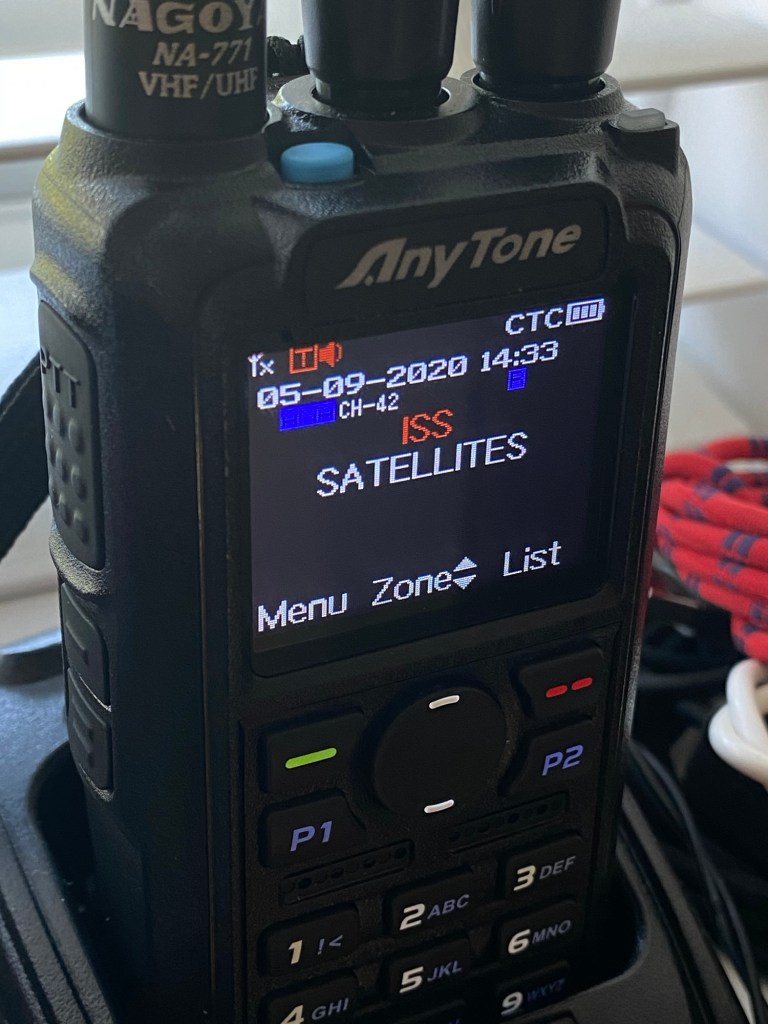
In this Instance below I used a digital transceiver and was pointing the aerial in the general direction of the International space station as it passed overhead on a specific date, when the Russian section of the ISS was transmitting slow scan television pictures as it passed over. I used my iPhone to decode the signal and to produce the pictures, using an app I had installed earlier. This was all part of a day celebrating the anniversary of Sputnik, the world’s first man made transmitting satellite.
My setup was totally mobile and so basic that I just about managed to get partial scans via this technique, see the two pictures below. I was literally sitting in the front seat of my car.
The picture I received from the ISS and my radio
Even though my pictures were not perfect I was still able to supply proof that I received the transmission and as a result was issued with the certificate below from ARISS – Amateur radio on the International Space Station, find out more about ARISS Here: ARISS
ARISS certificate
There are many of these types of events that occur all year round where you can experiment with all types of equipment to make contact with distant radio stations. This is the spirit of amateur radio.
For parts or not working, Does not power on don’t know what is wrong with it,screen looks to have a leak
EBay
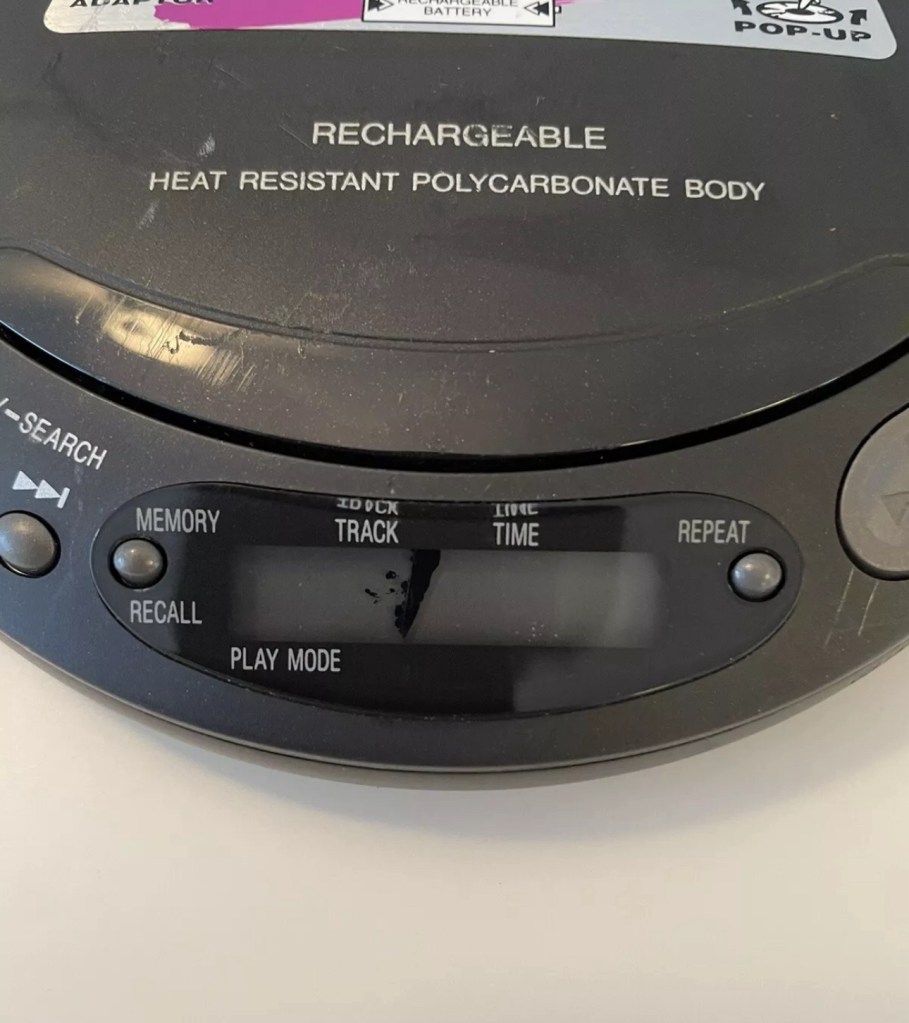
Technics SL-XP165 portable CD player
This is probably going to be one of if not the least problematic units I have received yet. Probably more along the lines of boring for those looking for a repair report, I fear I have brought you here under false pretences, that was not my intention and I apologise if that has been the case.
Another unit from 1996 (therefore now 28 years old) this one originally had rechargeable batteries which were a bonus item for such a unit at the time. Personally I’m using good old alkaline batteries for test purposes, I doubt I will be using rechargeables.
I down loaded the instruction pamphlet, grabbed a pair of earphones and then dropped in two AA batteries and a CD.
Nothing. Silence…..
I looked at the unit, the seller is right I thought….then I pushed the play button and took the switch off hold on the side and put the second switch into normal operation and almost blew my ears off.
SL-XP165SL-XP165Screen minor issues
Superb sound and it was quite obvious that the unit was working. All buttons are doing what they should do, the Xbass system is phenomenal and the volume dial is faultless and crackle free.
SL-XP165SL-XP165A bit tatty but perfect sound
It just goes to show the seller in this case wasn’t fully aware regarding how the unit works. You have to turn it on and off to get it working, it’s not all automated like other similar units. See video below.
Stop start works good
The unit is a bit tatty and the indicator panel has had some leak by the looks of it (See photo at top of this post) but even though this looks a bit poor cosmetically it does still display most of the information, it’s just not showing the track number info. Yes I could probably try another screen on this unit but what is the point? It works fine and the unit will gain no significant value for doing such a fix. It’s just not a financially viable choice unless I somehow come across a no value donor unit and seeing the prices people think these units are worth, I can’t see that happening anytime soon. And the Sony donors I have just aren’t compatible.
So I’ll leave it as it is. As the saying goes, “if it ain’t broke, don’t try to fix it.” It isn’t faulty, the only fault was in the sellers knowledge of its workings.
Another one saved from landfill. And that’s a positive.
I love this little unit, it has a great radio reception probably better than a number of Sony Walkmans I have worked on to be honest. It has arrived in good cosmetic condition with only a few dinks and scratches commensurate with its 30 year plus age.
Radio works well
On opening up the unit it’s patently obvious that this is another drive belt issue, it’s saggy and breaks on removal. Luckily I have a replacement belt that I purchased earlier.
It’s another saggy worn belt issue
And that is basically it. No major dramas it’s as simple as replacing the belt.
Speed adjuster circled
A bit of light grease on the gears, a tweak of the speed adjustment and all sounds as it should.
I’ve used a calibration tape with a 3Khz sine wave, it’s tuned in pretty close to the tone and I’ve used a downloaded oscillator software package to check the matching. It’s not a professional setup but it’s fine for my requirements.
All working with a new belt
Sorry there is nothing else much to write but I have a good working unit that plays tapes well and all I can say is I’ve saved yet another easily repairable unit from landfill. I already have someone who wants to take this one off my hands so I hope it will have many more years of trouble free operation.
The initial report of the purchase stated the issue was solely with the tape playback and that every else works fine. Cosmetically it looks fine apart from a bit of cleaning that is needed in the battery compartment, touch wood there isn’t any battery corrosion.
New belt kit
I’ve kind of jumped the gun a bit here in ordering a set of new drive belts for the unit, the fact it is 33 years old now probably means it would be money well spent. ( I may order a stock of belts for any future projects that I partake in) The belts alone were £6.95GBP so that now takes the total for this project to around £26.00GBP in total, but I’m going to use this personally so I’m not too concerned. In good condition and in full working order I could still make a small profit on this so at this stage I’m not too concerned.
The unit arrived on the 29th April. It is in a very good cosmetic state and all the lettering on the buttons is intact, a few small scratches and battle scars as expected but overall very good.
Radio and all button functions work fine, when you push any of the cassette buttons you can hear the motor run so no issues there. Let’s get this package dismantled.
Once inside the most obvious issue is that the belts have turned to mush.
Broken rotted beltsWhat’s left of the old belts
I remove what’s left of the old belts, give a good clean to the cams and reinstall new belts that I have purchased earlier. A little bit of grease to the moving parts and cogs and all moving smoothly. As I’m doing this I notice a problem that I was not expecting, there seems to be a damaged cog, see the video below:
Damaged cog
Well, that’s a bummer as I’m going to have to obtain a donor for a new cog on the fast forwarding capstan, I’m hoping they are all pretty much standard so I will keep an eye out for a cheap option to repair. Whilst checking the system out it becomes apparent that this cog is specific to the fast forward operation so as long as I don’t use this then it should all be ok…shouldn’t it?
New belts installed
In theory yes, however every now and then when in play mode there is a slight dip in quality so I’m not going to chance damage to a tape.
Conclusion: it’s fixed, sort of. I’m looking for a donor cog that will fully fix the issue, the radio is fine, tapes can be played it’s just that I don’t really want to damage any until this issue is sorted. It’s a shame as it really was just those rotten belts that needed replacing. I’m pleased with what has been accomplished, yet again another 30+ year old electronic item has been saved from landfill. That’s a result.
The radio was received earlier today. Cosmetically it is a bit tatty, batteries were placed into it and apart from a quick flash from the power light when it was switched on there was no sign of life. So the original description was false as it stated that it powered up with a very low volume. Oh well, not to worry, it now gives us something else to look at.
Tatty appearance
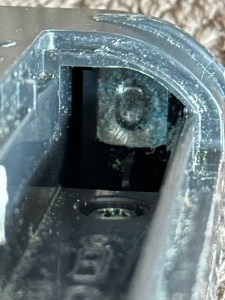
Looking in the battery compartment there looks to be corrosion, this seems to be a common problem with items I’m buying at the moment. The screws have all been tampered with so I suspect others have been inside this radio prior to my purchase, this could be interesting to see what’s already been tampered with or attempted.
Tatty appearance, non workingCorrosion….again
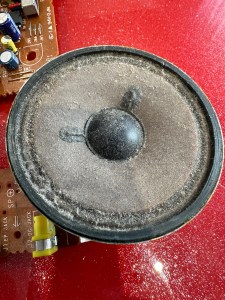
I’ve had the unit open and the first thing that comes to light is the utter filth inside. The speaker is thick with god knows what and the board and switches are also covered in the same filth. Before I do anything I’m going to get this cleaned up.
Filthy circuit boardDirt from speakerCorrosion
I’ve used IPA on the board and cover and on the (thankfully small) corrosion on the positive battery pole and this has cleaned up nice. I’ve used contact cleaner on all the switches and dials and these have also come up ok.
Speaker before cleanSpeaker after clean
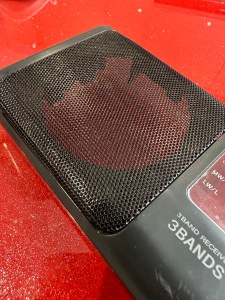
The speaker grill, I have tidied up and used permanent marker to get rid of the marks on this item. This has tidied it up really nicely.
Tatty appearance Grill after polish and touch up
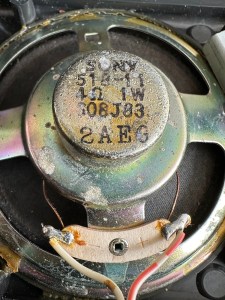
On the speaker I just used a dry cotton bud to wipe it over but I have my suspicions with this speaker, it looks quite worn and earlier reports on the lack and consistency of sound points to this being a potential issue with this unit. There are no clicks and pops when turning the unit on, there is a power and tuning light. Just no sound.
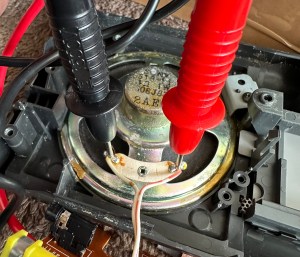
Speaker defective Multimeter to check speaker
The speaker is a 4 ohm 1w speaker, I’ve used a multimeter to check its operation and it’s showing as dead, not registering at all, it should be looking at indicating something within its 4 ohm range. I’ve double checked it by putting a battery across the terminals and there are no pops or clicks so this confirms things. I now need to source a new speaker.
Trying to source this speaker in the uk is a tad problematic. There are items available but I’m not paying out two to three times the value of the whole unit. I’m going to try some thrift shops to see if there are any suitable donor units available if not I’ll have to purchase a few of them from China, and that will still be cheaper than purchasing here in the UK, crazy isn’t it? But it’s a long wait….
I did manage to get one from the Uk. Paid about £5.18GBP and it should be here in a couple of days. The annoying thing is that the postage is almost the same cost as the actual speaker and that only cost £2.69GBP. Annoying though that is, it has to be done if we want to get this fixed.
New speaker Speaker placed
I couldn’t get a 1w 4 ohm speaker only a 1w 8 ohm speaker, this will be fine as at this level of use it will not affect output at all.
A small bit of desoldering, removal of the speaker clamp and the speaker comes away after a little persuasion. I take the opportunity to clean the board and all the battery contacts with some cleaner, and all corrosion marks and debris are now a thing of the past.
Corrosion cleaned
I put some contact adhesive on the speaker grill and put the new speaker in place, clamp is attached and I now solder the speaker wires back in place.
All screws back in place, new batteries in the rear and battery hat hatch closed, the unit looks good.
But does it work?
Radio works – have a listen
You betcha! Have a listen to the short video above to hear it as it should be.
I’m very pleased with this little project. Simple repair in the end but in my eyes it’s another item that isn’t going to landfill. And that’s a win for me, as it’s a nice little radio and I’m going to get some good use out of this.





























 Foxes Den
You must be logged in to post a comment.