

Back in March 2023 in the early days of this site I threw some figures out there regarding the amount of cameras on the planet up to and including 2022, you can read that post here: Vintage Camera figures
In this post I’m going show a graph and some figures regarding the decline of DSLR ( Digital Single Lens Reflex ) in the last 12 yrs.
It’s becoming obvious that people are ditching the traditional camera frame for the mobile phone and tablet approach and the figures you see in decline for traditional cameras have probably gone in the total reverse and multiplied many times over for the latter. It hurts the brain to realise the total amount of picture capture devices out there, as well as the waste that this produces as a result of what has become a throwaway society in which we all must share some guilt.
I can honestly state that in the last 12 months I have purchased close to 60 Cameras, 18 radios about 14 portable cd and tape players and not one of them has been disposed of much to my wife’s displeasure. (To be honest she’s very supportive of what I do as it keeps me out of mischief.)
Anyway I’m starting to drift a bit, so in my last post back in 23 I think I stated that there were estimated in 2022 to be something like 45 Billion photo capture devices on the planet, enough for 5.5 units per person that inhabits this Ball floating in space, a phenomenal number. And now there are probably even more.
The traditional camera is being ditched though and as you can see in this graph supplied by Statista It is a seriously declining part of the consumer market.
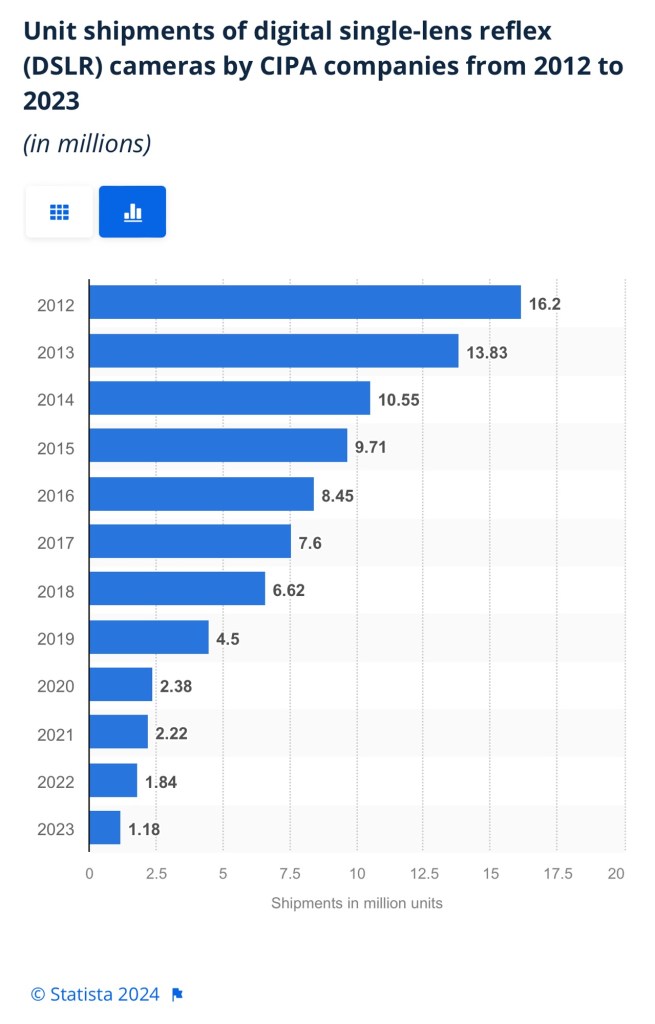
The number of digital single-lens reflex (DSLR) camera shipments worldwide has been on a downhill ride since 2012. In 2023, a total of around 1.18 million DSLR cameras were shipped by *CIPA companies all over the world. Despite the decline in shipments, the average price of digital cameras per unit has continued to remain stable.
In eleven years the annual sales of a DSLR has dropped by almost 16 million units in 2012 to a paltry 1.18 million in 2023, as I’ve stated the sales of mobile devices have probably quadrupled and risen in the opposite direction.
The question is, are traditional cameras going to be more of an antiquity in the near future or will there always be a demand? There are so many out there that I can’t see them commanding any good price through rarity as there are just so many out there.
I learnt my trade in photography back in the late 70s early 80s. Back then we did everything by hand from mixing the chemicals, manually printing using enlargers and various types of papers, dryers and drums. Dodging and shading, manually touching up any defects as work was produced. We even made dupe trans, did letrasetting and made the boss man tea. A computer does it all now….apart from the tea but I bet that’s on the horizon.
The chemicals we mixed were in 100 litre batches and were pure poison. E6 Colour developer contained Hydroquinone, and the final bath (Stabiliser) all this chemical was pure formaldehyde, we never had masks or gloves back then and after mixing a batch of these chemicals you were out in the yard for a good half hour coughing your guts up. There were many other chemicals involving ammonia and powdered citric acid and these were just a few of what we used. If you could only imaging the shear hell we went through for you to get your photographs.
Probably why I have such bad Bronchitis and Asthma nearly 45 years on.
What I’m saying is the digital world of today is immense progression and removes all that danger away from the business. It’s killed the business as much as any other big business out there. But it’s probably not as much fun or as much pleasure as doing the whole process by hand using traditional skills. Heck I bet that will kick start a conversation between the traditionalists and modernists.
Whatever way we look at things, time moves on, progression is always going to occur and we must (Even though we don’t always want to) adapt to change. And it’s going to change for everyone big time in the next decade or so.
Even though it’s like saying goodbye for a final time to a dear old friend. I enjoyed my role I played in it.
Supplementary notes
*CIPA stands for “Camera & Imaging Products Association”, which is the trade association of the Japanese photo industry.
The section “digital cameras” includes the following producers: Olympus, Casio, Canon, Kodak, Sanyo Electric, Sigma, Seiko Epson, Sony, Tomy, Nikon, Panasonic, Fujifilm, Hoya, Ricoh.
 Foxes Den
You must be logged in to post a comment.