A nice little starter camera from 1987 sold as faulty when actually its operation was just misunderstood. Not so much a fix, just a lesson in why you should read instruction manuals.
What the listing stated:
Nikon F-401 35mm SLR Film Camera Body Only – Spares or Repairs. Unsure why it won’t work, I bought brand new batteries and it doesn’t want to power on. No exterior damage or scratches to suggest it’s been dropped. Battery compartment is nice and clean. Any further queries feel free to ask. Thank you for browsing.
EBay
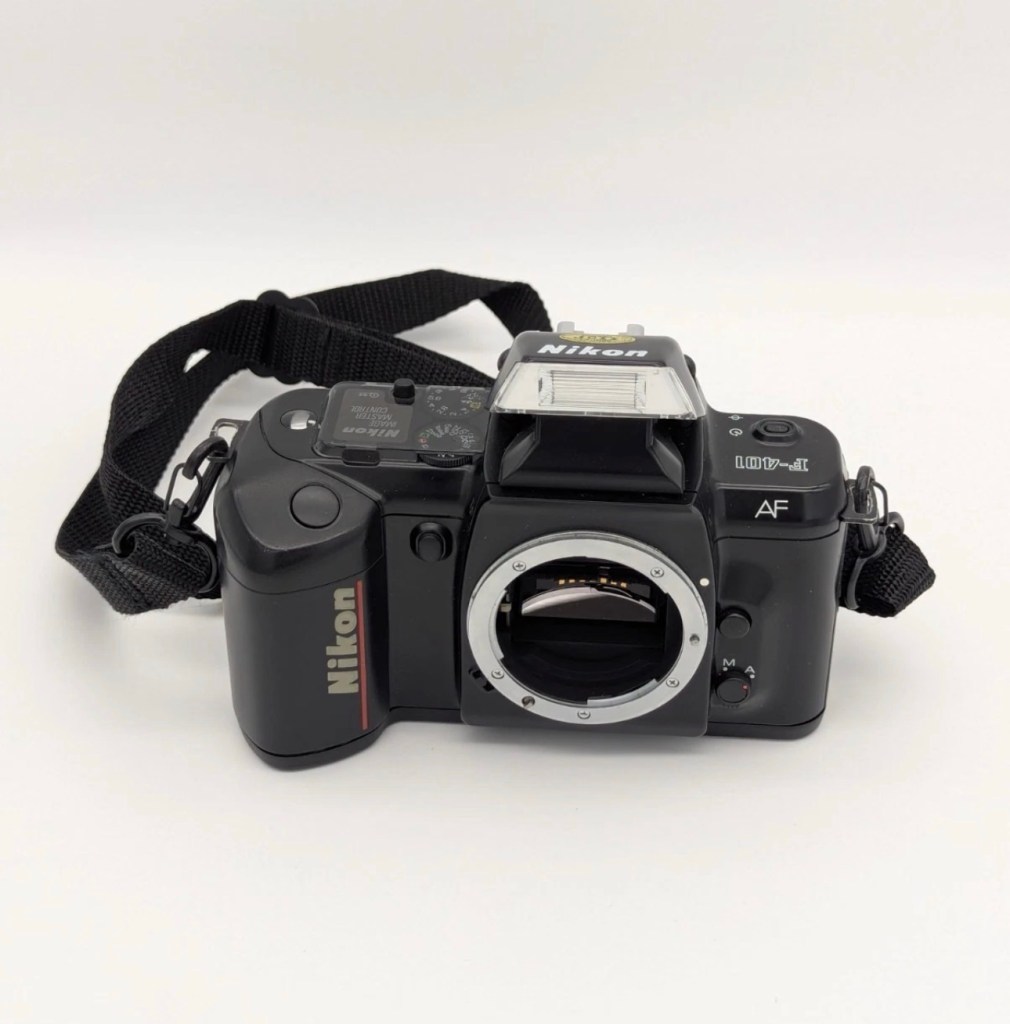
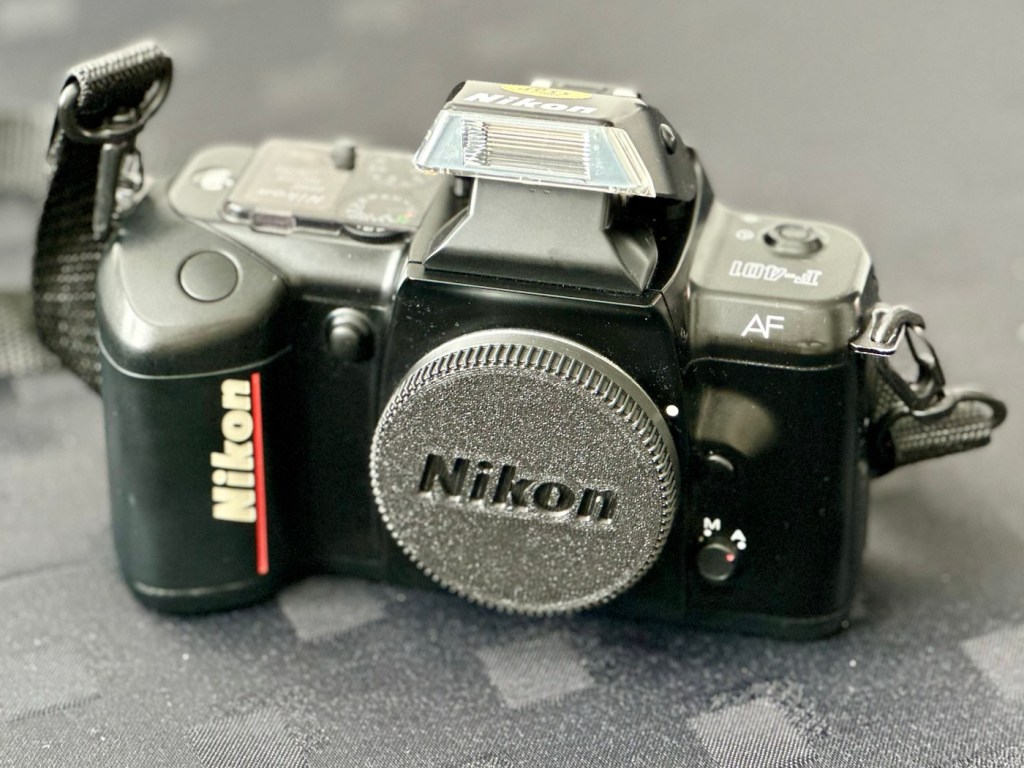
The camera I have purchased
Known pretty much as a dollar camera, it’s a Nikon but aimed at the entry level, and is of a plastic construction. The dollar tag is generally used to say just how cheaply available it is. I paid a bit more than a dollar, I paid £4:00GBP, after knocking the seller down from the £12:00GBP he was originally requesting. Still a bargain I believe, will be a nice little starter camera for someone if I can get it working.
Here’s a little about this camera:
The Nikon F-401 (N4004 in North America) was a beginner’s level, autofocus, 35mm, single-lens reflex (SLR) film camera built by Nikon and introduced in 1987.The camera represented one of Nikon’s first endeavours into consumer-based autofocus, as a follow-up to their first autofocus SLR in 1986, the Nikon F-501 (known as the N2020 in North America). The camera lacked many of the advanced features that more seasoned amateurs and professionals required, but it was a harbinger of the future as it included a pronounced, built-in grip as well as an integrated TTL Flash that is now commonplace on all but the most high-end SLR cameras.
The F-401 introduced the now common-place feature of using a thumbwheel instead of lens aperture ring to adjust the aperture. Furthermore, the camera’s lack of support for AI lenses meant that while all previous Nikon lenses could be mounted to the camera, none supported automatic exposure TTL metering.
An upgraded version the F-401S (also known as the N4004S) was released in April 1989. The F-401X (also known as the N5005) followed in September 1991.
By the 1990s, the F-401 was part of a lineup of autofocus consumer SLRs that included the more expensive Nikon F-601 and Nikon F-801.
Wikipedia
Looking on line at other F-401s that are for sale seems to highlight that power issues are a regular point of failure for these cameras. Let’s await its arrival so we can carry out a full assessment of this unit.
Assessment:
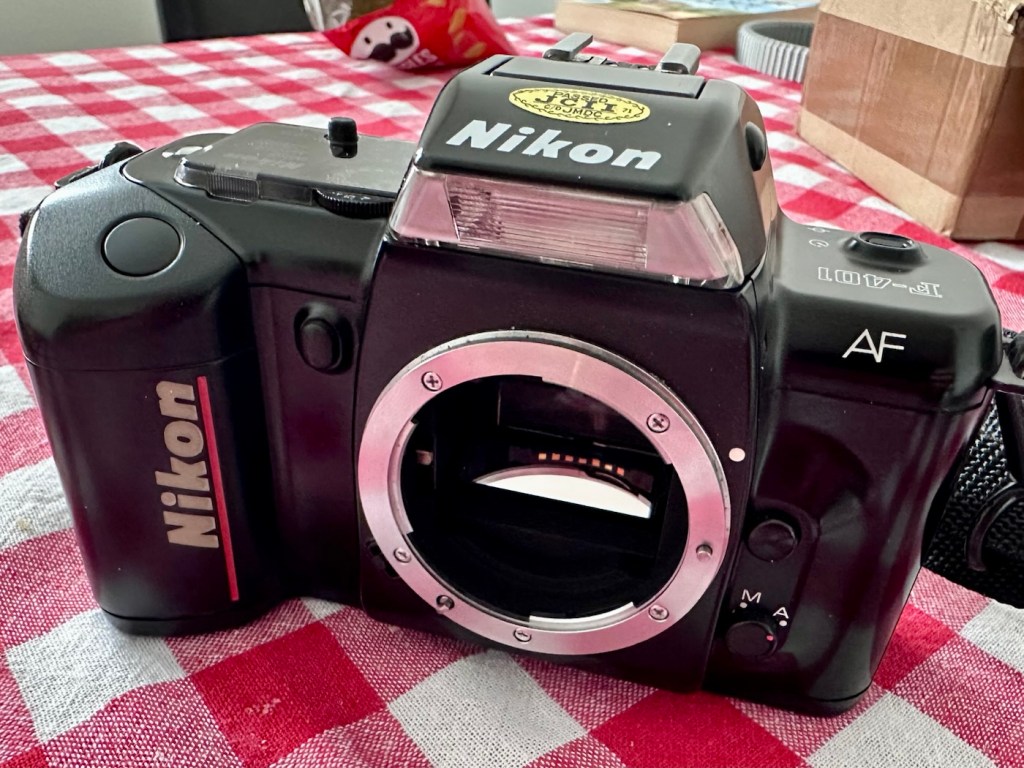
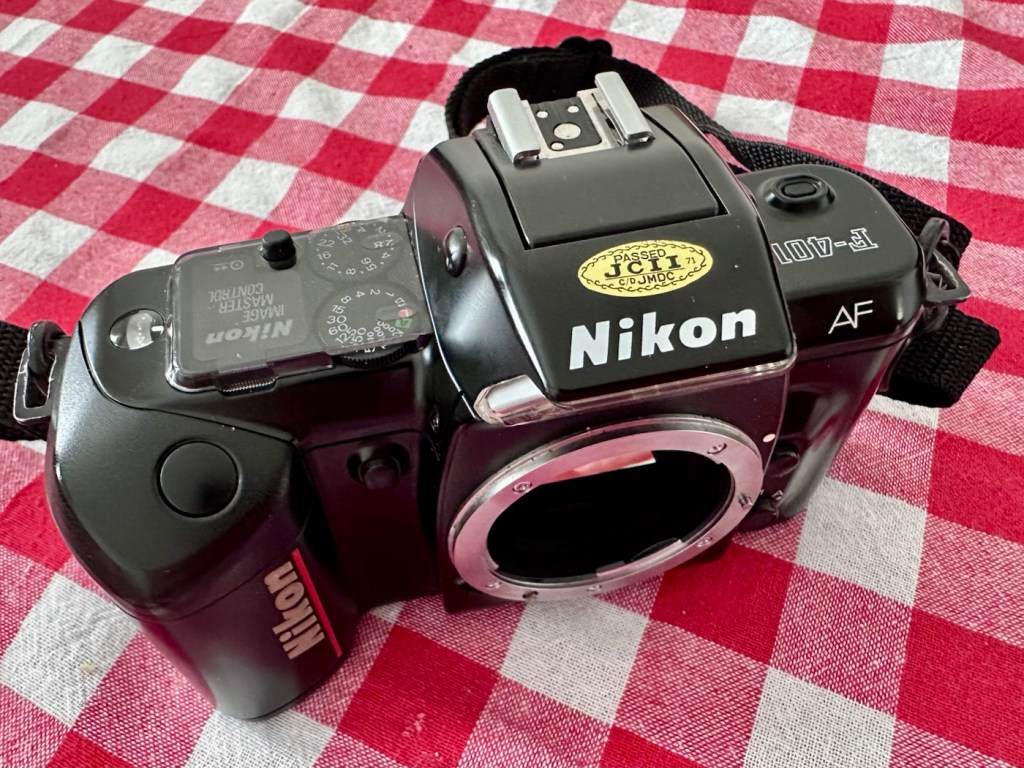
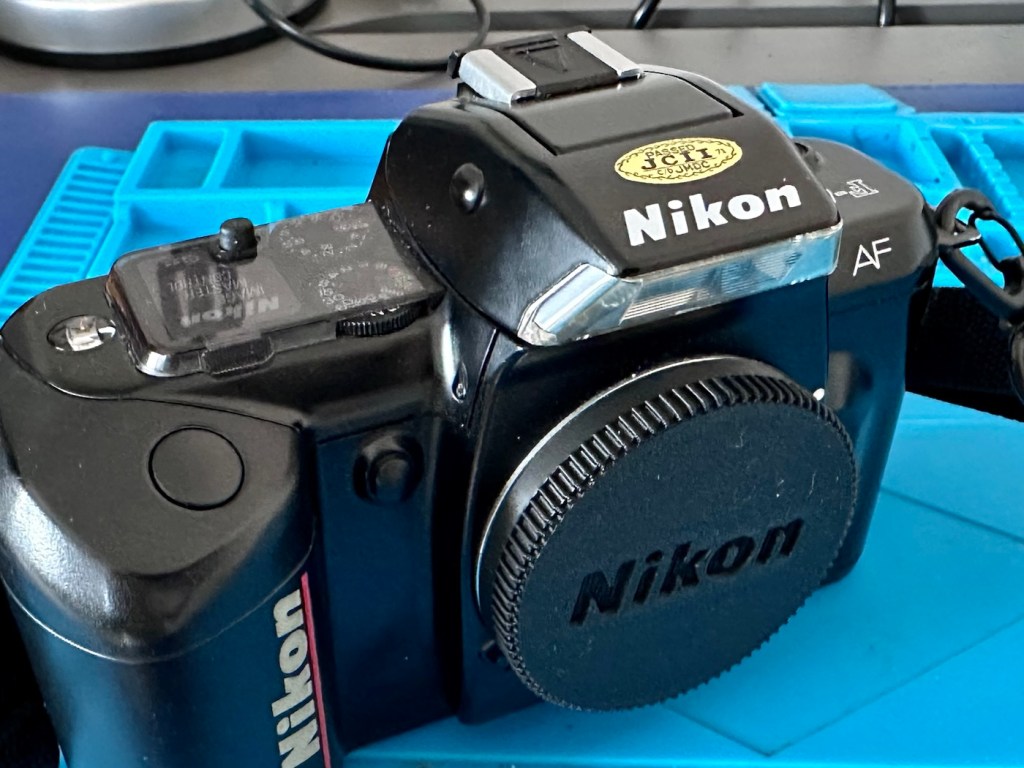
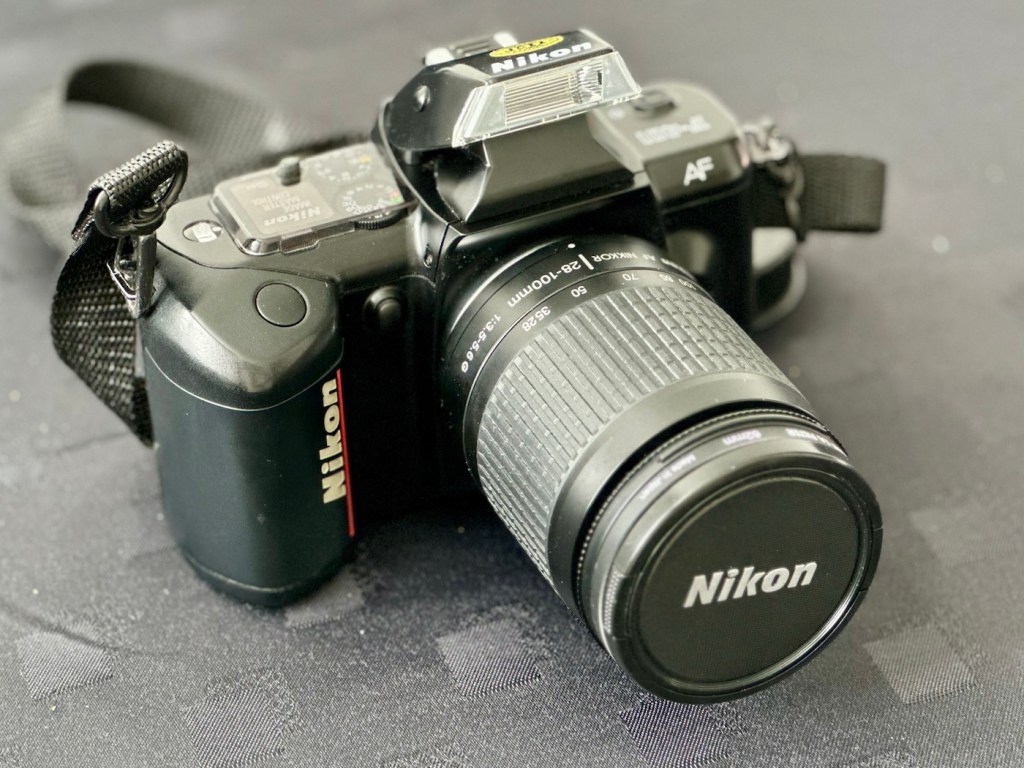
Here’s what has arrived today with the postman
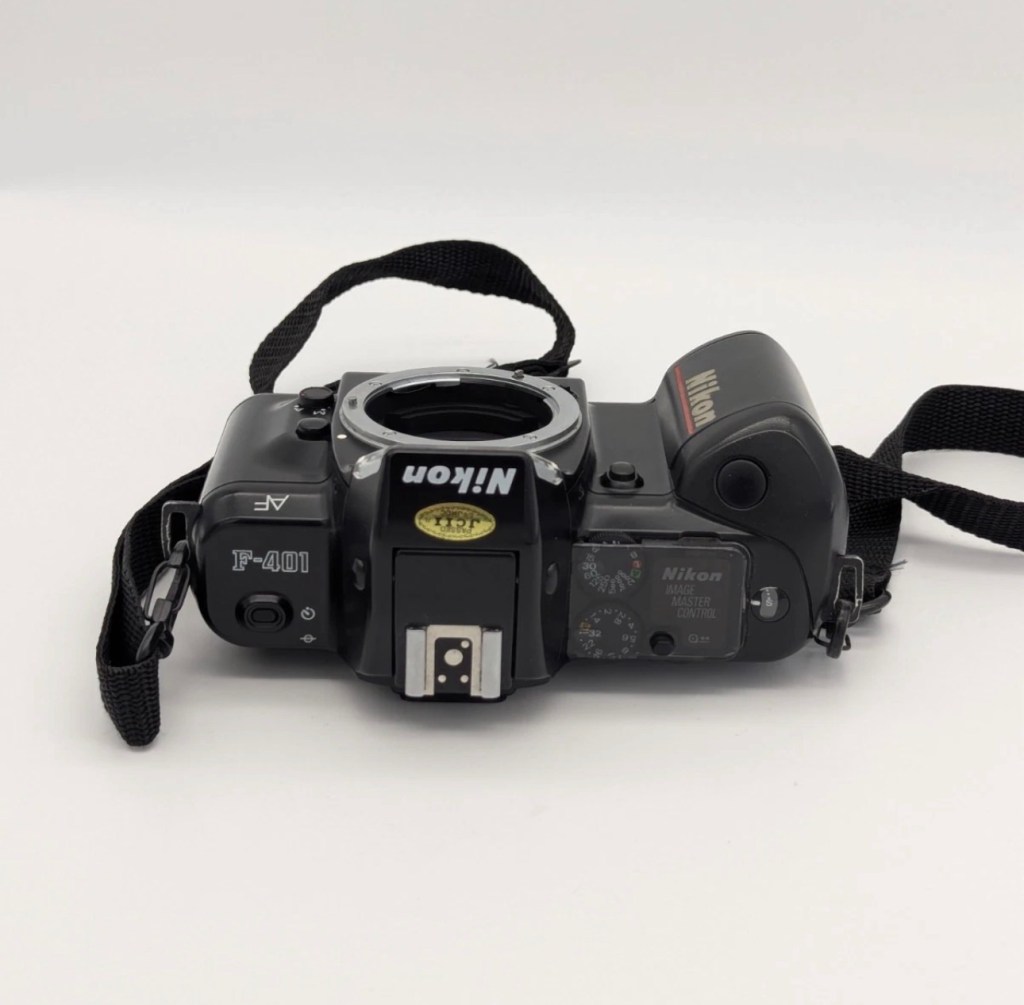
The camera that arrived today
I’ve just sat at the kitchen table looking this camera over, and for £4:00GBP it’s a bargain. It’s very clean despite not having a body cap, there is only a tiny bit of paint damage near one of the strap connectors, apart from that this camera is in a very good (cosmetically) condition. A bit of a clean will take it to another level, however we will look at that once the fix has been done.
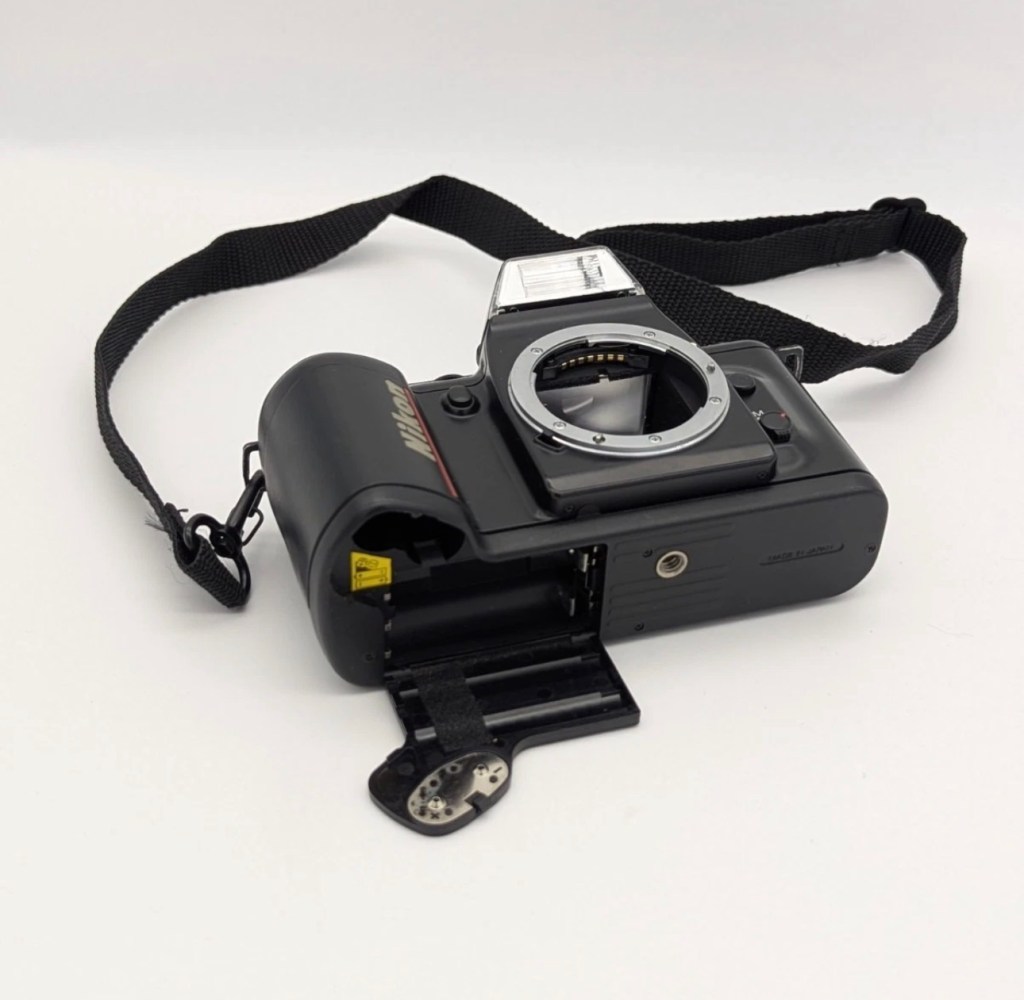
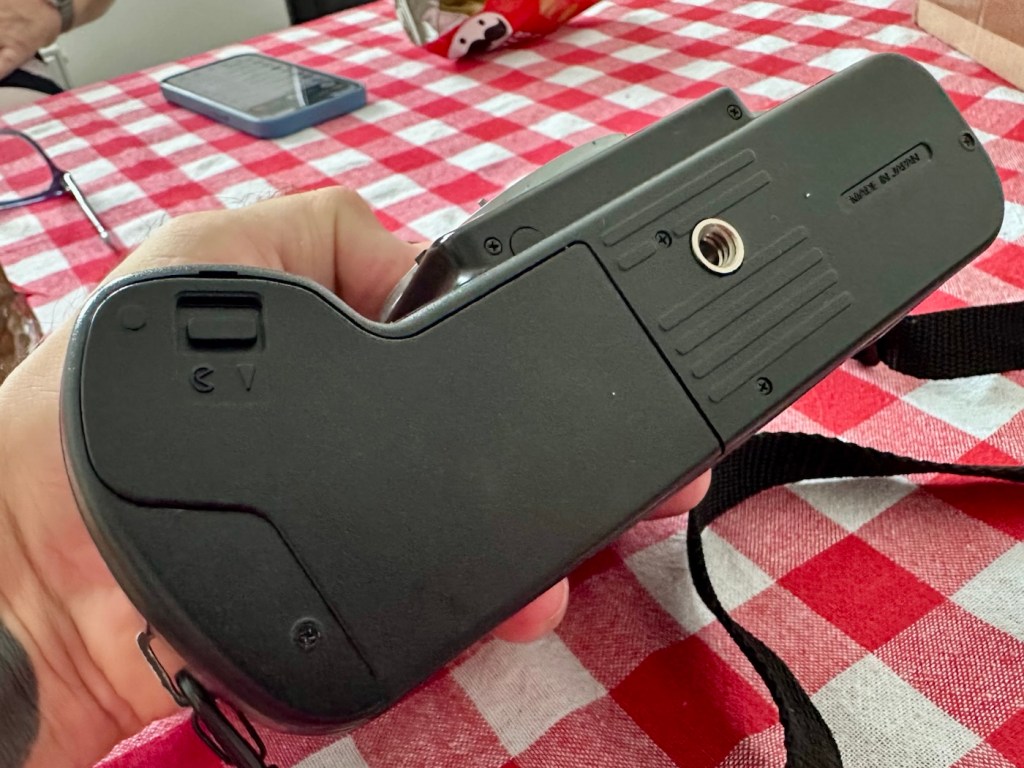
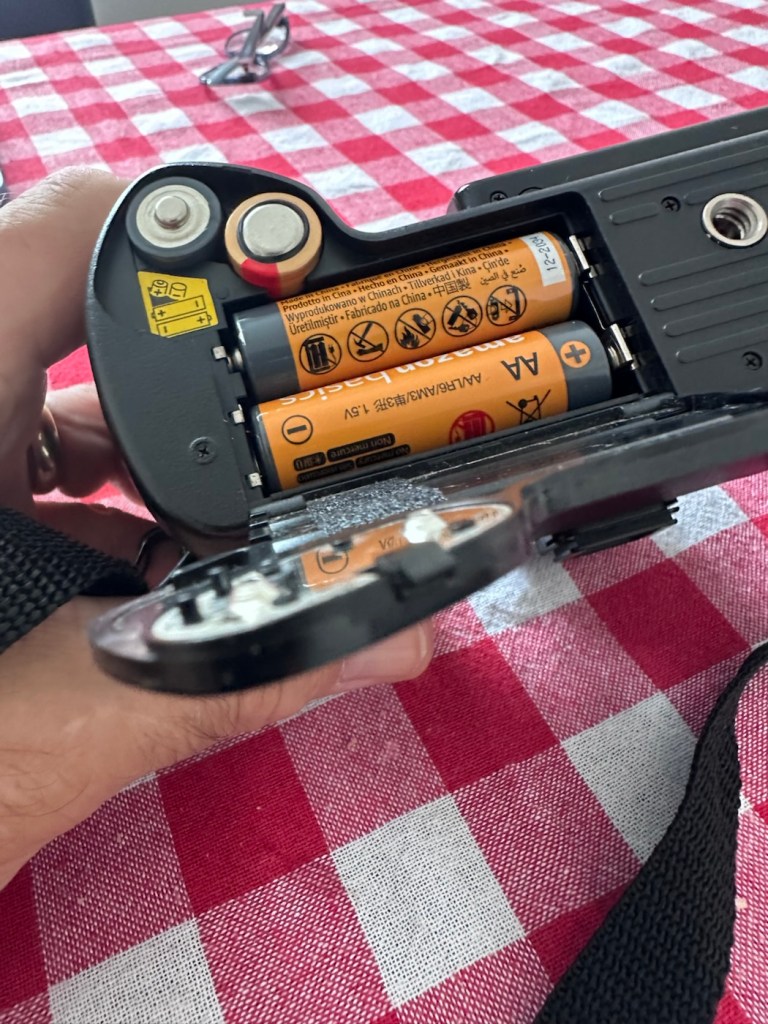
Fresh batteries installed
I have put 4 x AA batteries into the base of the camera and there appears to be no life in the camera. Contacts appear clean, the batteries are good, let’s take a deeper look into what the issue may be.
Repair:
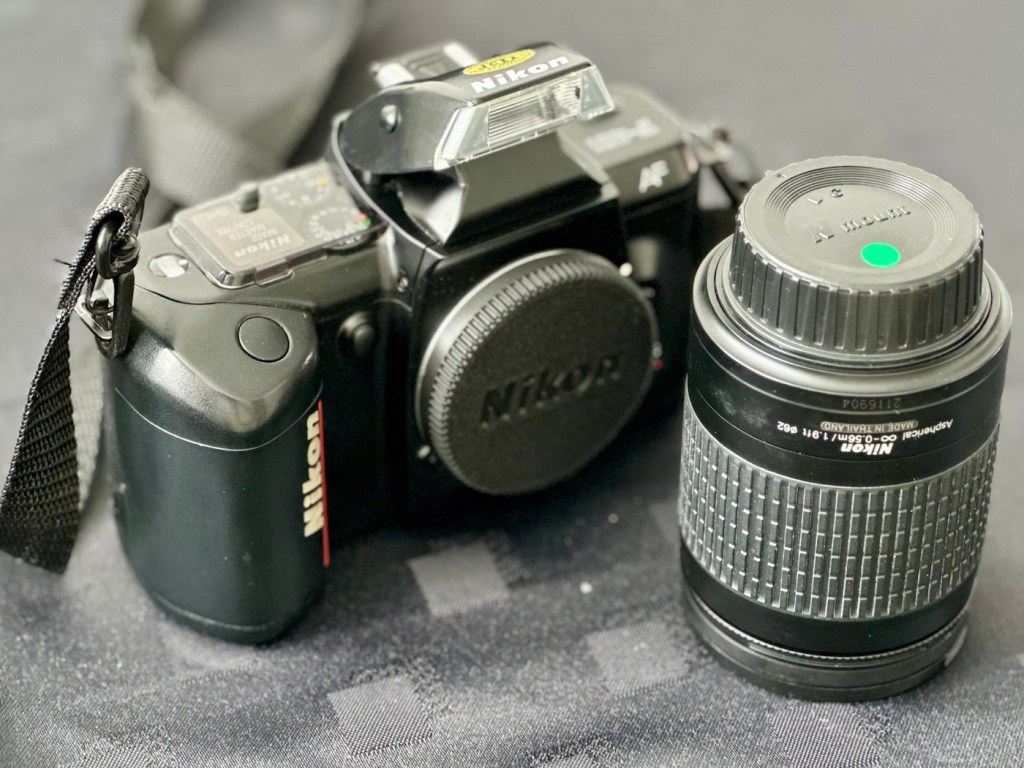
As I always do with any camera I purchase, I like to ensure the lens barrel, mirror and curtain are protected. In this case I will therefore 3D print a suitable body cap, and a hot shoe cover. If I then have to start any in depth cleaning at least I won’t have to worry about any excess debris intruding into this area.
New body cap and hotshoe cover
The next thing I really study with any new camera that I obtain is the instruction manual. If some of the sellers actually did the same then they’d quickly realise, that sometimes there are no issues with the unit, it can really just be down to the quirkiness of the camera and how its controls work. Each camera brand differs slightly, so if you have no experience with a specific brand, it can quickly come across as the camera is not working. In a lot of cameras I deal with this is not the case. Knowledge really is king here.
And I suspect that this very camera may just well be a case of the sellers lack of operational knowledge.
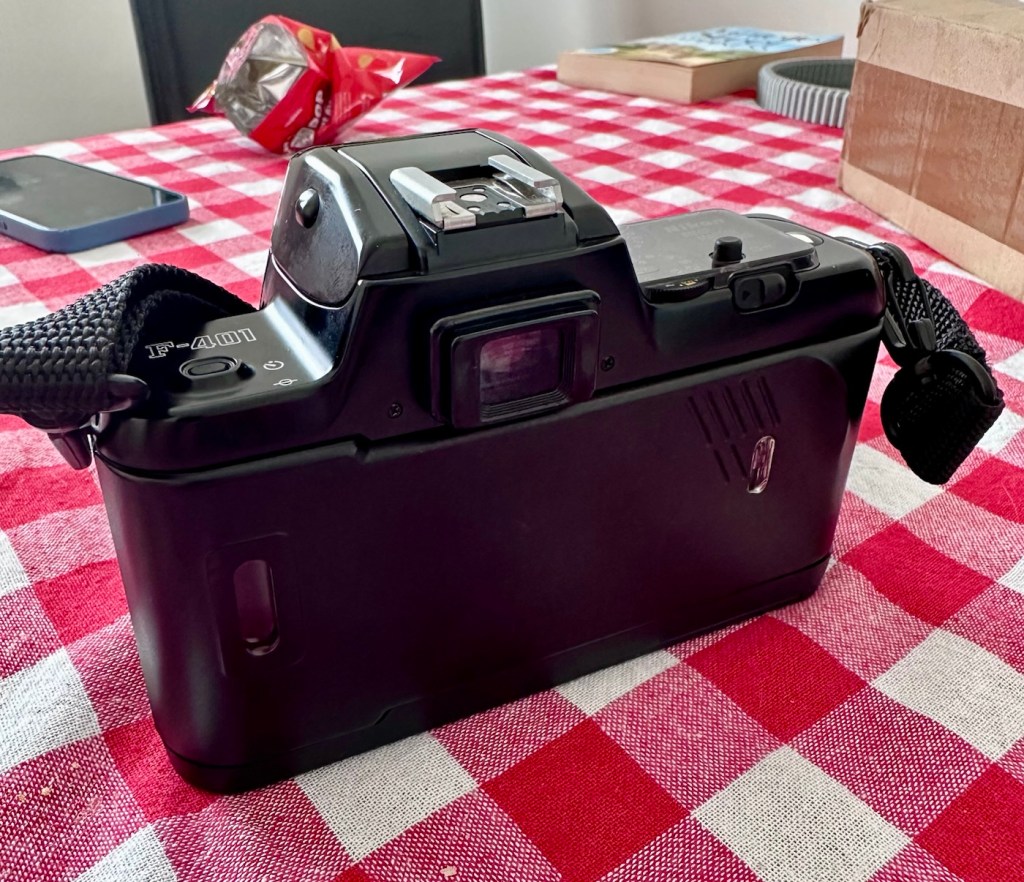
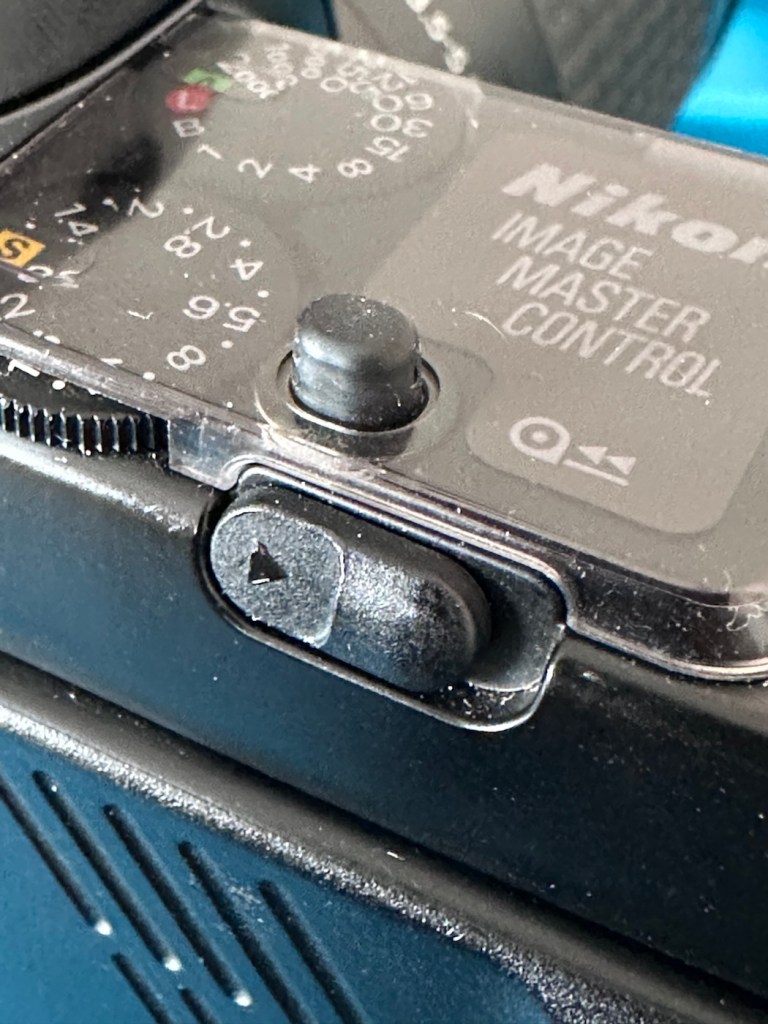
I really feel like a fraud here, there is a button on the rear of the camera directly behind the shutter button. Here there is also a small slide switch. This combination of slide switch and button allows you to rewind the film when finished. The button appeared depressed, and when pushed a number of times along with moving the switch side to side the button then popped up and the camera kicked in to life.
Rewind slide and button. This was stuck down
A little contact cleaner placed behind the slide and down the side of the button ensured a free and easy operation. When the rewind procedure was used at least six times it has worked perfectly without issue.
When the rear of the camera is opened, the exposure counter resets as it should. When it is closed again and the shutter button is depressed, three quick fire actuations occur forwarding the film to its first exposure. All is working well.
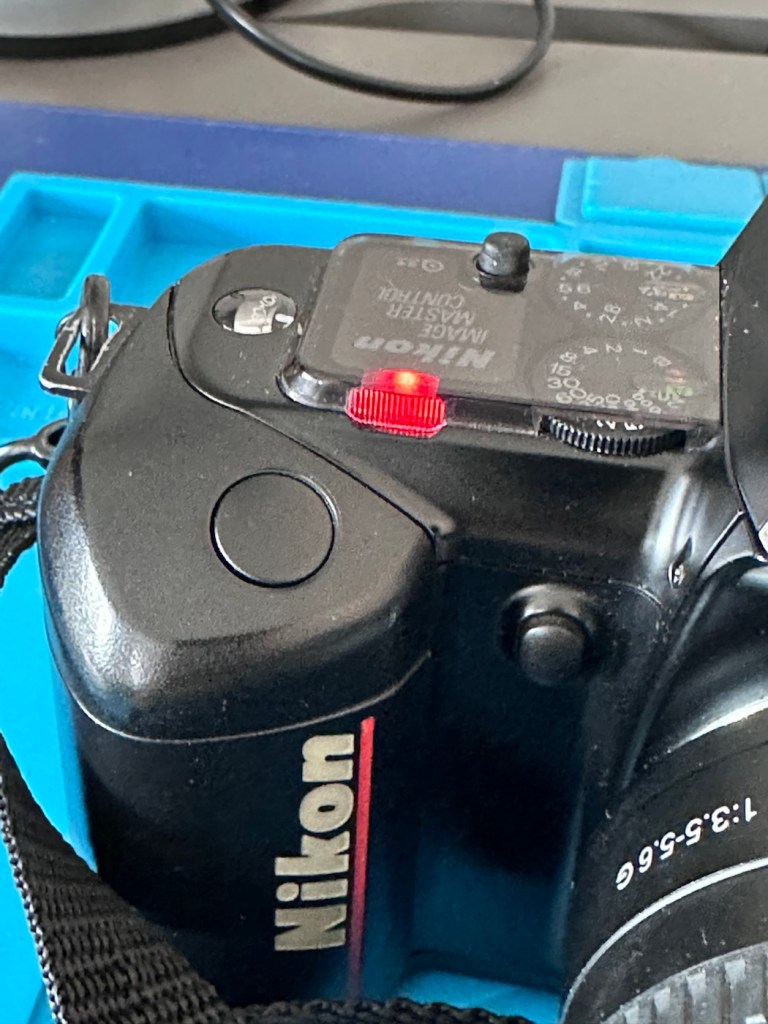
Self timer operationalAll indications working
A Nikkor 28-100 lens on the front confirms all indications are working in the viewfinder, and auto focus appears to be just fine. All aspects of operation on the camera have been tested and everything is doing exactly what it should be doing. This camera was never broken. Its operation was just mis-understood.
Result:
£4:00GBP is a very good price to pay for a fully operational camera, even though it was purchased as a faulty item. Every camera i purchase, I always download a .pdf instruction manual file to store on my server. Nine times out of ten a brief read of just the setup information can sort out a myriad of issues, and if the seller had done the same they would have been able to up their sales prices accordingly. I’m not complaining though as I’m able to bag a bargain on many occasions.
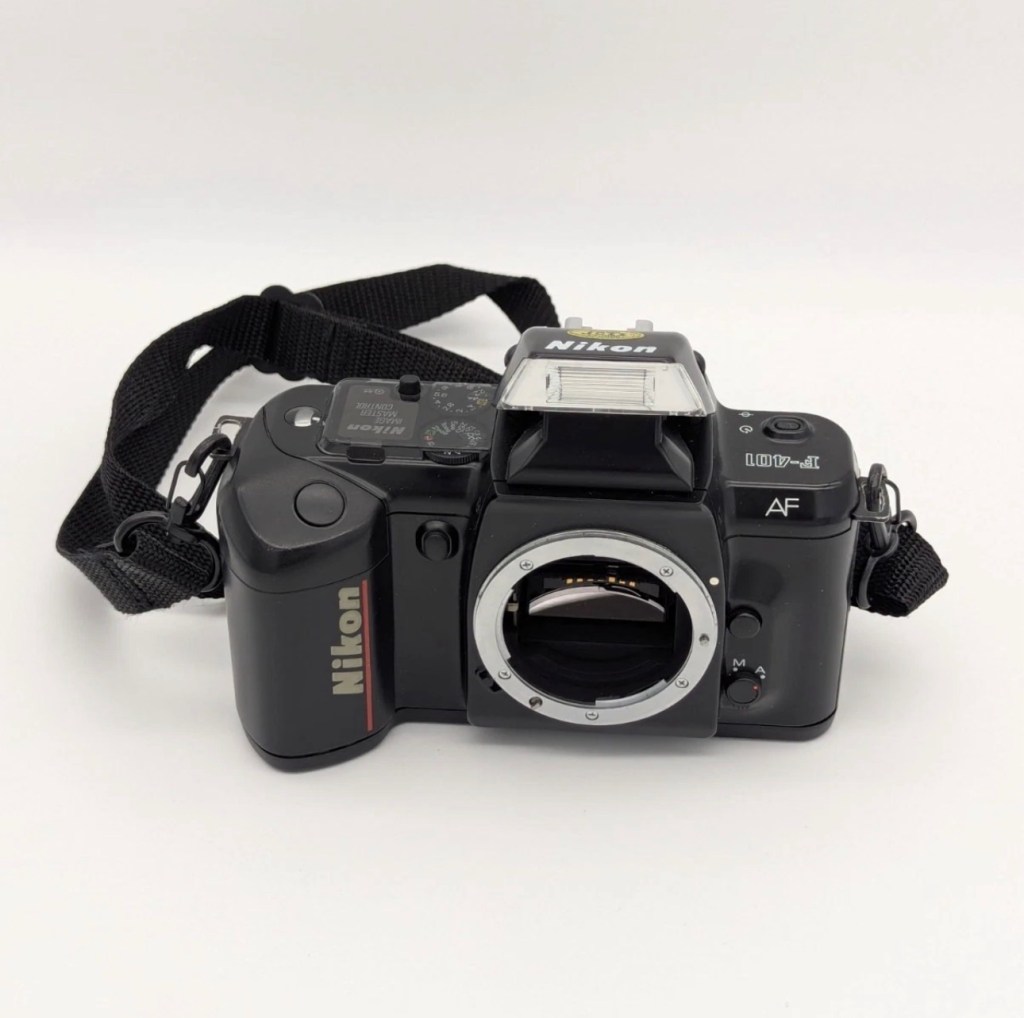
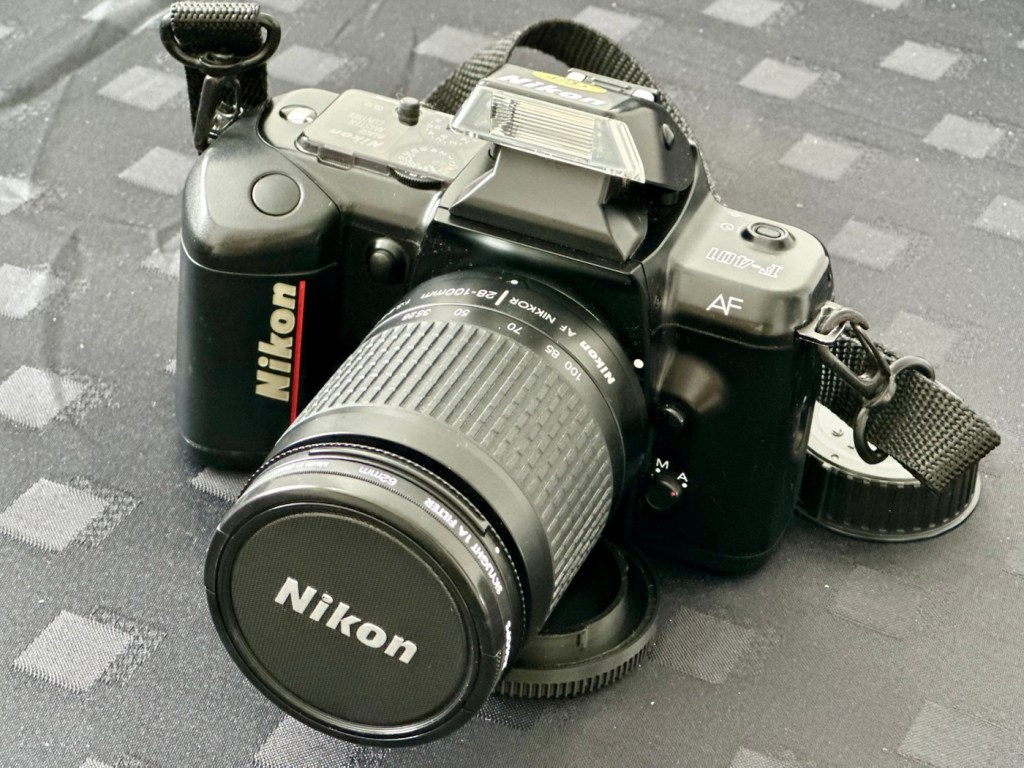
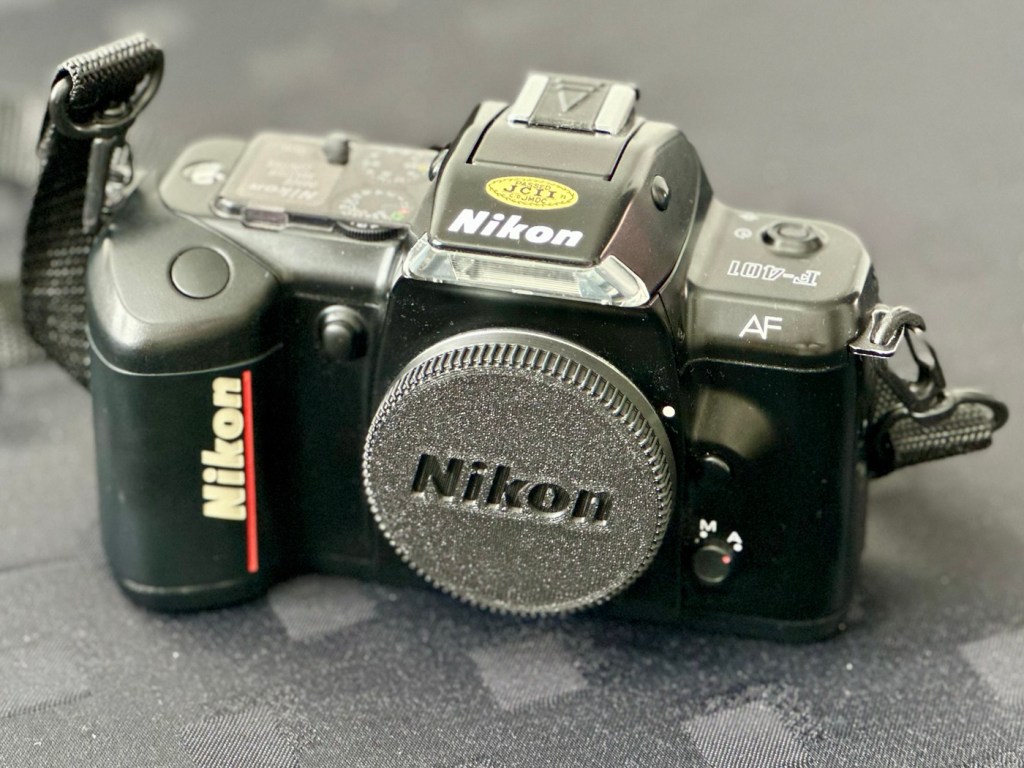
Here’s how this little unloved piece of camera looks after I have sorted it out, cleaned it and paired it up with a suitable lens:
Looking fine and in full working order
To think if this camera had not been purchased it would have just been chucked in the waste. Instruction manuals are supplied for a reason, and it’s always wise to refer to one when things start to go wrong, nine times out of ten there isn’t a problem, just a minor misunderstanding.
Take it from me, instruction manuals are good. I have hundreds stored electronically referencing cameras I have had, through my hands over the past years.
Thanks for passing by, and as always it is very much appreciated.
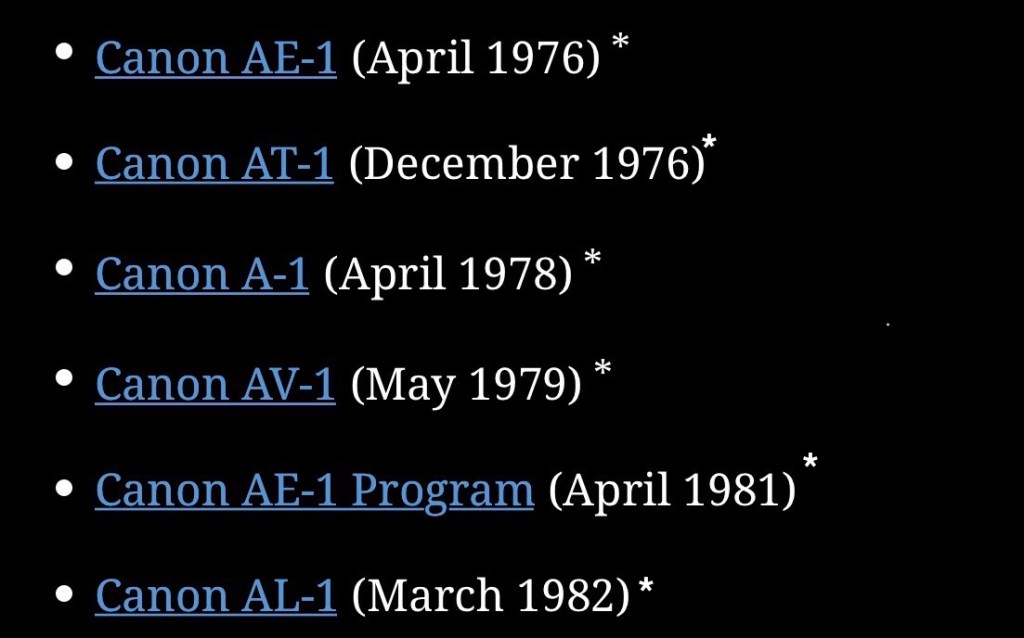
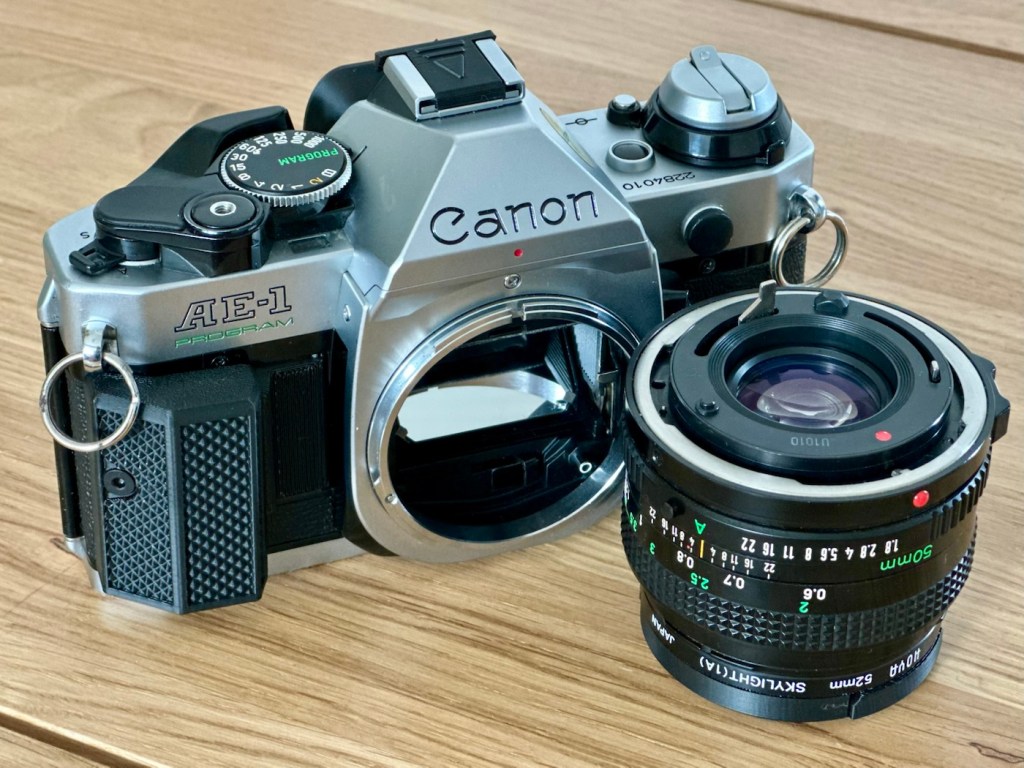
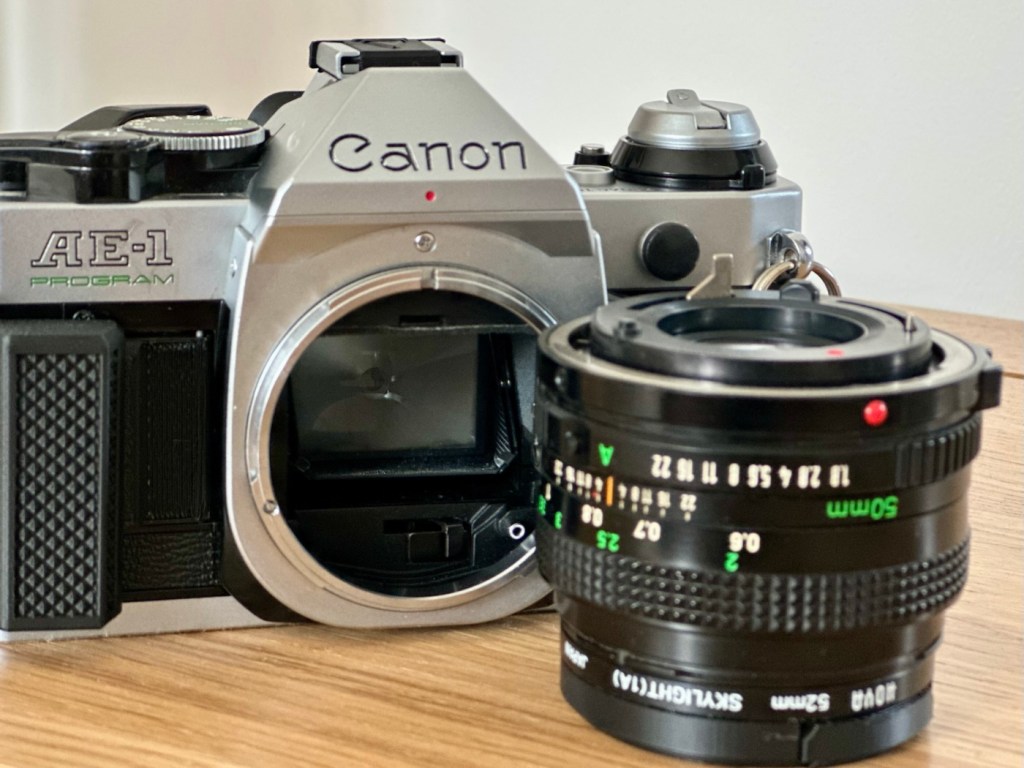
I have my final piece of the jigsaw. My sixth, and final camera of the classic Canon “A” series collection
I purchased this camera as part of a job lot of 5 cameras that were faulty, read about that purchase here: More camera odds & sods
Canon AE1 – Program
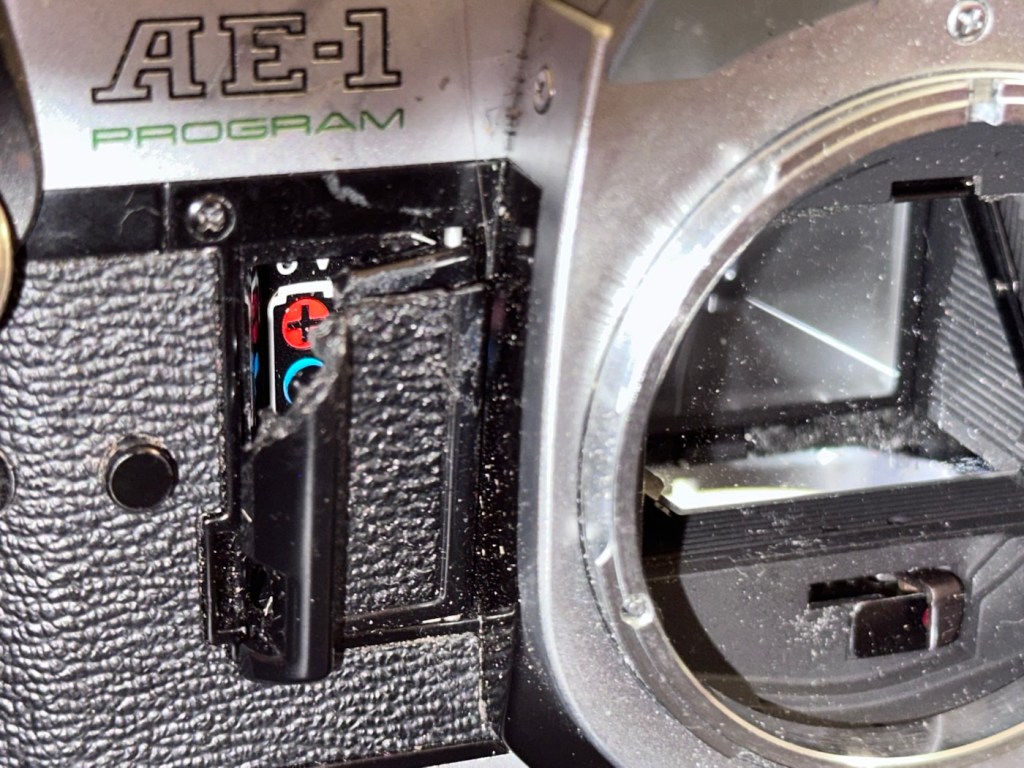
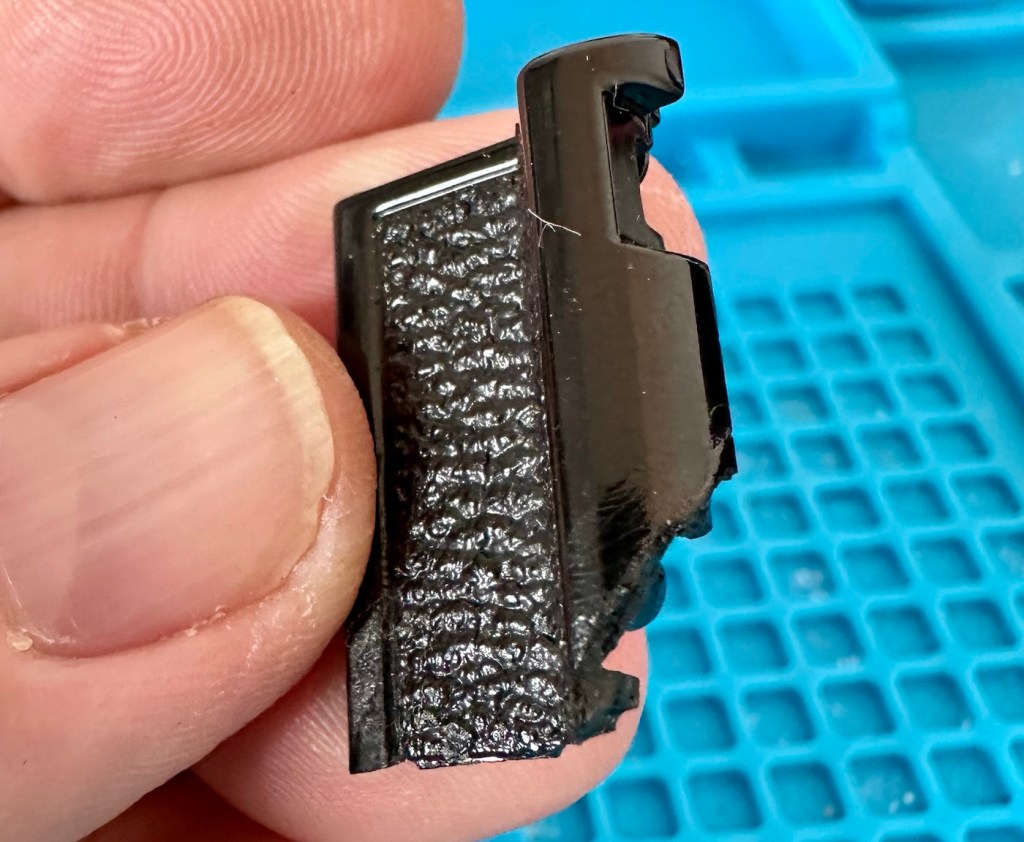
Broken battery door
I’ve been working towards purchasing the entire range of Canon “A” series cameras, and this is the final piece of the jigsaw for me. I haven’t paid premium prices, I have purchased each and every one of them as damaged items and have had to effect the repairs on them to get them working. It’s a wonderful collection of old cameras, all showing their individual battle scars but each performing without fault in taking photographs. What they were designed to do, growing old gracefully and with a now extended life span.
My complete collection
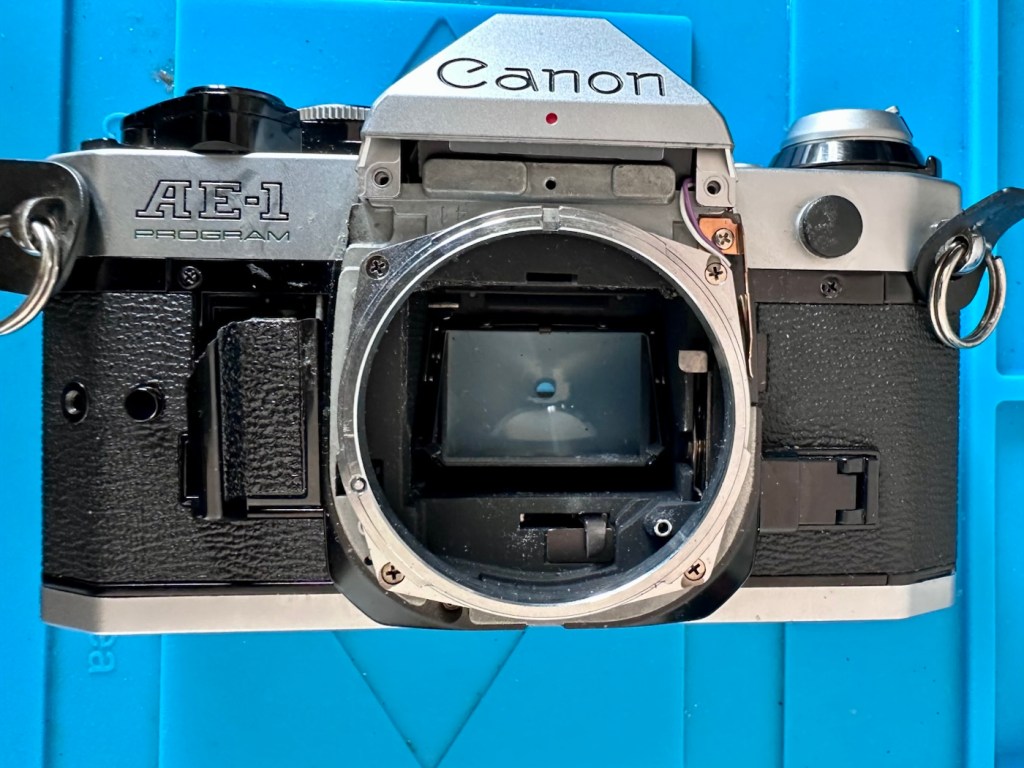
It works out that this camera has only cost me £8:00GBP, and that is a superb price to pay for one of these cameras, even if it was only for parts it would have been a bargain, however these all have the ability to be revitalised and to be given another crack at life. I have done a very brief assessment and nothing appears to be operating as it should be. Electronically this is potentially a very unstable camera, I just need to run a final test on the electrical system. It has two parts that need replacing. There is a small power winder cover that is missing, it’s not important but I will replace it purely for aesthetic reasons. Secondly the battery cover is broken, I do have a 3D file downloaded so I will see how that prints out.
This camera is currently unloved, very dirty and will require quite a bit of work just to bring it up to usable standards. I don’t wish for it to be pristine and at display standards, I want it to be clean and capable of carrying out what it was originally purposed to do, it will be used and thoroughly loved.
Here’s a little bit about the AE1-Program:
The Canon AE-1 Program is a 35 mm single-lens reflex camera that uses Canon’s FD mount lenses manufactured by Canon Camera (today Canon Incorporated) in Japan and introduced in April 1981 as the successor to the Canon AE-1, five years after that camera’s introduction. The major difference was the addition of the Program AE mode first seen in the A-1. This mode sets both the shutter speed and aperture automatically—albeit with a slight bias towards the shutter speed setting. The user focuses the camera and then presses the shutter button. For those desiring more control, the AE-1’s shutter priority auto-exposure and full manual modes are still available.
Wikipedia
Repair
The first thing to do is to get the relevant battery in place and to see what does or doesn’t light up or function. These cameras take a standard 6v 4LR44 battery, and I have some more of these arriving later today, these cameras are reliant on that power source to pretty much do everything, so we have to have one in place to carry out an accurate assessment. Once i can see how the electrical system is working I can then make a decision on how to progress.
The battery has arrived and when it is installed, nothing happens. Electrically the camera is dead and requires attention, and that’s not good. The auto, lock, self timer switch under the winder is not moving, and hence the winder won’t wind, and the shutter won’t fire. It’s a very poorly camera. I go to remove the 6v battery and it is extremely hot, I’d suspect very close to exploding, this is not good at all. I’ve put the battery to one side, it’s now obvious that we have a short circuit somewhere causing the battery to overheat.
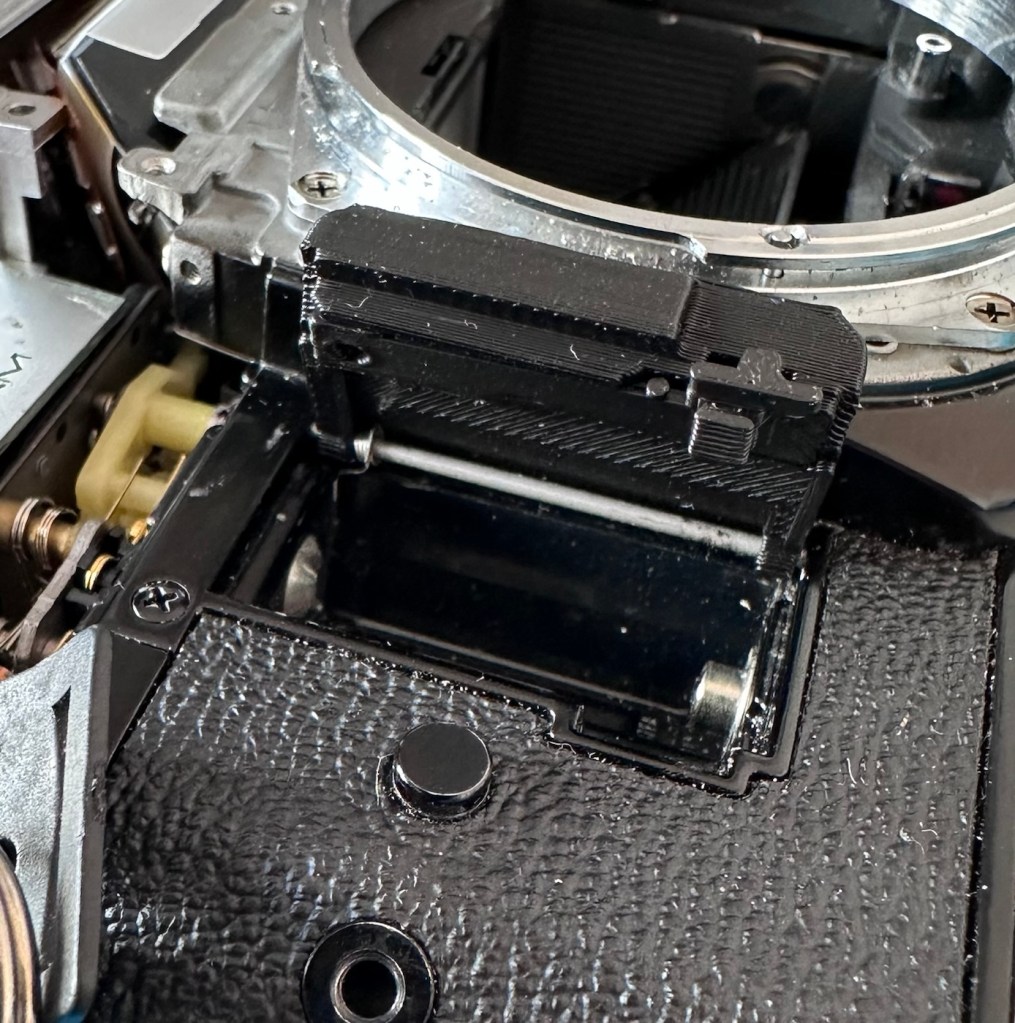
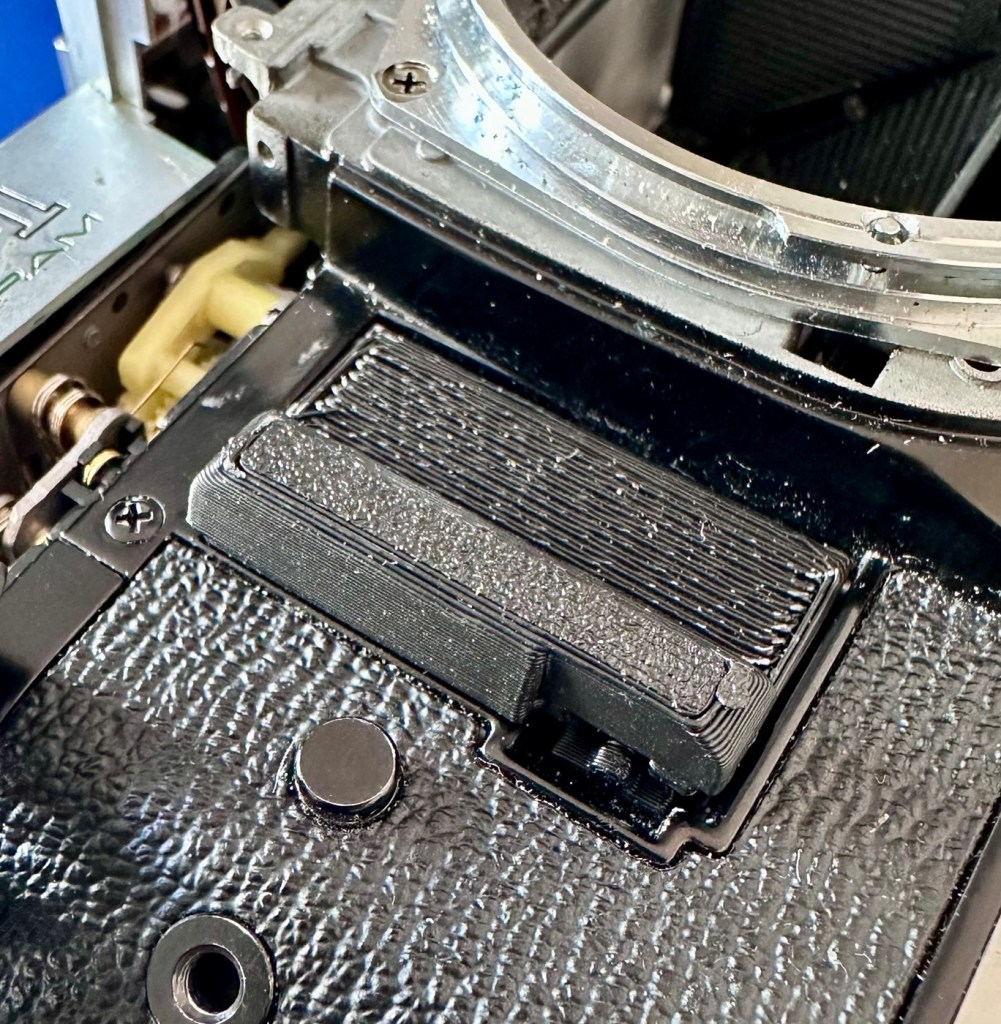
I have printed off a replacement door and catch. It’s not to the original standard but should do the job, until a quality one becomes available. To replace this door the top of the camera has to be removed anyway, so whilst I’m in there I will try to see if I can find the cause of the short circuit.
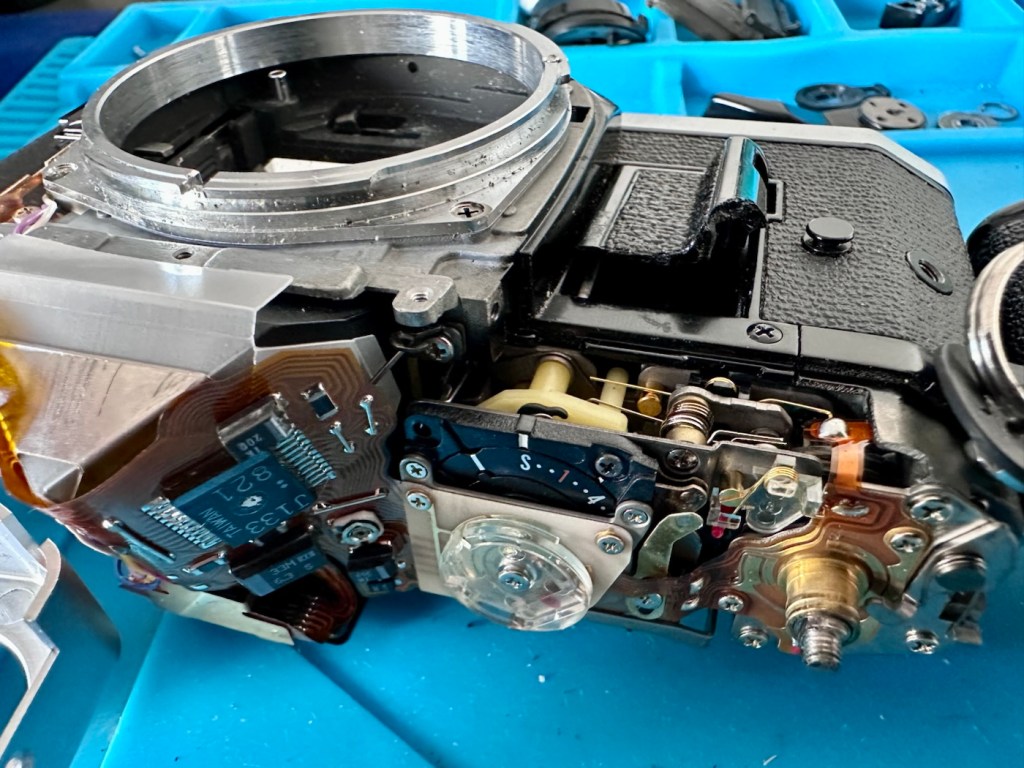
Top off. Damaged battery door removed
The pin that supports the door has to be pulled up through the mass of electronics to release the old door and the little spring that opens the door.
New replacement door installed after being printed
The printed door has cost me approximately 0.22p to print, and considering that Canon no longer produce the door, the options are limited to auction sites that charge horrendous amounts up to £30:00GBP, or the alternative is a 3D printed option of about £15:00GBP. Seeing this camera has cost me £8:00GBP, a layout of 0.22p will do for me just to get this camera up and running. I can always “tart” it up in the end if I choose to. To be honest, if it does a job, if the camera does what it should, then should I really worry about it? Probably not.
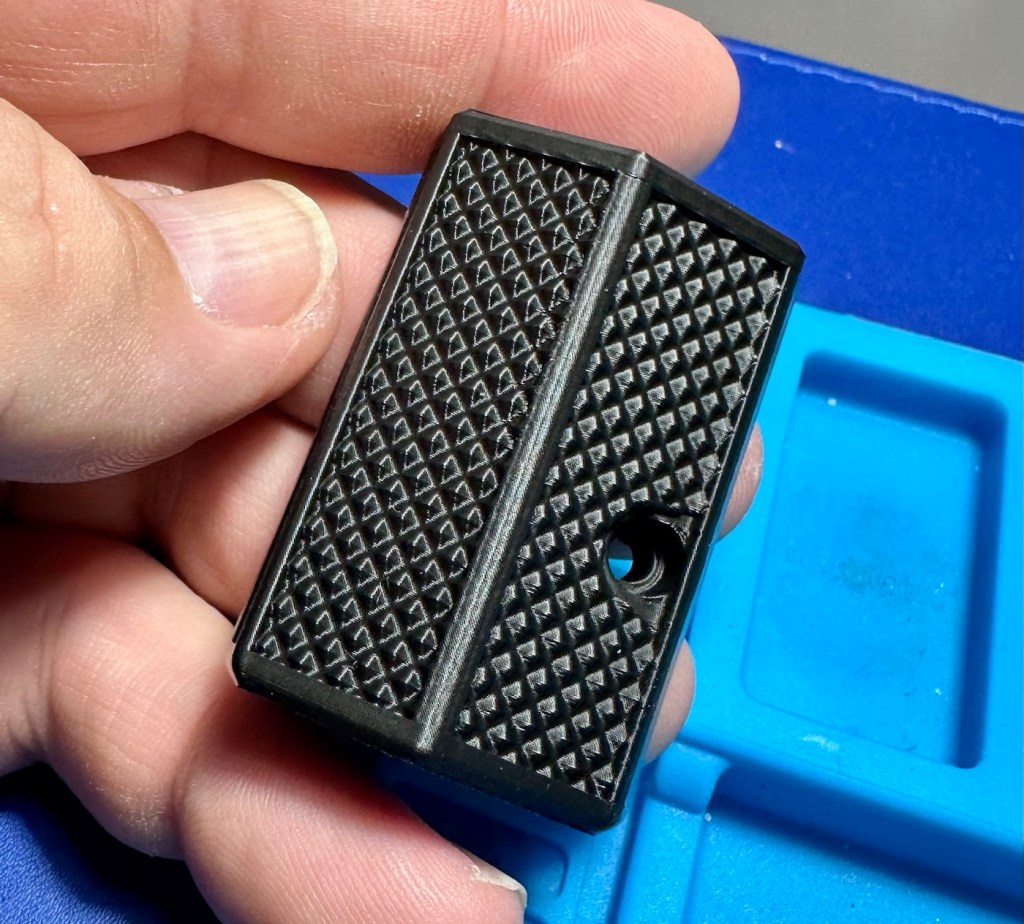
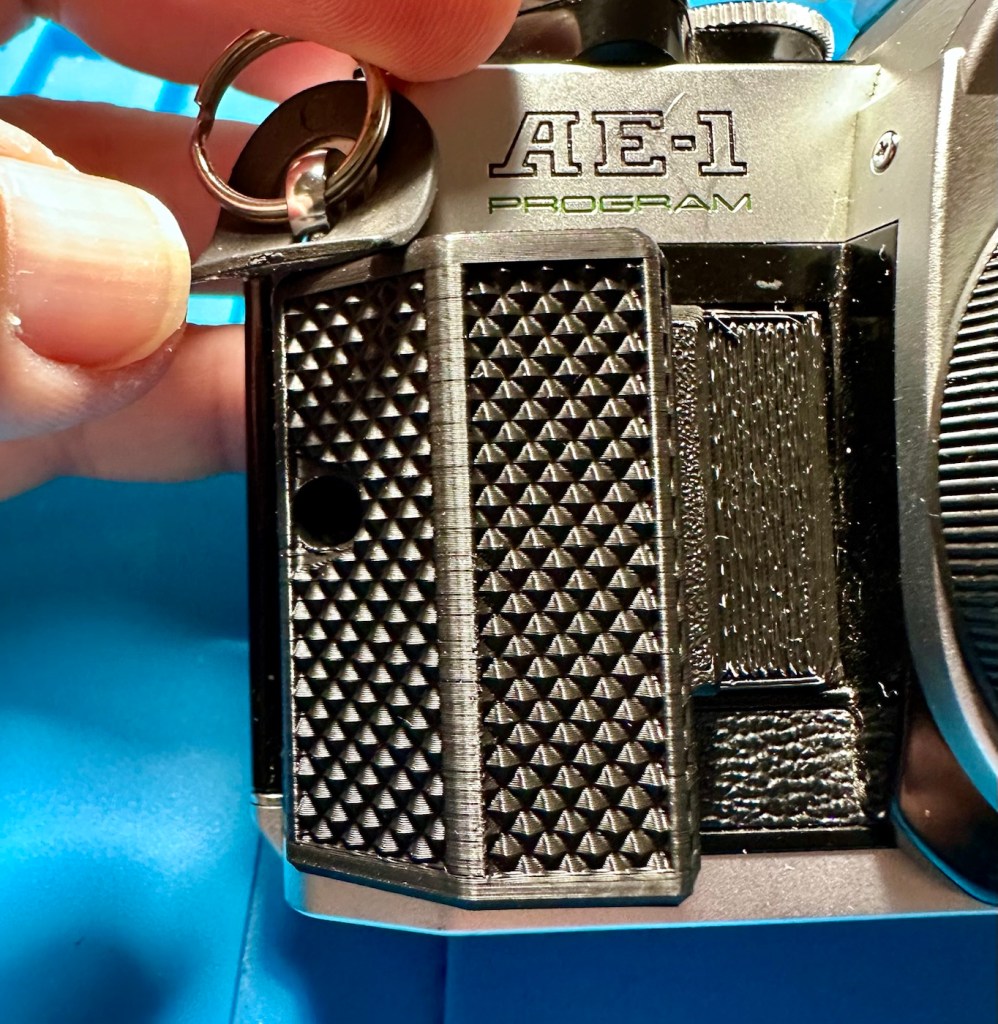
Just for the sake of it I have also 3D printed a speed grip that used to be facilitated on the “A” series cameras. These give a little more security to the battery chamber door, stop the door opening if the catch should fail, and give extra grip to the camera body. And it kind of looks nice so I have printed one out to use. I just need a black M3/8 screw to attach it.
New speed grip printed
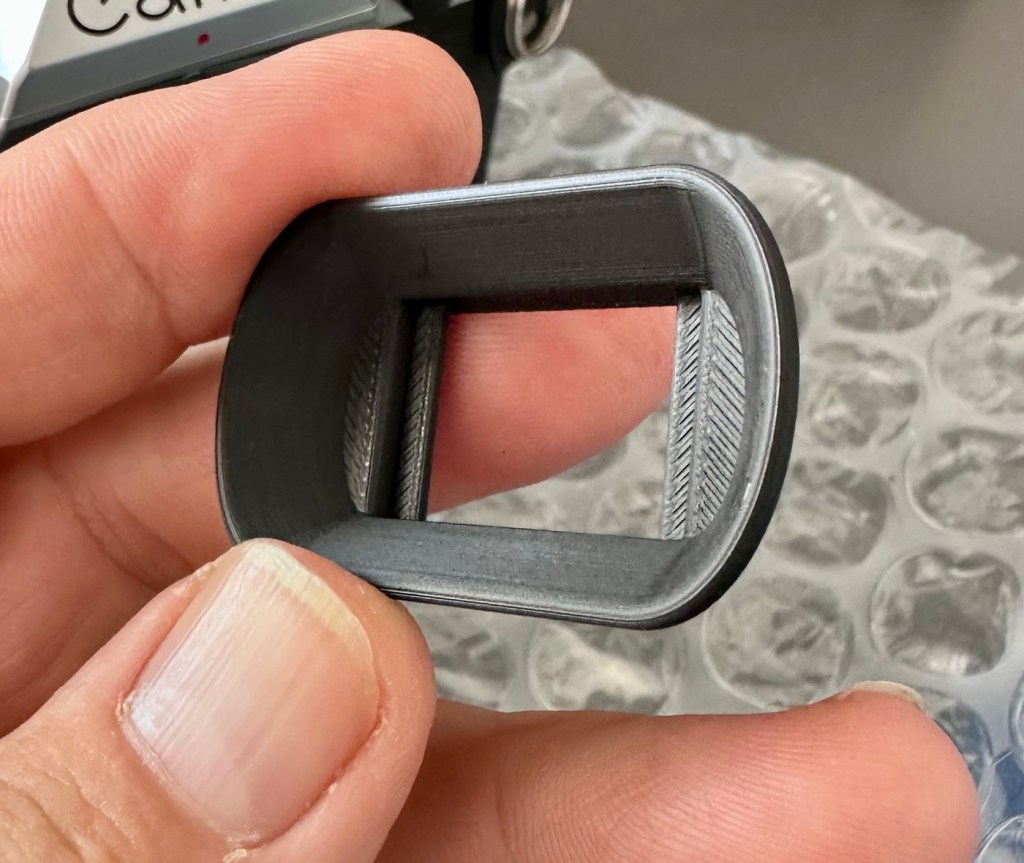
I’ve also printed off a eye cap for the camera. Just because I can to be honest, it just finishes it off in my opinion.
New eye cap
I stated that the switch that puts the camera into auto mode, switches it off and operates the self timer was seized. When the top is removed and all the relevant parts are removed the area in question can then be observed. And there was a problem.
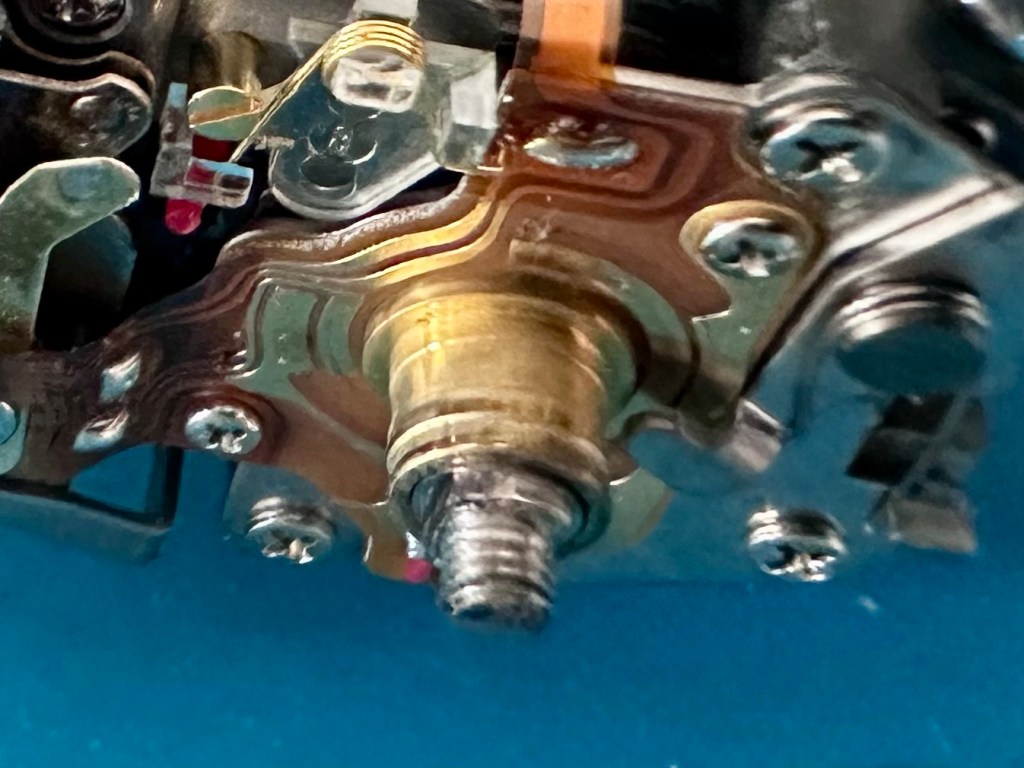
Under the film winder is a small Perspex frame with a spring loaded catch. This operates the three settings “A” – auto, “L” – lock or “S” – self timer. The switch must have been forced in the past, as the metal catch had sprung under the Perspex plate and was firmly wedged between the copper contacts underneath causing the short.
The copper traces under the Perspex
The metal catch had to be coerced back into position, lifted slightly to sit comfortably back in the position it had previously occupied. A quick test confirmed that the switch was now behaving how it should, and clicking firmly throughout its range.
The selector switch under the film winder in the correct position
The original battery that overheated was now showing as severely depleted due to the earlier problem, this has had to be disposed of, and so into the battery recycling receptacle it goes.
With the camera now reassembled I can try a new battery, and the result is the polar opposite of what occurred earlier. Straight away the shutter fired, when I put the switch into auto mode, the shutter could be fired again in fact it could be fired repeatedly. The light meter inside the viewfinder is working and showing lights. When in auto mode, and the battery check button is pressed you hear an intermittent sounder showing the electrical circuit is now operational, the more frequent the sound the healthier the battery is. When in self timer mode it didn’t work, it should beep and after ten seconds should fire. Hopefully it’s just dirty contacts, but none the less it will need looking at next time I take the top off. And all the while the new battery has remained cool with no temperature change. We have found the short circuit and the basic camera operation has been restored.
One thing I noticed with the shutter working is that there is quite a “Shutter cough” often heard on these older unloved canon cameras. Not a real issue, this will mean further dismantling of the camera to get to the shutter area for a little clean and some light lubrication.
So, let’s deal with that little “Cough”….open wide now!
I’m going to approach this issue by going in through the base of the camera, here I can deal with two issues at the same time. I suspect someone has been in here before me as there is only one screw securing the base when there should in fact be three. I will get these replaced now as I do have a fairly good supply of spares in stock.
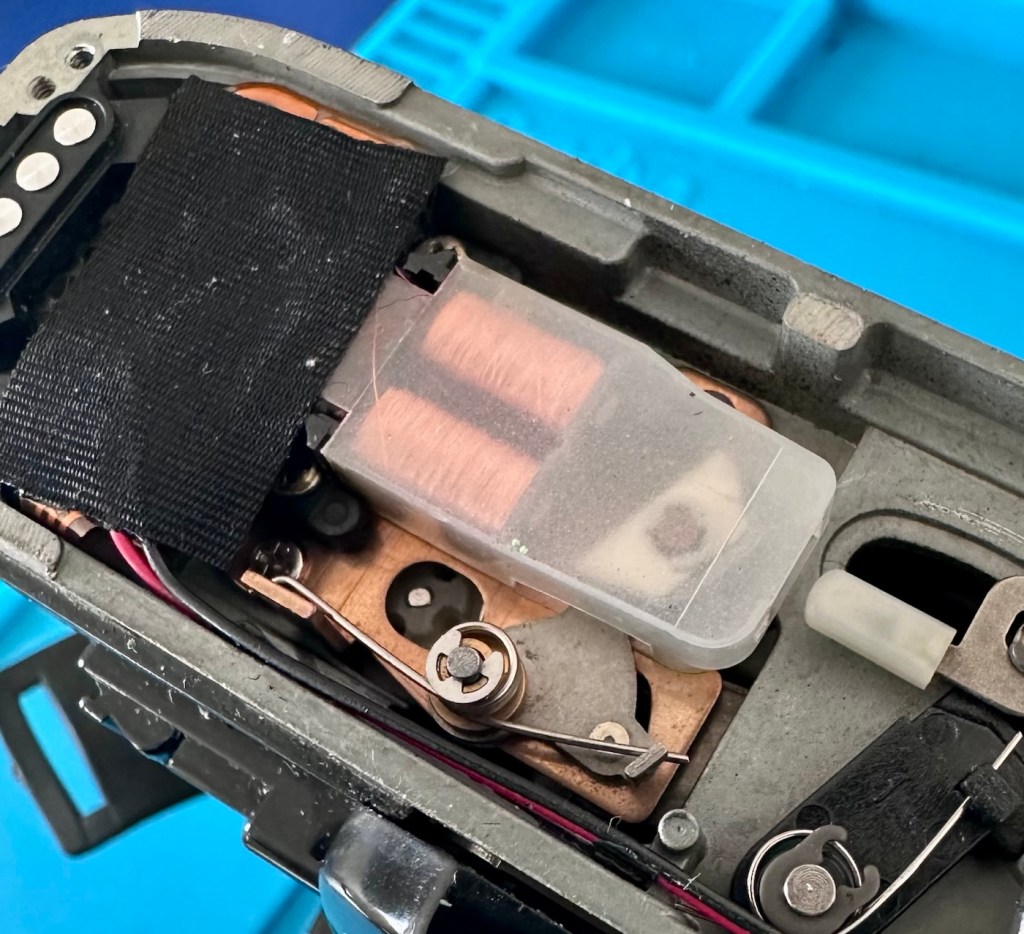
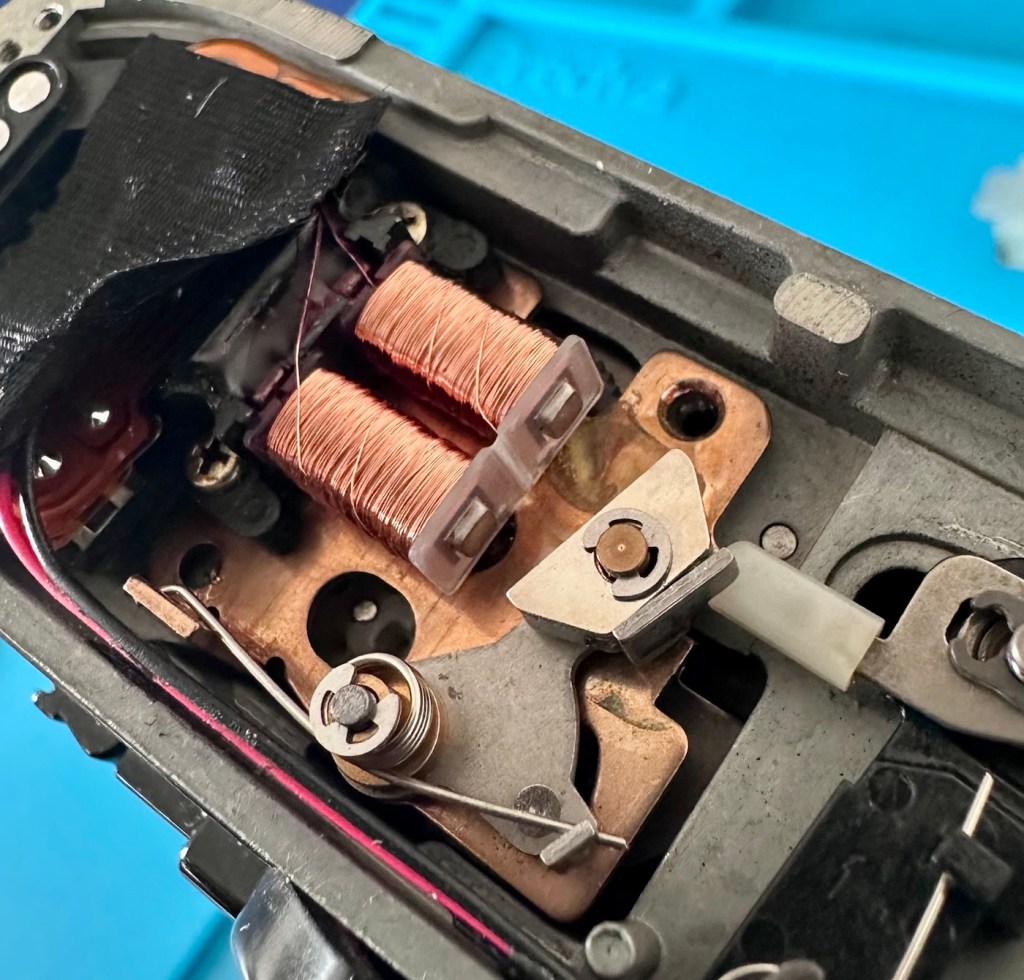
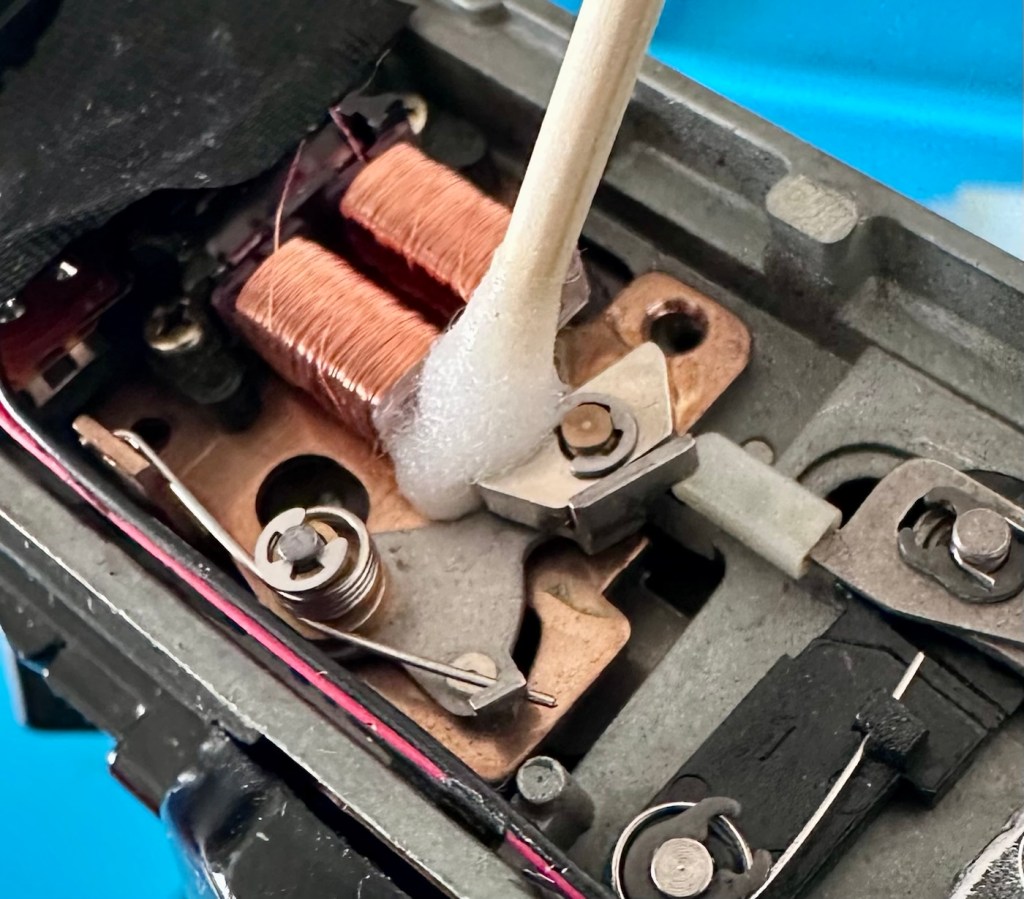
This is the magnet coil, it’s known to get dirty after time causing issues such as a continuous wind with no mirror movement.
Magnet coil
This camera doesn’t have that issue, but because I’m in here it’s a simple case of removing two screws, the casing and then just clean the magnet and coil contacts with some IPA.
Case removedContacts cleaned
That done, the plastic case is put back on, and the two screws put back into place. Simple job done, it’s future proofing the camera against this issue ever occurring. A blow through with an air canister and a little light lubrication of moving parts in the area and then we can move onto the next issue I want to address.
I’m going to attempt a shortcut with my oiler pen to see if I can deal with the camera cough without going too deep inside the camera. With the long needle of the oiler I may be able to reach deep enough into the internal workings of the camera to oil up the offending cogs and levers. If it doesn’t work then I will have no option but to open up the camera and get inside. It’s worth seeing if I can get the shortcut to work, it’s not a permanent fix but might buy me a year or so of cough free operation.
I’ve left the camera overnight for the very limited amount of clock oil I used to get into all the nooks and crannies, and I’ve checked when I got back home from work, and I’m pleased to say it’s has worked perfectly. Have a look at this little video below that shows how it sounded with the cough, and then after treatment.
Before and after cough
Now with the cough issue sorted it’s time to go back to see if we can address the self timer issue. With the base now secure with all its screws (I’ve replaced the two missing ones) it’s time to get the top off again and have another look around.
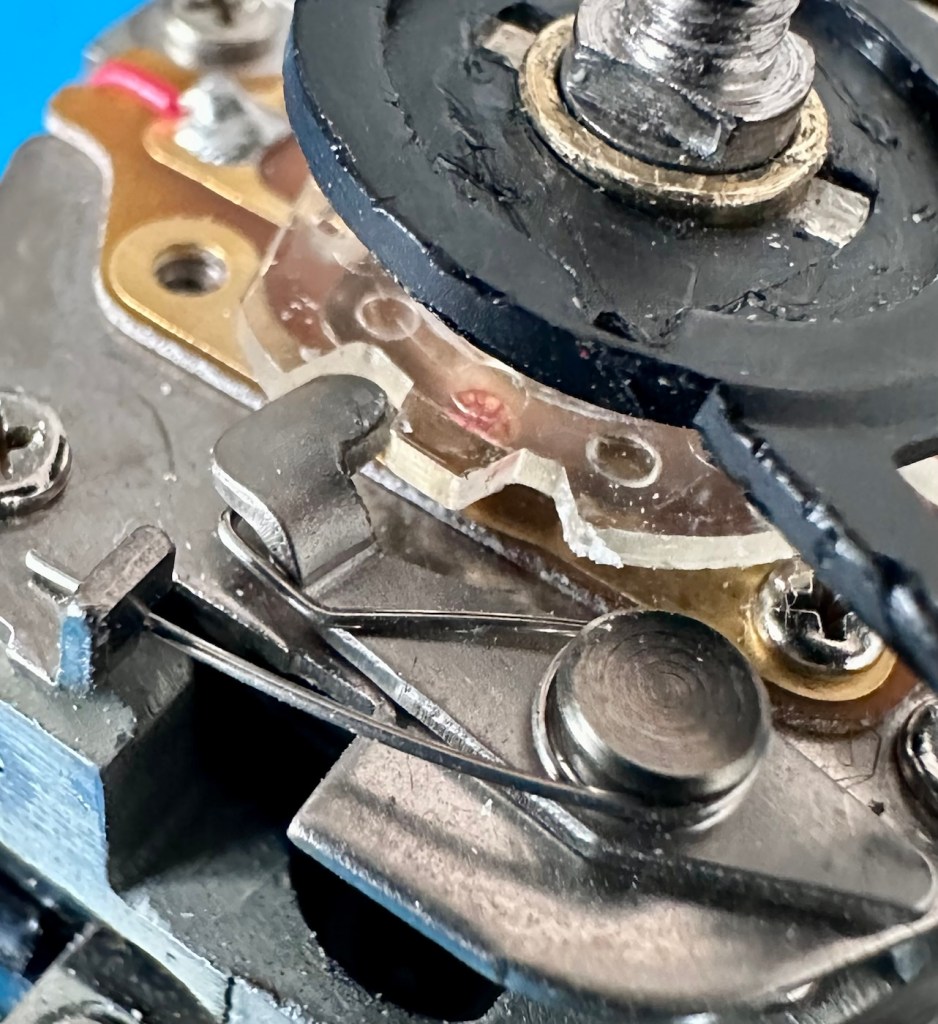
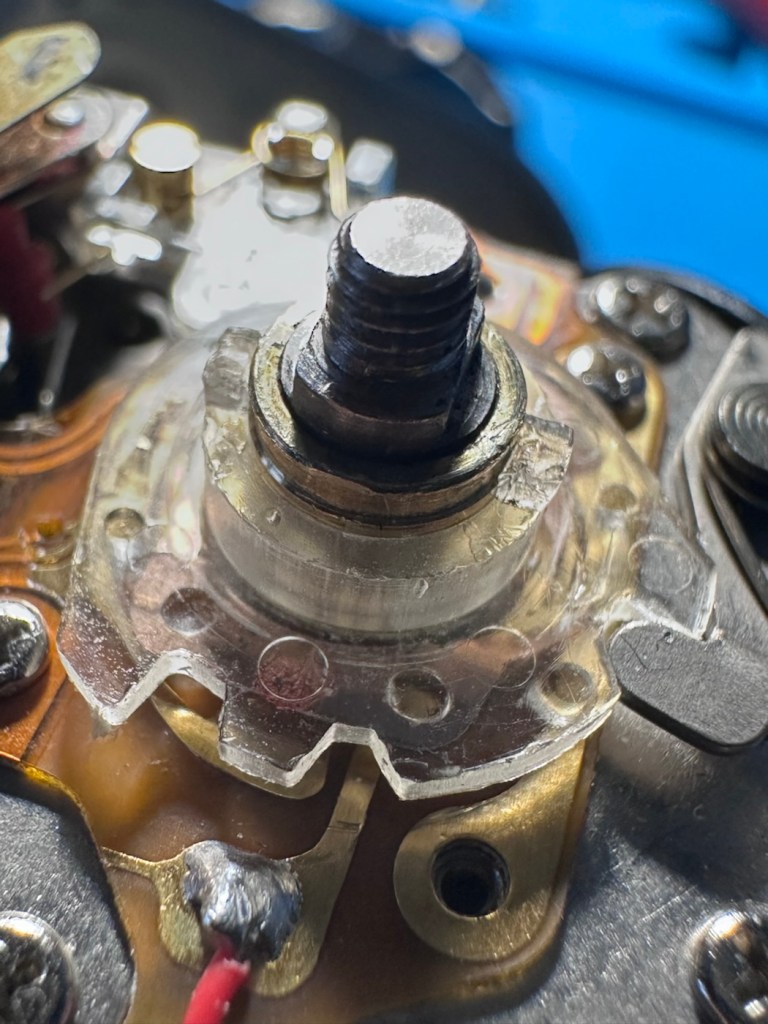
Inside the camera just below the wind on lever is the mechanism that operates the selector lever. There are four tiny copper contacts that connect with the copper circuit just below. One of these four contacts had been crushed to a level where contact was no longer made with the circuit board below.
Copper based circuit board and copper contacts under this acrylic selector
Using a small set of tweezers, I was able to bend the delicate copper contact back into shape allowing it to once again make a connection with the contacts on the circuit board. I’ve also cleaned all points of contact with IPA to ensure all surfaces were clean. A quick test at this point proved the circuit, I was now able to reassemble the camera yet again. Prior to this though I gave a good blow through the circuitry with some compressed air before sealing the top of the camera back in place.
The self timer is now fully operational.
Self timer now working
The major issues have now been addressed. Let’s get on with the bread and butter items.
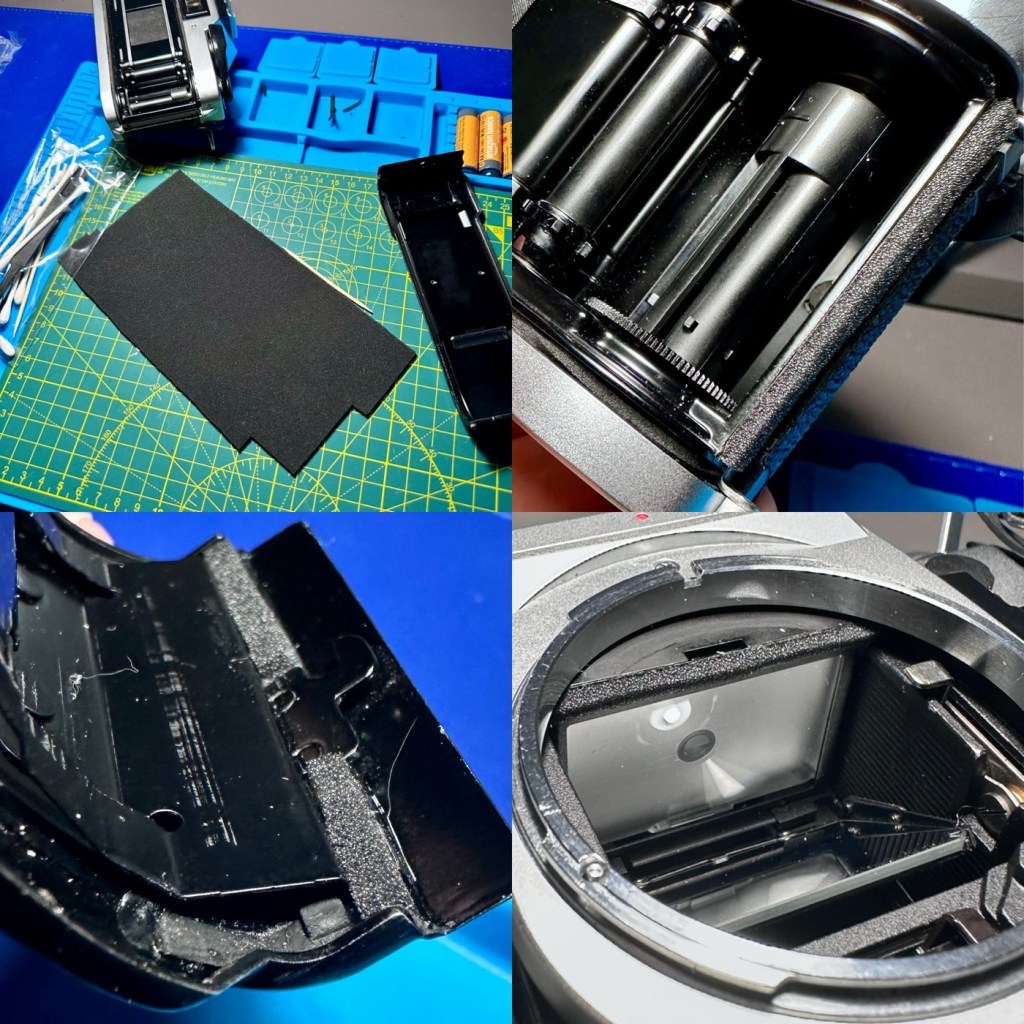
The light seals including the mirror bumper were in a very poor state and had to be removed. This took a lot of patience as the felt had broken down into dust and clumpy particles. I used IPA to soften the old adhesive and probably used about a dozen cotton buds to remove all the debris. The thing with cleaning these areas is when you think it’s clean, clean it again, and once more for luck. In theory cleanliness here is your friend as it helps you through the next stages immensely.
New felt and light seals
Once all the old felt and seals are removed, and dried, I can cut the new seals to size and get them installed. This has been completed and the new seals have gone into place without issue. Personally for me, this is the most boring but essential task in restoring old cameras. It’s one of those tasks you put off until the end as it is so fiddly and has to be just right.
With the light seals now complete, the last task now is to give the camera a thorough clean.
Result
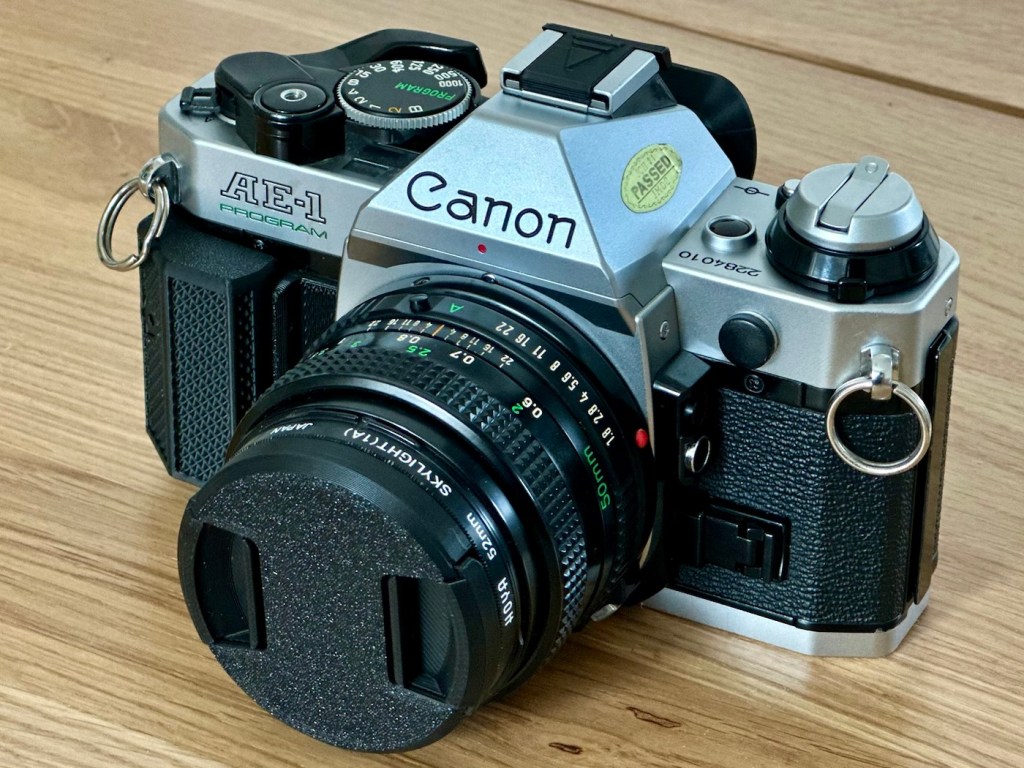
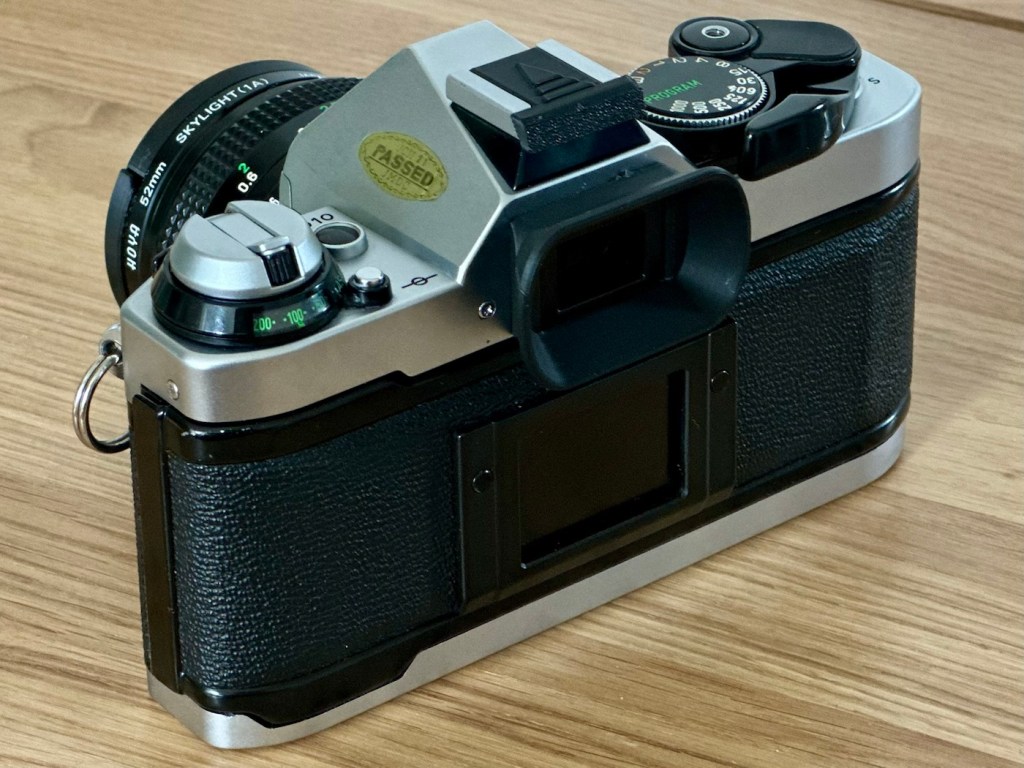
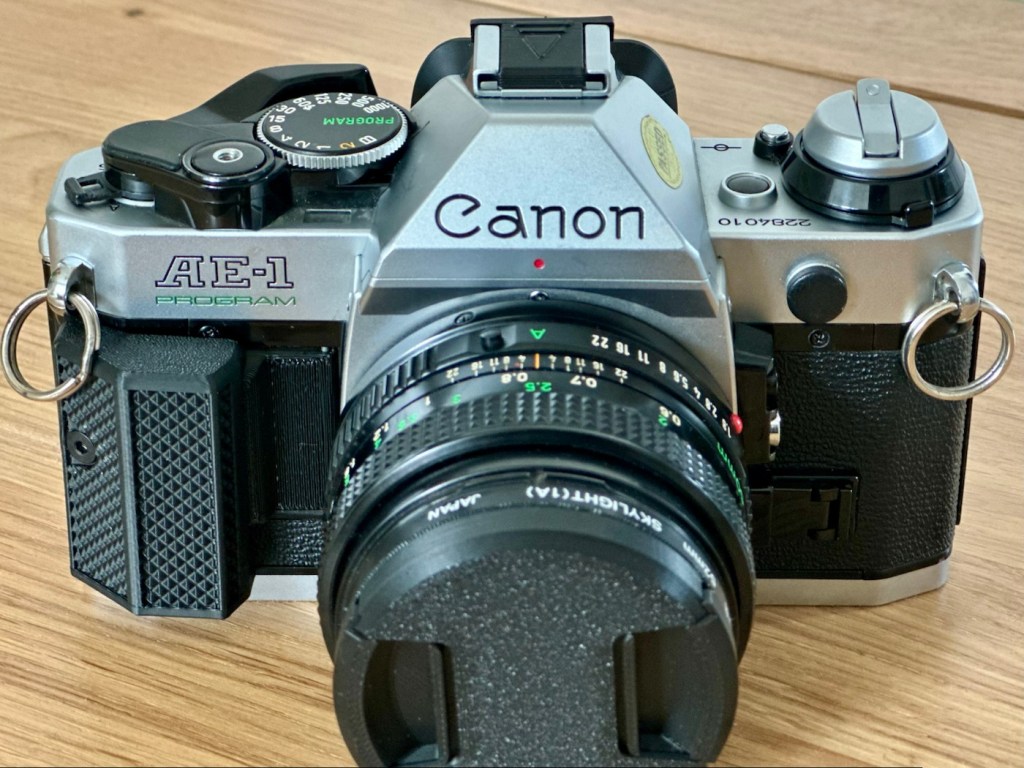
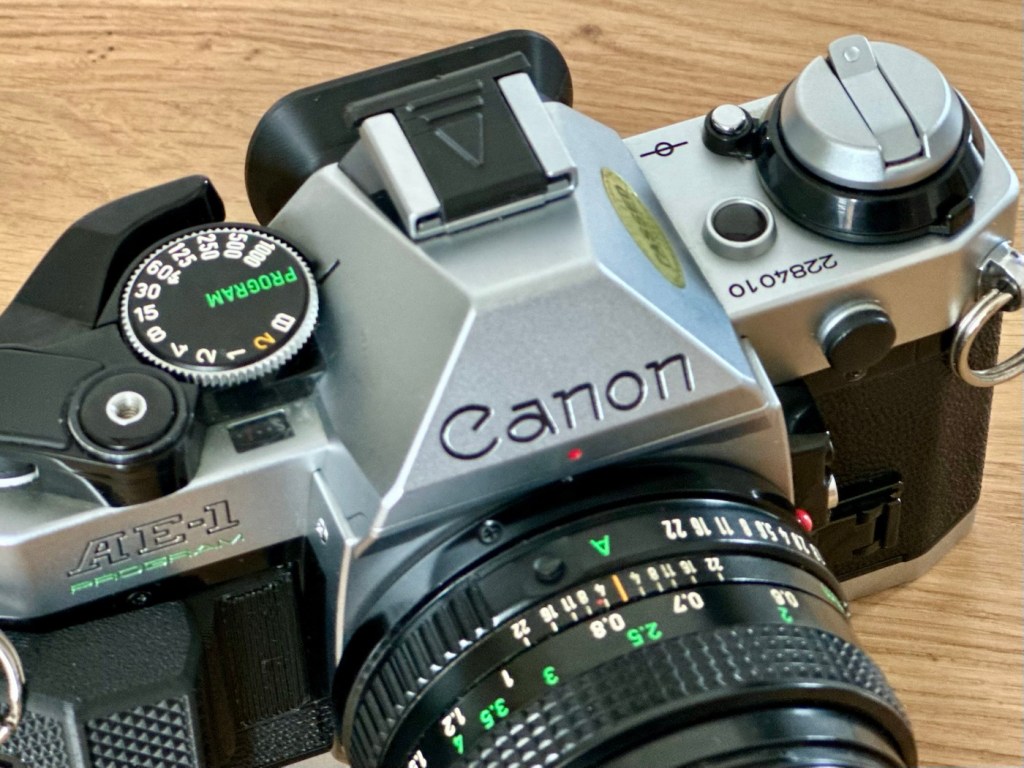
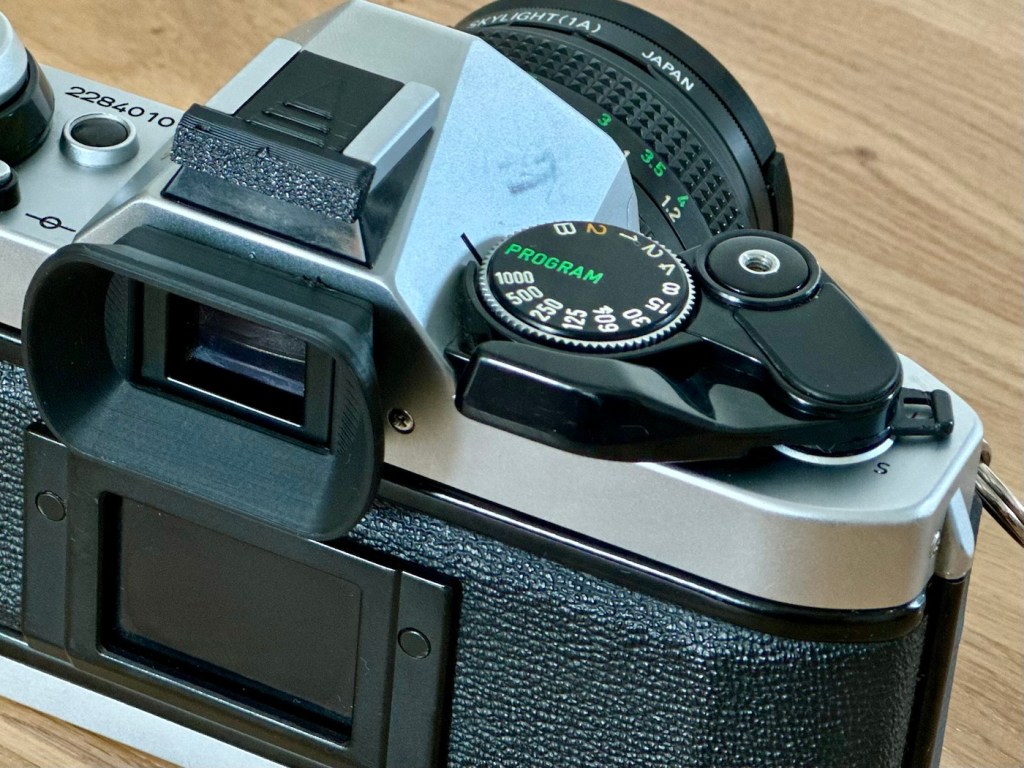
A buff of the leatherette, and a good polish of the metal work and she is looking resplendent. A new quick grip, hot shoe cover and battery door and the look is complete. My £8:00GBP cast off, dirty, damaged and broken camera is now looking a lot healthier and is now in a good working order.
Looking good working well
I’m awaiting a roll of XP2 black and white film to arrive, and that will be the test film for this camera. I’m probably going to feature it in my weekly 7 days and 7 photos series at some point. I will post a link to that post when it occurs.
It’s been a long time bringing this camera back to life but I’m so pleased at how it has gone. These “A” series cameras will always be my favourite because of the place they have in my photographic past. I have a few that I have been working on, but this was the one that actually completed my collection. I now need to find a suitable way to display them all, rather than leave them packed away in storage.
Thank you for passing by, as always it is very much appreciated.
Do you actually read posts or are you a serial liker?
Are you holding a grudge? About?
It’s a wet autumn early morning in the East Midlands and once again insomnia has gotten the better of me, as once again I’ve failed in my attempt to get a good night sleep after a long run of night shifts.
Whilst i was sitting there wondering what i could do without disturbing the wife from her slumber, an idea came to me regarding a post i could write. So up i rise, and off to my room i go and the drivel you are about to endure is a result of that decision. My standards are quite low, my grammar is even worse. Please don’t hold that against me.
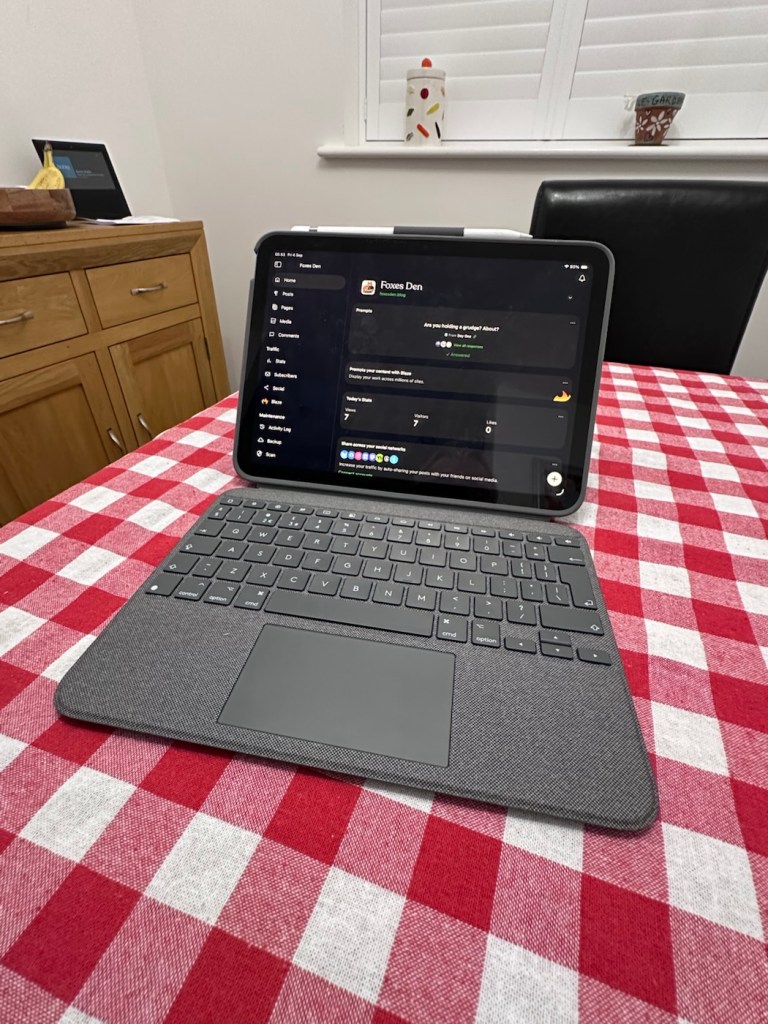
iPad on
I turn on the iPad, and the WP daily prompt arises from the internals of the machine. How apt? “Are you holding a grudge?” Now, this wasn’t planned but I couldn’t have asked for a better prompt. Apparently it must have struck a nerve with me in the past as i have already answered it once before.
Anyone who knows me will be quite aware that i write my posts for two main reasons. One is as a wellness journal, it helps keep my overactive brain in check, it allows me to get my thoughts and activities in print, and gives me that release i sometimes require, it allows my family to check in on my piece of mind and to allow them to see what i am getting up to. Secondly, it allows me to have a permanent record of the cameras and items i have repaired. This second reason has proved to be a fantastic resource, as when on the rare occasion that i pass an item on, or sell one online i have a full record of the history of the item that i can pass onto the individual who is purchasing, giving them a full history of the item and its repair history. This has proved to be an excellent and beneficial selling point as such.
The posts are not put together in days, despite how poor my writing style can be, the whole production of that post can take many months. A post that i suspect may in fact be published later today has been in production since late December 2025, getting on for nine months now. Now that doesn’t mean that because it has taken almost 9 months that you will be presented with a 1000 page book, you wont, thats just not me. What you will get is a concise record of what i have had to do over that time to get this item back into a working condition. I currently have 22 posts in a draft format and one of those is still in draft after originally being started in May 2025, that one alone has been worked on now for 16 months, a whole year and four months and it is still a work in progress.
My way of working is that as soon as i get stuck or delayed on one subject, i move on to the next until i either obtain the parts i require (this can take months if the item is unique) or until i have a brainwave on how to complete an activity. Add to that i have a home, a wife and a job that all quite deservedly require my attention, you can now see just what the delays are in getting some of these projects to a final “Print” condition.
I can hear you all now saying, “Just get to the point lad.”
Well, my grudge point is this “like” system that WP insists on using across this platform. The way i work is that when i like a post i will genuinely like it, and if it is worthy i will also post a comment. I follow many bloggers on this platform, all of them exceptional authors with exceptionally good writing ability that i am always in awe of.
Just the other evening my phone pinged constantly for around thirty seconds as an individual touched upon my site and liked almost 20 of my past posts. This is my grudge point. Collectively those 20 posts took up probably the best part of a year of my life one way or another, and this individual read all those posts in less than 30 seconds. Obviously he didn’t.
Now, please don’t get me wrong here, i do not blog for likes, that has never been the point of all this. However i do always appreciate peoples kind words and comments, good, bad and indifferent and especially the constructive ones. It just annoys me that someone feels they can boost their activity via WP at the expense of individuals that spend an awful lot of time getting the content prepared in the first place.
I follow a lot of blogs where English is not the authors first language, i even copy some onto a worksheet and get the content translated so that i can see what has been written, its always nice to reply to these authors, and there has been many a complimentary comment comeback, often showing surprise of the lengths i have gone through to read their posts.
I think WP should have a minimum time put on the “Like” system of around a minute, hence preventing multiple likes of posts. In the case above, the individual would have had to hang around for about 20 minutes to complete that task, and i am quite sure that would have never occurred. So, how about a minimum dwell time of at least a minute, this would at least be sufficient time to get an idea of what the post is about, and this would be an awful lot more respectful for the contributing author. What do you think about that?
I respectfully went back and read the posts of the chap that did the speed liking episode, he’s selling stuff, questionable stuff along with questionable advice, so i guess he has succeeded in what he was trying to achieve, attracting attention to his own page, i fell right into that trap didn’t i?
Sorry that this has dragged on a bit, i really do appreciate you passing by and taking a short time out of your days to spend some time with me. It’s like a virtual cup of tea really, and as i have been sitting here for close on an hour now without a real cuppa, i now realise its time to make one to take up to the wife who should be stirring about now. And i might just have one myself!
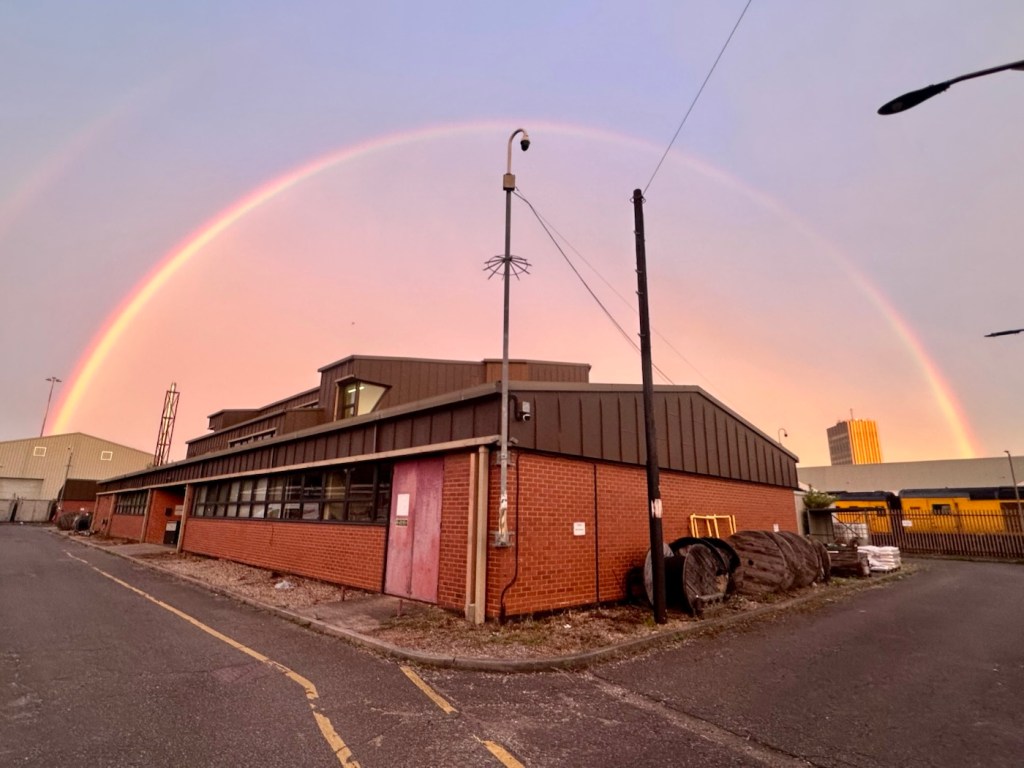
Left work this morning to see this gorgeous sight filling the sky
Just leaving work this morning after a long night shift. It appeared very red outside, as I looked behind as I got to the car I saw this beautiful 180 degree double rainbow over the station at Leicester. Strange thing is it was not raining, I suspect we have some rain incoming.






You must be logged in to post a comment.